
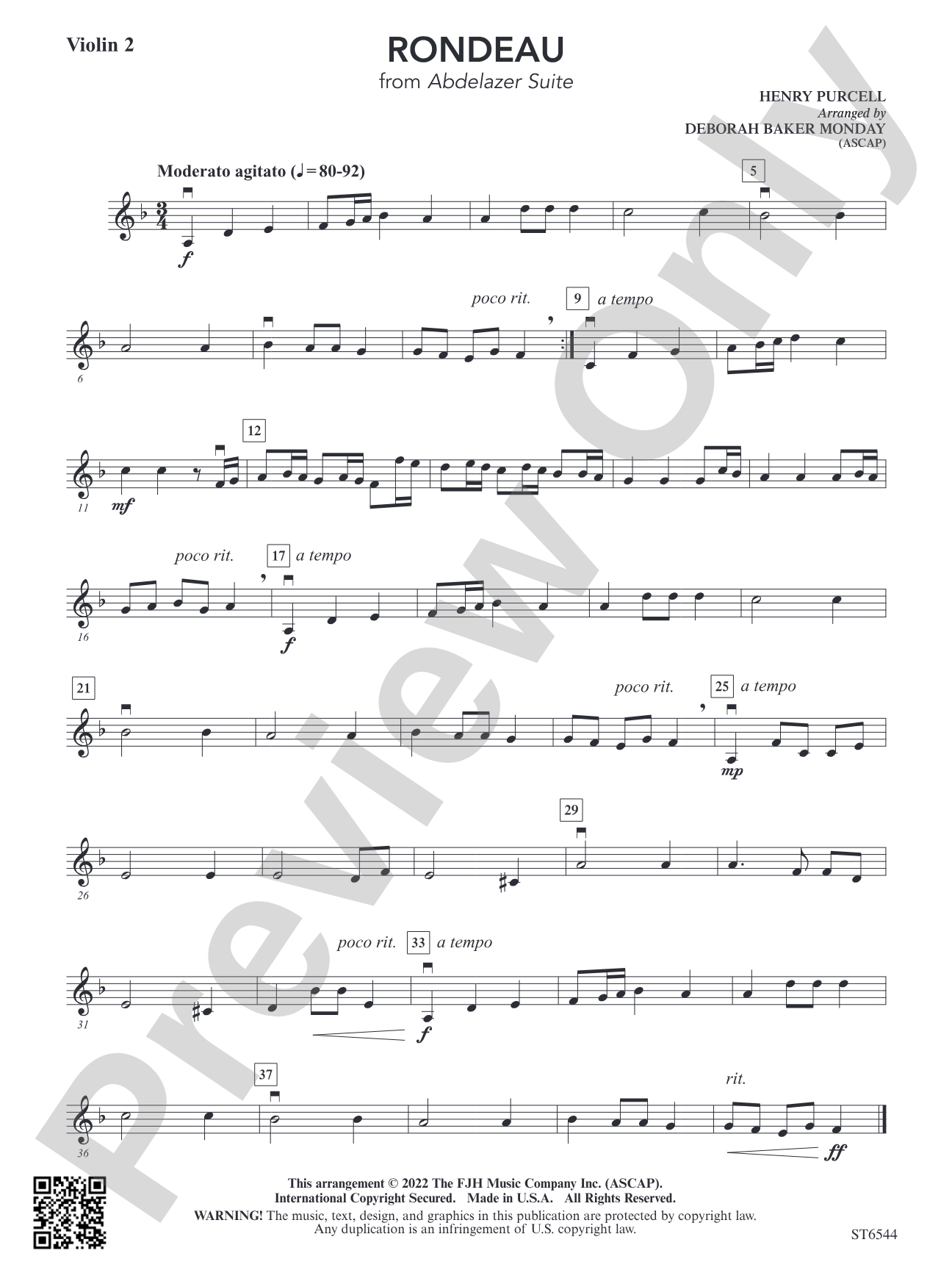

Rondeau (from Abdelazer Suite): Violin 2
from Abdelazer Suite
By Henry Purcell / arr. Deborah Baker Monday
Grade: 3
Item: 98-PC-DST6544_VN2
$7.00
Pickup currently not available
Description
The famous theme from Purcell's Rondeau (also well-known from Britten's use in The Young Person's Guide to the Orchestra) is expertly arranged to engage all sections of the orchestra while staying true to the original. A perfect addition at any point in the concert without overly taxing the orchestra, yet still offering a tremendous sound. (1:45)


Don't just read it, hear it, play along with it, and watch your students grow with it. In MakeMusic Cloud, Rondeau (from Abdelazer Suite): Violin 2 comes alive with professional accompaniment, adjustable tempo, and built-in practice tools that turn solo practice into real progress.
Open in the Player
Jump straight in and assign it today.
Start Your Free Trial
Open this title and explore the full library in minutes.
Sample Audio
1
Audio File
--:--
0:00
0:00
Sample Video
Additional Details
Series:
FJH String Orchestra
Publisher:
The FJH Music Company, Inc.
SKU:
98-PC-DST6544_VN2
More about this title
About the Composer: Henry Purcell
Henry Purcell (1659-1695) stands as England's greatest Baroque composer and a towering figure in Western music history. His command of counterpoint, harmonic innovation, and dramatic expression shaped instrumental and vocal music across Europe, and his works remain central to the string orchestra repertoire nearly 330 years after his death.
Purcell's output spanned sacred music, theatrical works, chamber music, and suites for instrumental ensembles. The Abdelazer Suite, written for a 1676 stage production, showcases his gift for memorable melody and orchestral color. That the Rondeau from this suite became the theme for Britten's 20th-century educational masterpiece speaks to the timelessness of Purcell's invention.
Why we love this
Deborah Baker Monday's arrangement captures the Rondeau's infectious energy without demanding virtuosity from your orchestra, making it equally at home in a school concert or festival setting. The orchestration distributes the material thoughtfully across all sections, ensuring no part feels like filler while the texture stays transparent enough for developing musicians to hear their role clearly. You get the gravitas of a genuine masterwork and a piece your students will recognize from Britten.
What to expect
Bright and purposeful, with a lilting elegance that reflects its origins as stage music. The Rondeau moves with courtly poise yet maintains an underlying vitality, inviting the orchestra into a conversation where melody and accompaniment trade places. There is joy in its clarity and a satisfying sense of architecture in its form.
Who it's for
String orchestras at the Grade 3 level looking for a crowd-pleasing concert opener or closer that carries real musical weight. Directors seeking repertoire that challenges musicianship and ensemble balance without requiring advanced technique will find this arrangement ideal. Student musicians benefit from experiencing a canonical Baroque masterwork in a fully realized orchestration designed for their abilities.
How to get the most out of it
- Keep the articulation crisp and consistent across sections; the Rondeau thrives on rhythmic clarity and a sense of forward momentum rather than romantic rubato.
- Balance the melody between first and second violins so the tune cuts through without strings overwhelming any accompanying voices.
- Attend to the bass line as an active participant in the architecture, not just harmonic support; it gives the piece its architectural backbone.
- Use the 1:45 duration as a guide for pacing; resist the urge to slow down, which can sap the piece's charm and dance-like character.
How to use it
Open a concert with this arrangement to establish sophistication and energy from the first moments, or pair it with works by later composers influenced by Baroque forms to trace historical connections. Its modest length and high impact make it an excellent programming partner for longer works, allowing audiences a moment of crystalline clarity before moving into more complex territory.
Skills your students will build
- Playing rhythmically independent lines within a transparent texture
- Balancing melody and accompaniment across multiple instrumental groups
- Reading and executing articulation markings with precision
- Understanding Baroque phrase structure and form