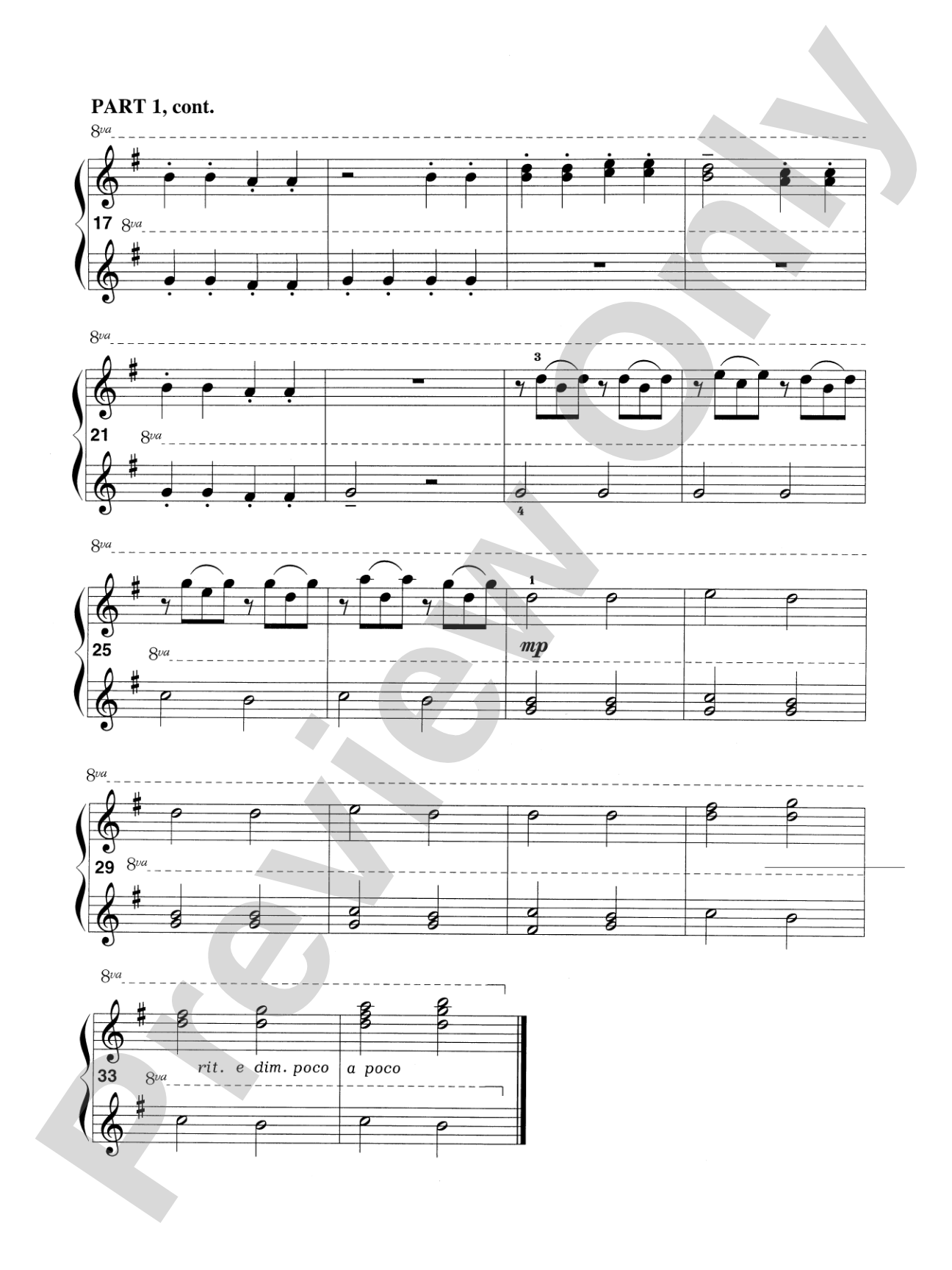
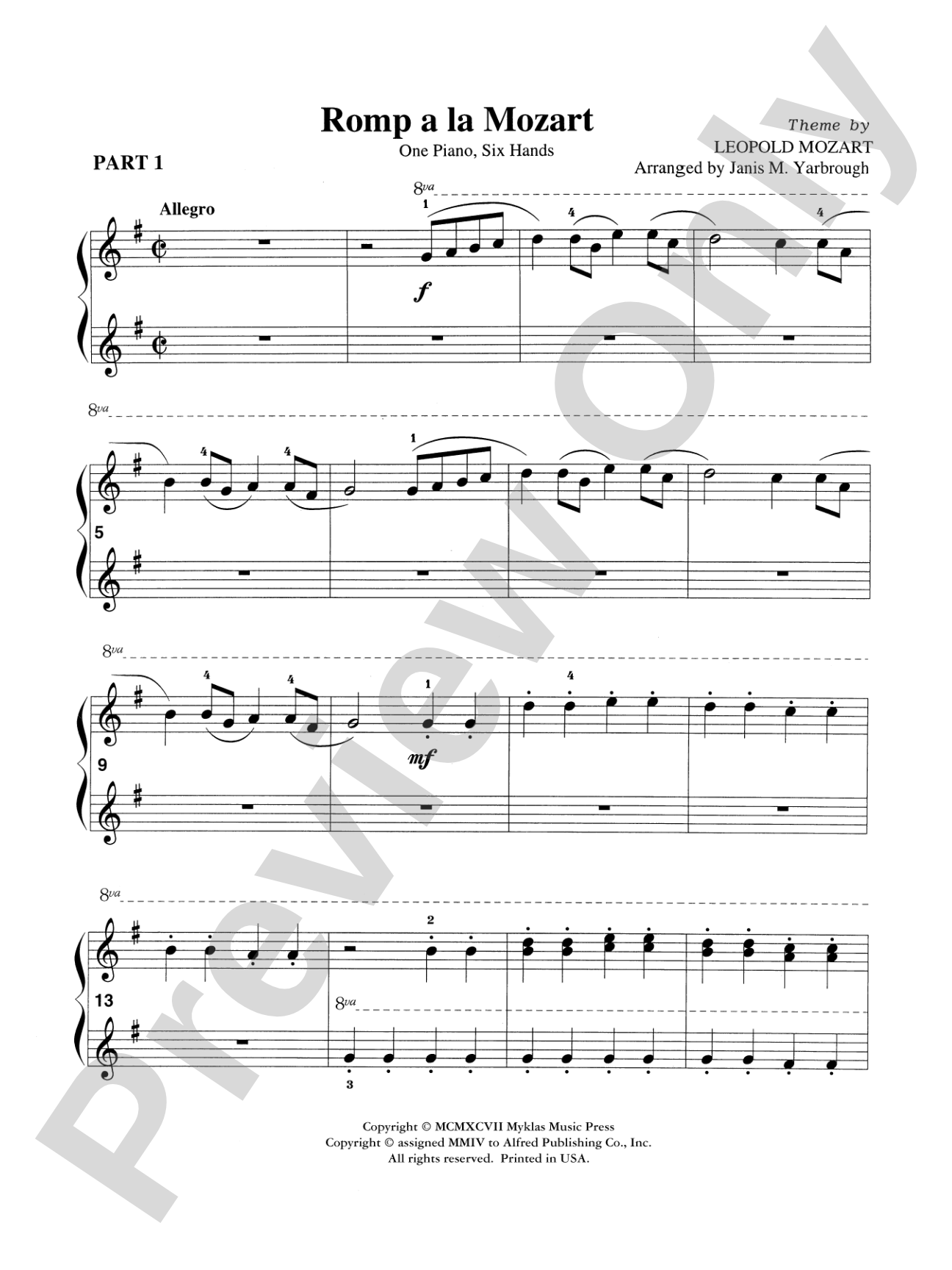
Romp a la Mozart - Piano Trio (1 Piano, 6 Hands) Sheet Music Preview

Romp a la Mozart - Piano Trio (1 Piano, 6 Hands): Piano

By Leopold Mozart / arr. Janis Yarbrough

Level: Late Elementary

Item: 00-PB-0000667

Digital Download
$5.50
Description
This theme by W. A. Mozart's father, Leopold, sounds very much like "Twinkle, Twinkle, Little Star." This five-finger arrangement by Janis Yarbrough is in G major and cut time. One score for each performer is included along with a conductors score. A Federation Festivals 2024-2028 selection.

Romp a la Mozart - Piano Trio (1 Piano, 6 Hands): Piano isn't in MakeMusic Cloud just yet...but it could be. Let us know you'd like to see it, and you'll help shape what comes next. In the meantime, start a free trial and dive into thousands of interactive titles your students can play along with today.

Sample Audio
No sample audio found.
Sample Video
Additional Details
Series: The Myklas Trio Series
Publisher: Alfred Music
Page Count: 10
SKU: 00-PB-0000667

More about this title

About the Composer: Leopold Mozart

Leopold Mozart (1719-1787) was a respected violinist, composer, and pedagogue in his own right, though history often remembers him primarily as Wolfgang's father and teacher. He published a foundational violin method and composed a substantial body of chamber works that reveal genuine musical imagination and craftsmanship. His compositions for young musicians remain valuable teaching materials because they balance melodic charm with clear harmonic structure.

Leopold's training methods shaped Wolfgang's precocious development, but his own catalog deserves recognition. Works like this theme demonstrate his gift for memorable melody and his understanding of what engages young performers. He represents an important tradition of musician-fathers who contributed meaningfully to the classical repertoire.

Why we love this

Janis Yarbrough's arrangement transforms a classical gem into a playable, engaging ensemble experience for late elementary pianists without dumbing down the source material. The five-finger approach makes this accessible while the cut time signature and G major key keep things moving with real musical purpose. It's the kind of piece that builds ensemble awareness and shared responsibility among three young musicians without requiring advanced technique.

What to expect

Cheerful and crystalline, with the elegance of a classical melody that refuses to feel stuffy. The cut time creates a gentle forward momentum without breathlessness, and the familiar tune gives students a confident foothold as they navigate the collaborative process of playing with others.

Who it's for

Late elementary pianists ready to explore chamber music in a supportive, three-person setting. This arrangement suits studio teachers, group piano classes, and school music programs looking for accessible ensemble repertoire that still demands musical maturity. It's also a smart Federation Festivals selection for students building solo and ensemble experience simultaneously.

How to get the most out of it

  • Balance the independent lines by having each pianist practice their part separately with a metronome first, then gradually bring them together at a slow tempo.
  • Emphasize the conductors score during rehearsals so all three players hear the piece as a unified whole rather than three separate parts.
  • Work dynamics collaboratively as an ensemble; late elementary students often play by default at the same volume, so marking a few deliberate dynamic shifts will make the piece come alive.
  • Let the familiar melodic contour (its kinship to "Twinkle, Twinkle, Little Star") guide phrasing and breathing, treating it as vocal music translated to the keyboard.

How to use it

Slot this into a spring or early fall concert as a charming opener or interlude between larger works. It works beautifully alongside other baroque and classical chamber pieces, or as a bridge between solos when you're featuring multiple pianists. For festivals and competitions, the included conductor's score and three individual parts make preparation straightforward.

Skills your students will build

  • Reading cut time and maintaining steady tempo within a compound meter feel
  • Balancing independent melodic lines within an ensemble texture
  • Coordinating entry points and releases with two other performers
  • Sustaining focus on a single harmonic color (G major) without tonal drift
  • Responding to a conductor's cues in a small group setting

You May Also Like