
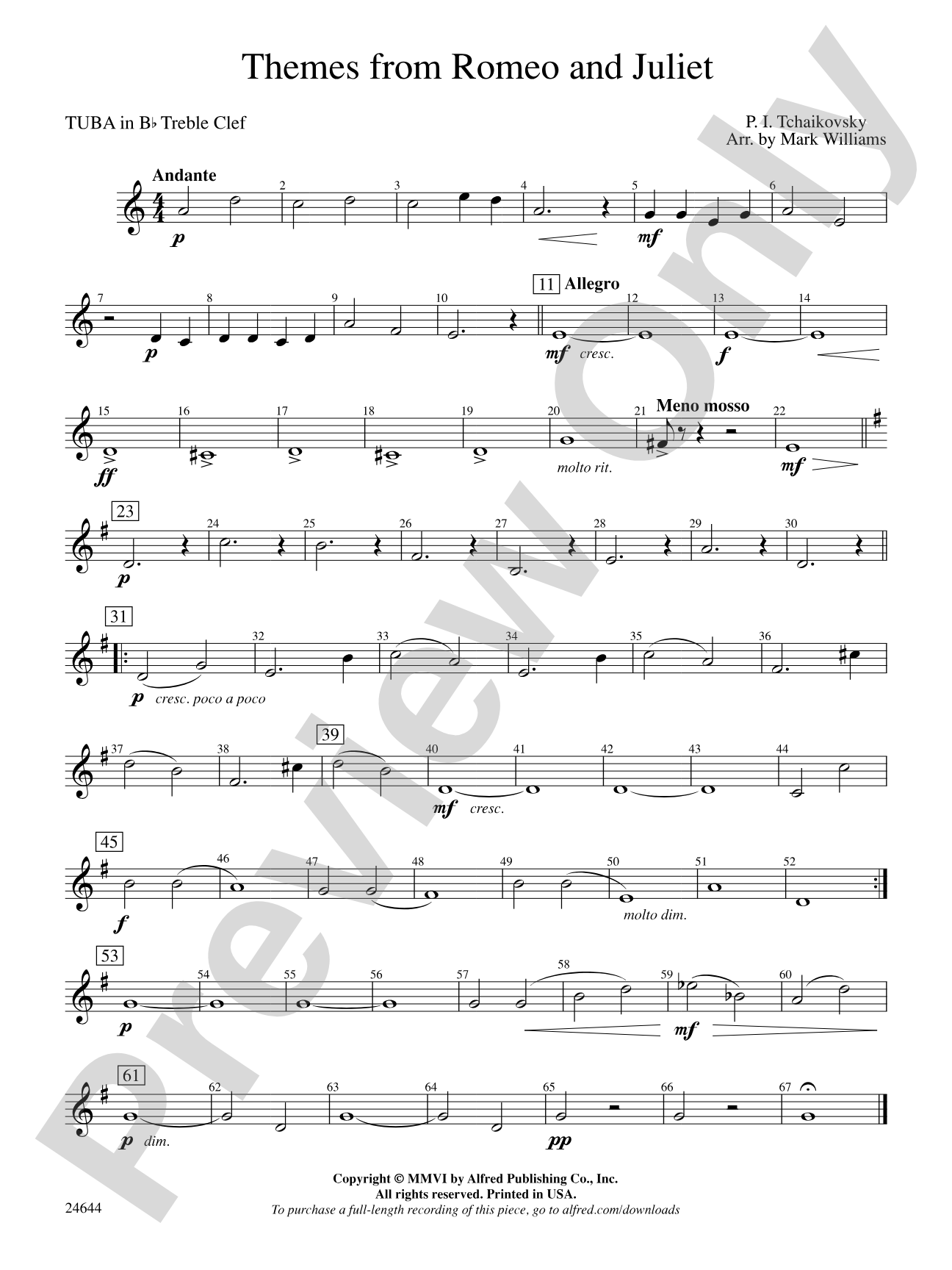

Romeo and Juliet, Themes from: (wp) B-flat Tuba T.C.
Arr. Mark Williams
Grade: 2 (Medium Easy)
Item: 00-PC-0000812_wpTBBTC
$3.00
Pickup currently not available
Description
Inspired by William Shakespeare's classic play Romeo and Juliet, Peter Ilyich Tchaikovsky composed an orchestral masterwork of sublime beauty and power. This arrangement by Mark Williams makes this music finally available to younger bands. The famous melodies and rich harmonies will have strong appeal to students and audiences, and provide a great tool for the teaching of chromatics and the musical style of the Romantic period. Highly recommended for concerts and contests.


Don't just read it, hear it, play along with it, and watch your students grow with it. In MakeMusic Cloud, Romeo and Juliet, Themes from: (wp) B-flat Tuba T.C. comes alive with professional accompaniment, adjustable tempo, and built-in practice tools that turn solo practice into real progress.
Open in the Player
Jump straight in and assign it today.
Start Your Free Trial
Open this title and explore the full library in minutes.
Sample Audio
1
Audio File
--:--
0:00
0:00
Sample Video
No sample videos found.
Additional Details
Series:
Challenger Band Series
Publisher:
Alfred Music
Page Count:
130
SKU:
00-PC-0000812_wpTBBTC
More about this title
About the Arranger: Mark Williams

Mark Williams built his reputation as a composer and arranger who understood what young musicians could achieve. With over 200 published works across band, orchestra, and choir, he shaped school music programs across North America through both his compositions and his co-authorship of the Accent on Achievement Band Method. His background as a bassoon player and arranger for the 560th Air Force Band informed his sophisticated yet accessible orchestrations.
Based in Washington state for much of his career, Williams served as clinician and guest conductor in 34 states, five Canadian provinces, and Australia. He earned recognition including the Western International Band Clinic's Gralia Competition and multiple ASCAP Special Awards. His work as Conductor and Artistic Director for the Spokane British Brass Band complemented his deep commitment to developing young musicians through carefully crafted repertoire.
Why we love this
Williams respects Tchaikovsky's magnificent themes while reshaping them for younger ensembles without compromise. The arrangement opens Romantic masterwork literature to students who might otherwise encounter only simplified excerpts, and its focus on chromatic writing makes it a genuine teaching tool rather than just a performance piece. Audiences recognize these celebrated melodies immediately, which creates an impressive concert moment and genuine engagement from both players and listeners.
What to expect
Sublime and dramatically compelling. The famous melodies unfold with Romantic sweep and emotional depth, carrying students through soaring passages, tender moments, and climactic statements that rival their original orchestral form. Williams's arrangement creates genuine power from a young ensemble.
Who it's for
Grade 2 concert bands ready to tackle Romantic-era orchestral masterworks with sophistication and maturity. This arrangement serves directors who want their students to experience Tchaikovsky's compositional genius while building chromatic literacy and understanding of 19th-century musical language.
How to get the most out of it
- Balance the famous melodies across your woodwind and brass sections; these lines need to sing with vocal quality even when moving through the band.
- Shape the chromatic passages with clear intention. Students often rush through half-step movement, so practice these sections slowly and listen for smooth voice leading.
- Honor the Romantic style's rubato and expressive phrasing. Allow the music to breathe rather than maintaining metronomic precision throughout.
- Use the full 130 pages of parts to ensure every student section has independent material. This arrangement doesn't double players unnecessarily, which means preparation requires attention from every stand.
How to use it
Program this as a concert centerpiece that demonstrates your band's musicality and range, or enter it in festival competition where its artistic ambition and accessibility create strong impressions with adjudicators. It pairs well alongside lighter contemporary works, as it provides substantial musical substance and cultural literacy in a single piece.
Skills your students will build
- Reading and executing chromatic passages across all voices
- Understanding Romantic-era harmonic language and orchestral texture
- Sustaining lyrical phrasing across longer melodic lines
- Balancing independent melodic parts within ensemble texture
- Interpreting stylistically appropriate tempo and dynamic shaping