
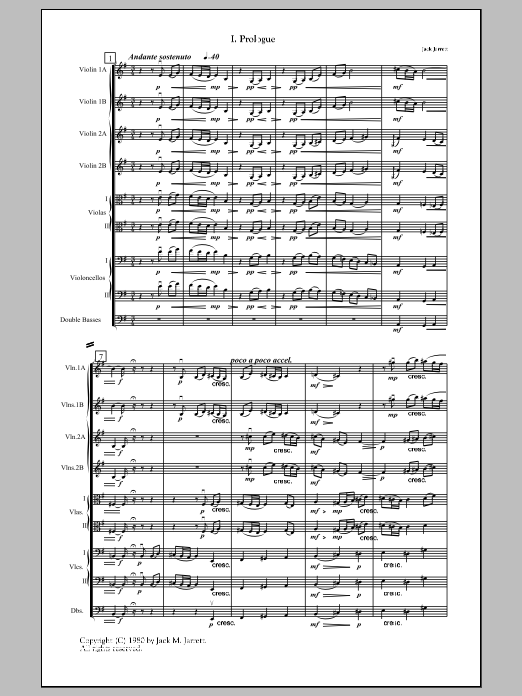

Romeo and Juliet, Symhonic Suite for Strings: String Orchestra Conductor Score & Parts
Arranged by Jack Jarrett
Item: 35-PK00279227
$12.35
Pickup currently not available
Buy Extra Parts (Digital PDF Download)
Parts Added to Cart!
Description
Five moveents for String Orchestra, depicting scenes from Shakespeare's play. Has been performed by the Rochester Philharmonic, the Richmond Symphony, the London Symphony, the Eastern Musc Festival, the National Gallery Orchestra and others. Duration: 24:00


Romeo and Juliet, Symhonic Suite for Strings: String Orchestra Conductor Score & Parts isn't in MakeMusic Cloud just yet...but it could be. Let us know you'd like to see it, and you'll help shape what comes next. In the meantime, start a free trial and dive into thousands of interactive titles your students can play along with today.
Request This Title
Tell us you want it.
Start Your Free Trial
Explore everything that's ready to play right now.
Sample Audio
No sample audio found.
Sample Video
No sample videos found.
Additional Details
Publisher:
Hal Leonard
SKU:
35-PK00279227
More about this title
Why we love this
Jarrett's five-movement structure gives you a dramatic arc without overloading rehearsal time. The piece has earned performances from serious orchestras (Rochester Philharmonic, London Symphony, National Gallery Orchestra), which tells you the string writing is both idiomatic and musically substantial. You get Shakespeare's narrative embedded in orchestral form, which opens conversations about program music and dramatic storytelling in your rehearsals.
What to expect
Jarrett's suite captures Shakespeare's emotional landscape through orchestral color: the romance of Verona's streets, the tension of family conflict, moments of lyrical beauty interrupted by darker currents. The writing balances accessibility with genuine musical substance, creating a soundworld that feels both theatrical and emotionally grounded.
Who it's for
String orchestras at the intermediate to advanced level looking for substantial concert repertoire with literary and dramatic appeal. Directors programming a full orchestral work that showcases both technical growth and musical storytelling can deploy this across a full rehearsal season without depleting your ensemble's energy. Students benefit from performing a multi-movement work with real orchestral context.
How to get the most out of it
- Shape the melodic lines with awareness of the emotional temperature in each scene; the distinction between Jarrett's underscoring of romance versus conflict will emerge through your phrasing choices, not aggressive tempo shifts.
- Balance your section leaders carefully, especially when thematic material passes between first violins and violas. Inner voices carry real musical weight here, so resist the urge to let them recede.
- Work the ensemble through rhythmic clarity in the faster sections before layering in interpretive depth. Five movements means coordination across varied textures, and precision comes first.
- The 24-minute duration benefits from a single, continuous performance context rather than sectional breaks. Plan your rehearsal stamina accordingly.
How to use it
Schedule this as a anchor piece for a spring or winter concert built around classical or literary themes. The 24-minute duration suits a program that includes shorter works or soloists; it commands respect without crowding your performance slots. Consider pairing it with related chamber works or solo features that let your string players catch their breath between movements.
Skills your students will build
- Reading and executing multiple tempo and meter changes across five connected movements
- Sustaining musical focus through an extended work with clear narrative structure
- Balancing inner-voice independence with ensemble cohesion in dense string textures
- Responding to dramatic character shifts and program music interpretation
- Maintaining intonation and section blend across varied dynamic levels and register shifts