Romeo And Juliet Sheet Music Preview

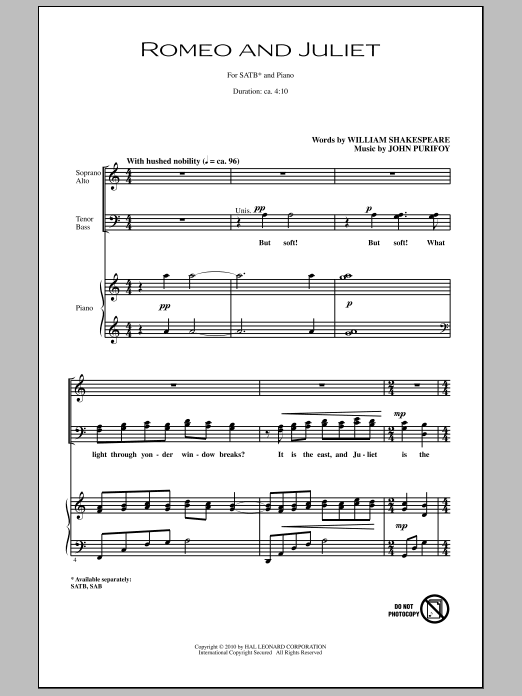
Romeo And Juliet: SATB Choral Octavo

By John Purifoy

Item: 35-DS00151327

Digital Download
$2.99
Description

Romeo And Juliet: SATB Choral Octavo isn't in MakeMusic Cloud just yet...but it could be. Let us know you'd like to see it, and you'll help shape what comes next. In the meantime, start a free trial and dive into thousands of interactive titles your students can play along with today.

Sample Audio
No sample audio found.
Sample Video
Additional Details
Publisher: Hal Leonard
Page Count: 10
SKU: 35-DS00151327

More about this title

About the Composer: John Purifoy

John Purifoy is a composer and arranger whose choral works span both sacred and secular repertoire. His settings demonstrate a keen ear for text underlay and harmonic color, making his compositions accessible to school and community choirs while maintaining musical substance.

Why we love this

Purifoy captures the emotional intensity of Shakespeare's tragedy in a piece that never feels overwrought. The four voices move with clarity and purpose, allowing the text to remain the anchor while the music supports rather than overwhelms the story.

What to expect

The setting respects the weight of Shakespeare's language while avoiding melodrama. Harmonies shift subtly to mirror emotional turns in the text, creating moments of tenderness and tension that feel earned rather than imposed.

Who it's for

This piece serves choirs with secure SATB singers who can handle poetry-driven text with intelligence and nuance. It works equally well for high school advanced choirs and community ensembles seeking repertoire that balances accessibility with musical maturity.

How to get the most out of it

  • Shape the melodic lines through the text's emotional arc; Shakespeare's language carries its own momentum, and your singers should follow its natural peaks and valleys rather than impose external phrasing.
  • Balance soprano and alto lines with care, particularly in moments where the upper voices diverge, ensuring neither line disappears into the texture.
  • Rehearse the tenor and bass parts as a rhythmic unit early on; their stability anchors the harmonic movement and gives sopranos and altos confidence to shape the melody.

How to use it

Pair this with other Renaissance or classical settings to build a thematic program exploring how composers across centuries have engaged with Shakespeare. It also stands alone as a concert opener or closer that signals artistic ambition without demanding extended rehearsal time.

Skills your students will build

  • Singing text-driven melody while maintaining harmonic accuracy in supporting voices
  • Interpreting poetic language through musical gesture and phrasing
  • Balancing four-part independence while maintaining ensemble cohesion
  • Shaping longer phrases with multiple dynamic and textual turning points

You May Also Like