
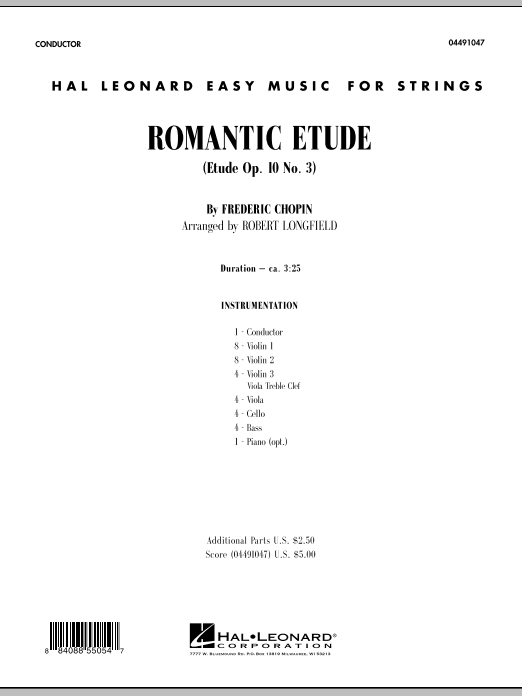

Romantic Etude (Op. 10, No. 3): String Orchestra Conductor Score & Parts
By Frederic Chopin / Arranged by Robert Longfield
Grade: 2
Item: 35-PK00175579
$40.00
Pickup currently not available
Buy Extra Parts (Digital PDF Download)
Parts Added to Cart!
Description
This new arrangement of a Chopin classic is ideal for string teaching and performance. Robert Longfield's setting is carefully crafted for younger players and gives a wonderful opportunity to teach expressive style and nuance. Dur: 3:25


Romantic Etude (Op. 10, No. 3): String Orchestra Conductor Score & Parts isn't in MakeMusic Cloud just yet...but it could be. Let us know you'd like to see it, and you'll help shape what comes next. In the meantime, start a free trial and dive into thousands of interactive titles your students can play along with today.
Request This Title
Tell us you want it.
Start Your Free Trial
Explore everything that's ready to play right now.
Sample Audio
No sample audio found.
Sample Video
No sample videos found.
Additional Details
Publisher:
Hal Leonard
SKU:
35-PK00175579
More about this title
About the Composer: Frederic Chopin
Frederic Chopin (1810-1849) was a Polish composer and pianist who fundamentally shaped the sound of the Romantic era. His music combines virtuosic technical demands with profound emotional depth, and his innovations in harmony and form influenced generations of composers. Chopin's works for solo piano remain central to the repertoire, but his compositions also offer invaluable teaching material when thoughtfully arranged for ensemble settings.
For music educators, Chopin represents a crucial bridge between Classical structure and Romantic expression. His etudes were originally conceived as technical studies with artistic substance, making them natural teaching vehicles for developing both skill and musical maturity in young players.
Why we love this
Longfield's orchestration strips away none of Chopin's lyrical power while making the piece genuinely playable for Grade 2 strings. You get authentic Romantic style without the technical barriers that would otherwise keep this work inaccessible to younger ensembles, and the emotional directness of the melody invites real musicality from players still developing their craft.
What to expect
This is music that breathes. The opening melody unfolds with Chopin's characteristic long-lined phrasing, supported by warm harmonic movement that gives young string players something substantial to listen to and balance against. The overall character is introspective and lyrical, inviting players into a more mature musical conversation than many Grade 2 pieces offer.
Who it's for
String orchestras at the upper elementary through early middle school level who are ready for genuine Romantic repertoire with emotional substance. Teachers seeking pieces that develop expressive playing without requiring virtuosic passage work will find this particularly valuable.
How to get the most out of it
- Shape the opening phrase as a single breath, even though younger players may need a discrete bow lift. The line should feel unbroken from the first note through the cadential gesture.
- Invest time in the harmonic progression underneath the melody. When violas and cellos understand their voice leading, the whole ensemble sounds more mature and the melody sits more naturally.
- Explore the dynamic landscape in rehearsal; Chopin's expressive markings, though sparse, are precise. Small shifts in volume create the character Chopin intended without asking players to do anything technically unreasonable.
- Consider using a light vibrato approach with first violins to add warmth without overloading younger players who are still developing their vibrato control. Consistency in the section matters more than quantity.
How to use it
This works beautifully as a standalone concert piece or as part of a Romantic era program that might include other arranged classics. The modest duration (3:25) makes it an ideal partner to a larger work, either as a graceful opening or as a contrasting middle movement in a multi-piece set.
Skills your students will build
- Sustaining long melodic lines with consistent tone and dynamic control
- Listening to and balancing multiple string voices simultaneously
- Responding to Romantic era expressive markings and harmonic structure
- Vibrato application that serves the music rather than merely technical exercise
- Ensemble blend in a context that prioritizes lyricism over rhythmic precision