
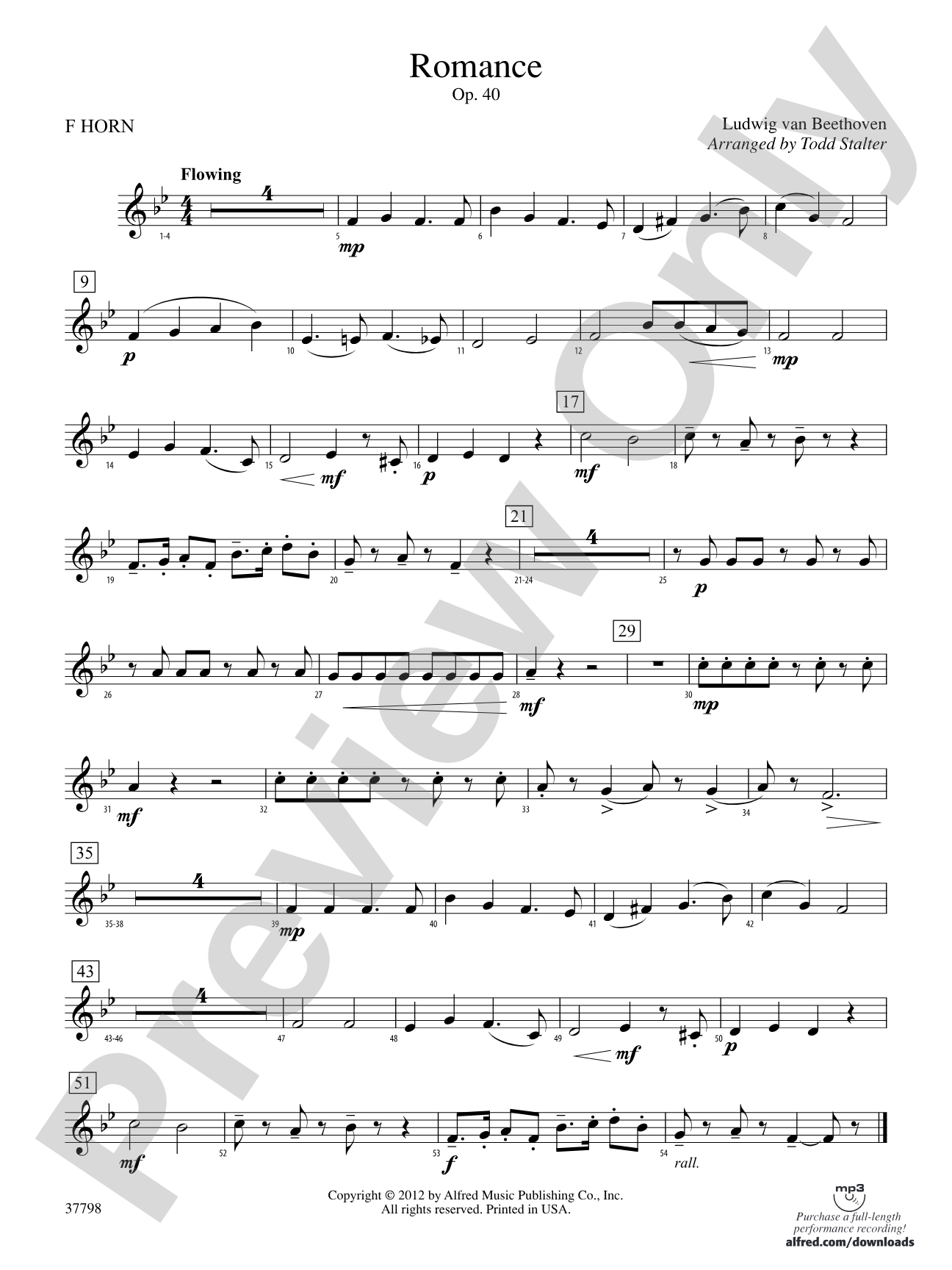

Romance, Op. 40: 1st F Horn
By Ludwig van Beethoven / arr. Todd Stalter
Grade: 1.5 (Easy)
Item: 00-PC-0015329_H1
$3.00
Pickup currently not available
Description
Beethoven wrote two "Romances" for violin and orchestra; his second one, the Op. 40 in G Major, was actually published in 1802, two years before the Op. 50 in F Major, even though the F Major "Romance" was composed four years earlier. The double stops of the violin solo are faithfully preserved in this arrangement, and careful attention to articulation and emphasis on melodic playing by every section of the band will make this piece an ideal choice to introduce the music of this master composer to young musicians. (2:50)


Don't just read it, hear it, play along with it, and watch your students grow with it. In MakeMusic Cloud, Romance, Op. 40: 1st F Horn comes alive with professional accompaniment, adjustable tempo, and built-in practice tools that turn solo practice into real progress.
Open in the Player
Jump straight in and assign it today.
Start Your Free Trial
Open this title and explore the full library in minutes.
Sample Audio
1
Audio File
--:--
0:00
0:00
Sample Video
No sample videos found.
Additional Details
Series:
Challenger Band Series
Publisher:
Alfred Music
Page Count:
116
SKU:
00-PC-0015329_H1
More about this title
About the Composer: Ludwig van Beethoven
Ludwig van Beethoven (1770-1827) stands as the pivotal figure between the Classical and Romantic eras, a composer who expanded the emotional and structural possibilities of every genre he touched. Born in Bonn and later based in Vienna, Beethoven moved beyond the formal elegance of his predecessors to create music of unprecedented depth, urgency, and personal expression. His works remain cornerstones of music education because they demonstrate how melodic integrity, structural clarity, and emotional directness can coexist in works of lasting power.
For young musicians, Beethoven's music offers an invaluable gateway to understanding how composers communicate profound ideas within disciplined forms. His melodies are singable and memorable; his harmonies are logical yet expressive. Whether teaching through his symphonies, concertos, or chamber works, educators find that Beethoven's clarity of purpose and architectural strength make his music both accessible to beginners and rewarding for deeper study.
Why we love this
This arrangement captures one of Beethoven's most lyrical instrumental voices and makes it genuinely playable for Grade 1.5 ensembles without sacrificing the character of the original. The careful preservation of the violin's double stops across the band voices teaches students how composers distribute complex melodic ideas across different instruments, and the emphasis on singing phrasing naturally trains every section in sustained, expressive playing from the ground up.
What to expect
The Romance unfolds with quiet elegance and gentle urgency. Its long, singing lines feel almost improvisational, as if the melody is thinking aloud; underneath, steady harmonic support creates a sense of inevitable forward motion. There is nobility here without bombast, lyricism without sentimentality.
Who it's for
Beginning to intermediate concert bands seeking substantial Classical repertoire that doesn't rely on familiarity with Beethoven's symphonies. This arrangement suits ensembles ready to move beyond march-based programming toward music that demands focused listening and sustained melodic attention from every player.
How to get the most out of it
- Shape the opening phrase as a single musical gesture; resist the urge to breathe or reset at every natural sectional break. Let the melody breathe through the band rather than stopping it.
- Balance the melodic line so that the primary voice is always audible, even when multiple sections carry the theme simultaneously. This clarity is what makes Beethoven's orchestration teaching.
- Attend closely to Stalter's articulation markings, which translate the original violin's bowings into band terminology. These markings are your guide to capturing the Romance's lyrical character.
- Slow the tempo slightly during sustained passages to allow younger musicians time to shape dynamics and arrive at long tones with confidence and control.
How to use it
Program this early on a concert to establish an intimate mood and demonstrate your ensemble's capacity for fine playing before moving into more energetic repertoire. It works equally well as an opening or second piece on a festival program where your band is preceded or followed by louder, structurally more complex works.
Skills your students will build
- Sustaining long melodic lines with consistent tone and phrasing across multiple measures
- Reading and executing articulation markings that translate Romantic-era violin technique into wind and percussion idiom
- Balancing parts to support a primary melody while maintaining ensemble cohesion
- Developing sensitivity to dynamic shading and rubato within a Classical formal structure
- Understanding how a single melodic idea can be distributed across different instruments without losing its singability