Romance In D Major Sheet Music Preview

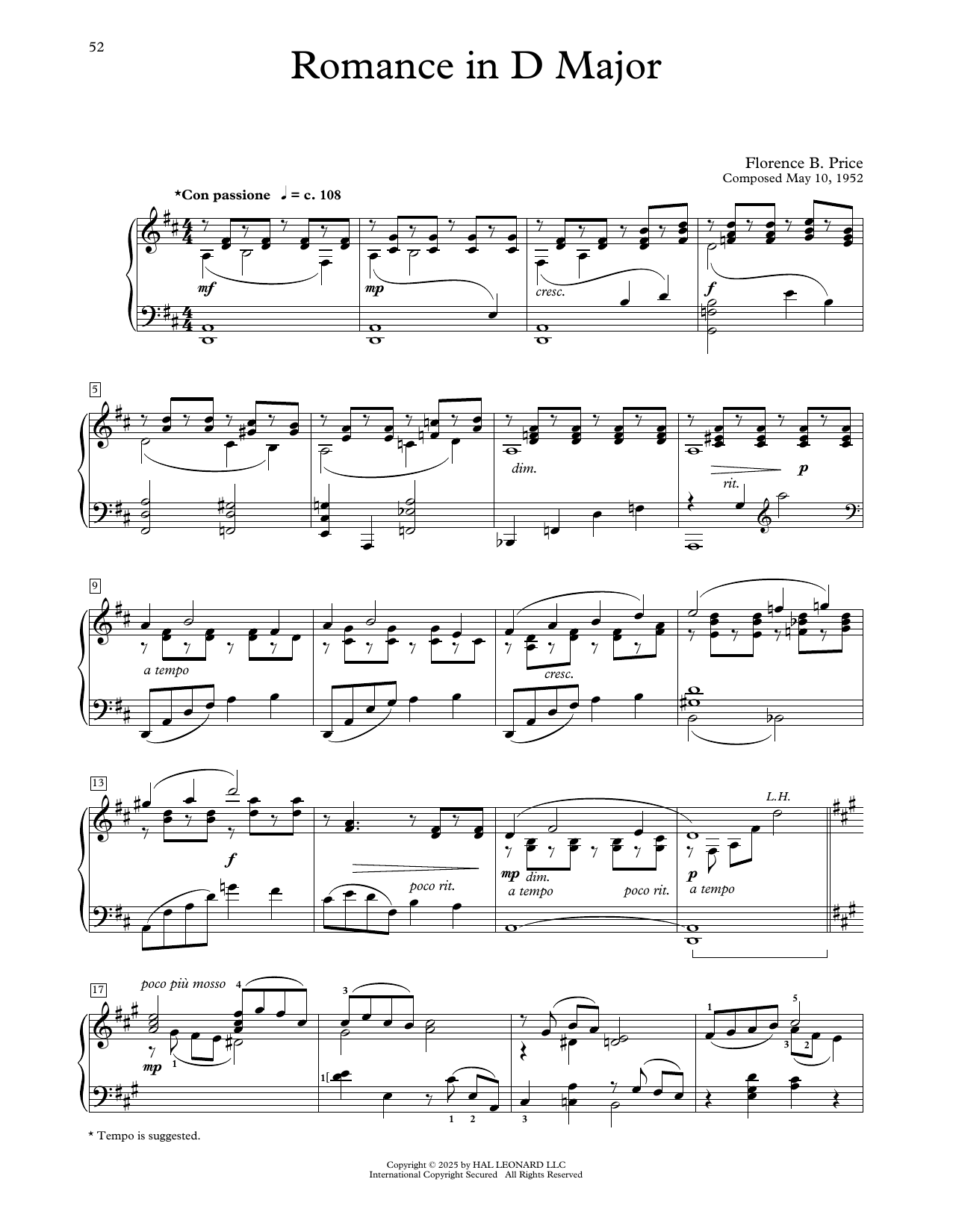
Romance In D Major: Educational Piano

By Florence Price / Edited by Michael Clark

Item: 35-DS01576384

Digital Download
$4.99
Description

Discover MakeMusic Cloud: thousands of interactive titles your students can play along with today.

Sample Audio
No sample audio found.
Sample Video
Additional Details
Publisher: Hal Leonard
Page Count: 2
SKU: 35-DS01576384

More about this title

About the Composer: Florence Price

Florence Price (1887–1953) was the first African American woman to have a symphony performed by a major American orchestra. A composer of remarkable versatility, she wrote across symphonic, chamber, and solo piano repertoire, drawing inspiration from spirituals, folk melodies, and the classical forms she mastered. Her music combines lyrical Romantic sensibilities with a distinct voice rooted in African American musical traditions, making her work essential to any complete picture of American composition.

Price's educational pieces remain vital teaching tools. They introduce students to refined harmonic language, elegant phrasing, and the historical importance of centering Black composers in the curriculum. Her writing for piano is idiomatic and pianistically sound, rewarding careful practice without overwhelming the developing musician.

Why we love this

This piece offers students an opportunity to engage with one of America's most significant composers while building genuine musical literacy. Price's command of melody and harmony creates a work that sounds mature and intentional, not simplified; students feel like they're learning "real" music, not exercises dressed up as pieces.

What to expect

Warm, introspective, and unhurried. The piece unfolds with the grace of a musical conversation, inviting the performer into moments of quiet reflection without ever losing forward momentum. There's a Romantic sensibility here that feels both familiar and distinctly its own.

Who it's for

Intermediate to advancing pianists ready for repertoire with genuine harmonic sophistication and lyrical depth. Teachers seeking to integrate Black composers into the curriculum will find this two-page piece accessible yet rewarding for students committed to learning it well.

How to get the most out of it

  • Shape the melodic line with long-term phrasing rather than bar-by-bar gestures. Even in quieter passages, keep the voice moving toward natural phrase endings.
  • Balance the texture so the right hand melody sings above the accompaniment without the left hand receding into silence. Aim for a clear hierarchy of voices.
  • Allow rubato in the expressive passages to enhance the Romantic character, but keep the pulse steady during more rhythmically active sections.
  • Attend to dynamic contrasts as architectural decisions. Softer moments should feel intentional and connected to the overall arc, not accidental.

How to use it

This works beautifully on a recital dedicated to women composers or as part of a concert exploring African American musical contributions to American classical tradition. Its length and pedagogical focus make it ideal for a student recital program where it can anchor a set or stand alone as a substantial solo offering.

Skills your students will build

  • Sustaining legato in the melodic line across hand positions
  • Balancing multiple voices in the texture
  • Interpreting Romantic harmonic language and voice leading
  • Shaping longer musical phrases with deliberate structure
  • Responding to dynamic and tempo indications as expressive choices

You May Also Like