
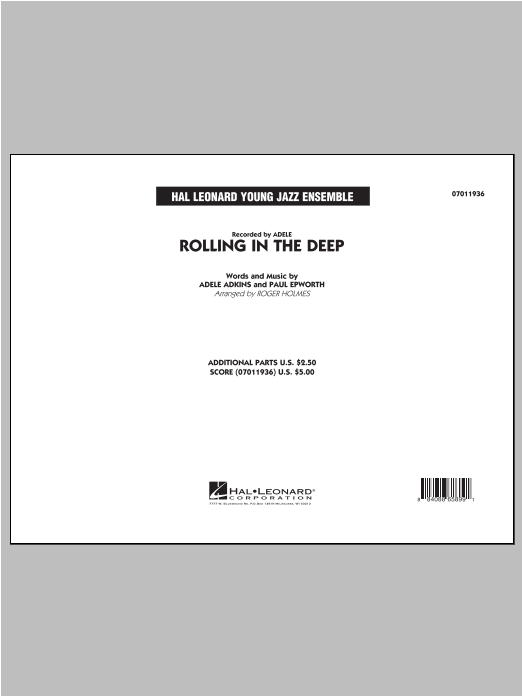

Rolling In The Deep: Jazz Ensemble Conductor Score & Parts
As performed by Adele / Arranged by Roger Holmes
Grade: 3
Item: 35-PK00243230
$50.00
Pickup currently not available
Buy Extra Parts (Digital PDF Download)
| Product | Price | Quantity |
|---|---|---|
| Rolling in the Deep - Full Score | $6.00 | |
| Rolling in the Deep - Alto Sax 1 | $6.00 | |
| Rolling in the Deep - Alto Sax 2 | $6.00 | |
| Rolling in the Deep - Tenor Sax 1 | $6.00 | |
| Rolling in the Deep - Tenor Sax 2 | $6.00 | |
| Rolling in the Deep - Baritone Sax | $6.00 | |
| Rolling in the Deep - Trumpet 1 | $6.00 | |
| Rolling in the Deep - Trumpet 2 | $6.00 | |
| Rolling in the Deep - Trumpet 3 | $6.00 | |
| Rolling in the Deep - Trumpet 4 | $6.00 | |
| Rolling in the Deep - Trombone 1 | $6.00 | |
| Rolling in the Deep - Trombone 2 | $6.00 | |
| Rolling in the Deep - Trombone 3 | $6.00 | |
| Rolling in the Deep - Trombone 4 | $6.00 | |
| Rolling in the Deep - Guitar | $6.00 | |
| Rolling in the Deep - Piano | $6.00 | |
| Rolling in the Deep - Bass | $6.00 | |
| Rolling in the Deep - Drums | $6.00 | |
| Rolling in the Deep - Aux Percussion | $6.00 |
Parts Added to Cart!
Description
Roger Holmes has turned Adele's Song of the Year into an effective and powerful version for jazz ensemble. The melody is traded around to various sections, along with counterlines and background patterns skillfully woven in. Requires no solos.


Rolling In The Deep: Jazz Ensemble Conductor Score & Parts isn't in MakeMusic Cloud just yet...but it could be. Let us know you'd like to see it, and you'll help shape what comes next. In the meantime, start a free trial and dive into thousands of interactive titles your students can play along with today.
Request This Title
Tell us you want it.
Start Your Free Trial
Explore everything that's ready to play right now.
Sample Audio
No sample audio found.
Sample Video
No sample videos found.
Additional Details
Publisher:
Hal Leonard
SKU:
35-PK00243230
More about this title
About the Artist: Adele
Adele's 2010 debut album 21 established her as a generational voice in pop music, built on her gift for emotional directness and vocal power. Her songwriting draws heavily from soul, jazz, and blues traditions, which makes her work particularly rewarding for jazz ensemble arrangements that can highlight the harmonic sophistication beneath the pop surface.
Why we love this
Roger Holmes strips away the original's production layers to reveal strong harmonic architecture and a melody that sings beautifully when passed between sections. The arrangement solves a real programming need: contemporary material with instant student engagement that doesn't require a soloist or ask them to sustain a ballad tempo through lengthy unaccompanied passages.
What to expect
Confident and grounded, with the soulful undertone of the original intact. The melody floats across different voices in a way that feels conversational rather than showy, and the supporting textures create a cohesive forward motion without ever feeling thin.
Who it's for
Jazz ensembles at the intermediate level who want contemporary repertoire with substance. Works well for programs seeking to engage students with material they know while building section balance and trading skills.
How to get the most out of it
- Balance the melody trades carefully so each section's entrance lands cleanly without drowning out the previous phrase. A crisp cutoff prevents the melody from muddying when it passes.
- Shape the background patterns rhythmically; they're not filler but supporting voices that drive the song forward. Ensemble precision here frees the melody section to breathe.
- Lock the harmonic foundation early in sectional rehearsals by drilling the rhythm section and lower voices in isolation, then layer the melody and counterlines once the pulse is secure.
- Let the emotional arc build gradually. This arrangement works best when you resist the urge to play powerfully from the opening and instead allow intensity to gather as the piece progresses.
How to use it
Pair this with standards or Latin jazz pieces to show students how deep harmonic language connects across genre lines. It's substantial enough to anchor a pops concert or to serve as a bridge piece that helps less experienced listeners understand what jazz ensemble arrangements can do with contemporary music.
Skills your students will build
- Executing clean section-to-section melody trades
- Maintaining textural clarity when multiple lines function simultaneously
- Balancing ensemble weight across different instrumental groupings
- Interpreting and maintaining groove over harmonic changes
- Understanding countermelody as a compositional tool, not accompaniment