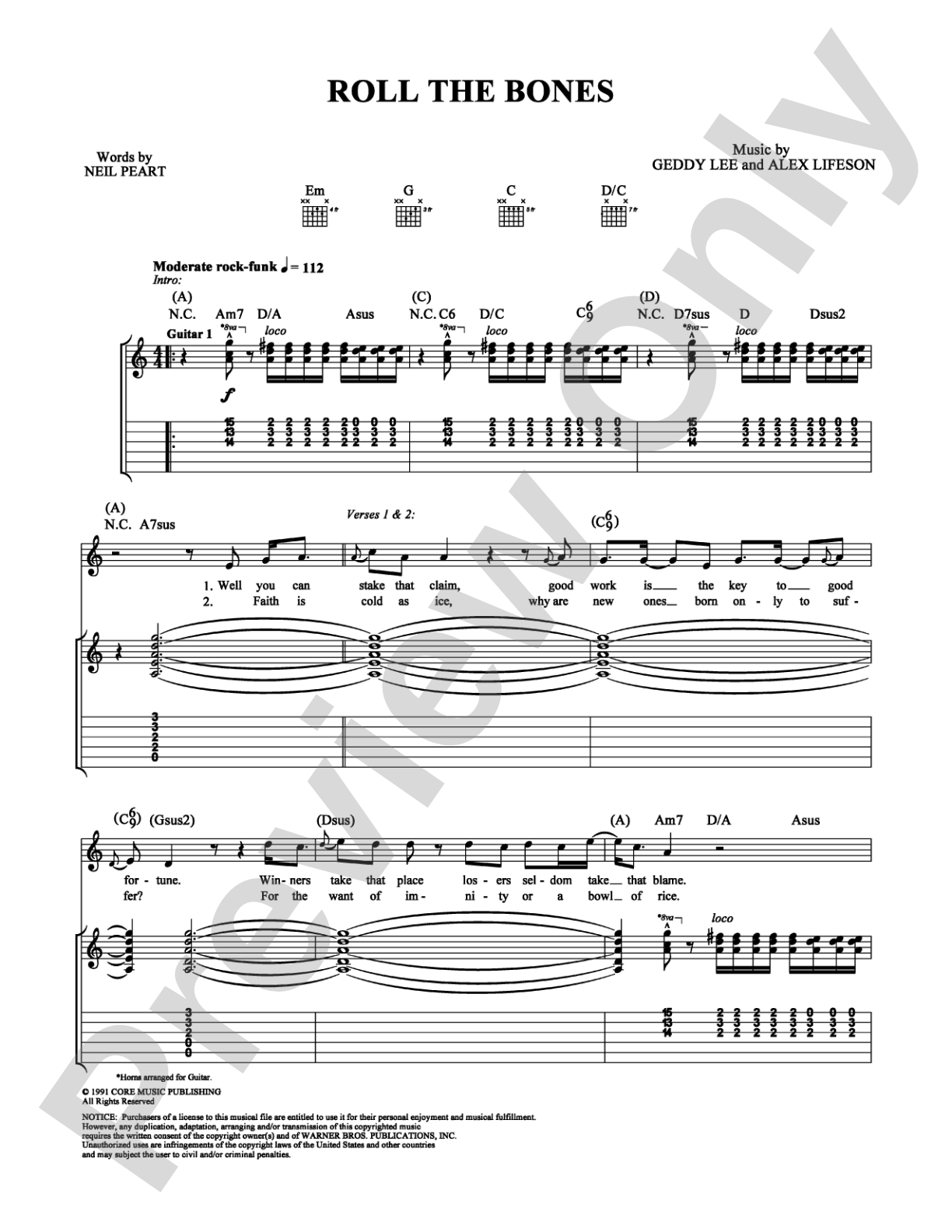
Roll the Bones: Guitar TAB Digital Sheet Music

Roll the Bones: Guitar TAB Digital Sheet Music

Rush, Geddy Lee, Alex Lifeson

Item: 00-PS-0002959

Digital Download
$2.99
Description

Roll the Bones: Guitar TAB Digital Sheet Music isn't in MakeMusic Cloud just yet...but it could be. Let us know you'd like to see it, and you'll help shape what comes next. In the meantime, start a free trial and dive into thousands of interactive titles your students can play along with today.

Sample Audio
No sample audio found.
Sample Video
Additional Details
SKU: 00-PS-0002959

More about this title

About the Artist: Rush

Rush stands as one of rock's most technically demanding and philosophically ambitious bands. Formed in Toronto in 1968, the trio of Geddy Lee (vocals, keyboards, bass pedals), Alex Lifeson (guitar), and Neil Peart (drums, lyrics) built a legacy spanning five decades through virtuosic musicianship and complex compositional structures that defy genre boundaries.

Their influence on music education extends beyond their devoted fanbase. Rush's catalog demonstrates how progressive rock can marry intricate time signatures, unconventional song structures, and instrumental sophistication with genuine emotional resonance. For guitar students and educators, their work represents a masterclass in how technical mastery serves musical storytelling rather than existing for its own sake.

Why we love this

Roll the Bones captures Rush at a moment of reinvention, blending their progressive DNA with groovier, more accessible rhythmic frameworks. Guitar students encounter a piece that demands precision in rhythm and articulation while remaining engaging enough to sustain motivation through multiple rehearsals. This track gives intermediate to advanced players a genuine rock classic without requiring an academic approach to appreciation.

What to expect

Roll the Bones pulses with kinetic energy and rhythmic sophistication. The guitar work sits somewhere between funk and prog rock, delivering grooves that feel modern while maintaining the band's signature density and technical control. Playing it demands alertness and precision, but rewards that effort with the satisfaction of inhabiting a genuinely impressive musical space.

Who it's for

Intermediate and advanced guitarists seeking substantial repertoire beyond standard blues or folk-based material. This TAB serves students ready to engage with complex rhythms, syncopated figures, and the technical demands of contemporary rock composition. Teachers programming recitals or ensemble concerts will find a piece that appeals to students' taste while advancing their musicianship.

How to get the most out of it

  • Lock into the rhythmic pocket early. Rush's syncopation rewards guitarists who treat rhythm as melodic; the riffs breathe when phrased with intention rather than played mechanically.
  • Study the relationship between guitar and bass lines before performing. Understanding how your part interlocks with the low end prevents rushing and clarifies the song's architectural shape.
  • Use the recorded version as a reference for articulation and dynamics, not a mandate. TAB indicates what notes to play; listening reveals how Lifeson shapes tone and attack for maximum impact.
  • Tackle the technical passages in sections, isolating any fingering combinations that feel awkward. Rush's writing prioritizes playability, but takes time to inhabit at tempo.

How to use it

Program this as a showcase piece for advanced guitarists in a rock or contemporary ensemble context. It works equally well as a solo recital selection or as part of a guitar ensemble program that balances classic rock with varied styles. The song's moderate length and immediate musicality make it suitable for student concerts where engagement matters as much as technical display.

Skills your students will build

  • Reading and executing syncopated rhythmic figures in standard notation and TAB
  • Interpreting note articulation and dynamics from recorded references
  • Maintaining rhythmic precision in complex, non-linear song structures
  • Coordinating with other musicians, particularly synchronizing guitar lines with bass rhythms
  • Building finger stamina and dexterity for sustained technical passages

You May Also Like