
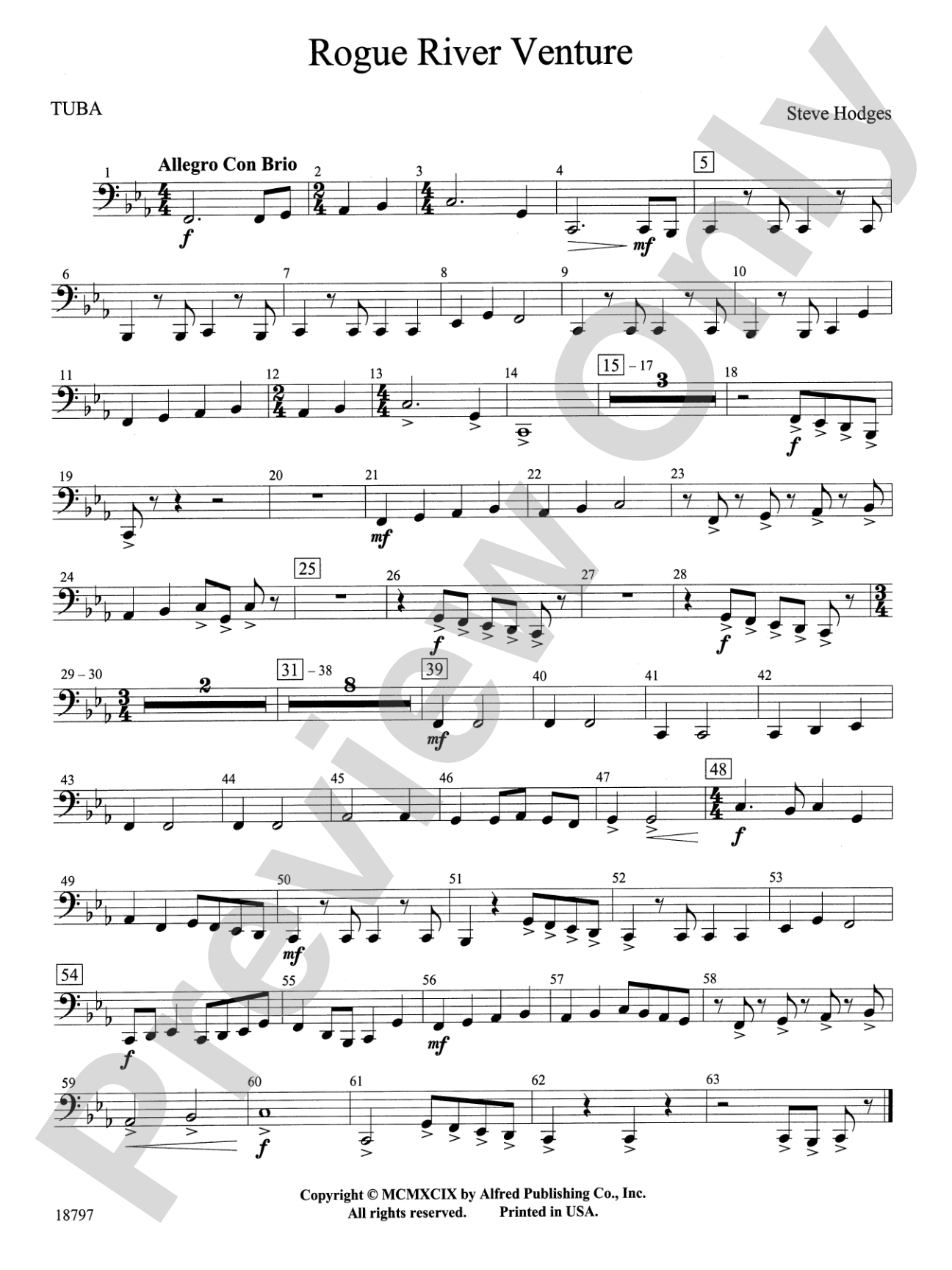

Rogue River Venture: Tuba
By Steve Hodges
Grade: 1.5 (Easy)
Item: 00-PC-0000282_TB1
$3.00
Pickup currently not available
Description
Take a ride down the rapids with this exciting new piece by Steve Hodges. Based on the Dorian mode, the melodies are shared by all sections of the band throughout the piece. The driving accompaniment of the first section is complemented well by the flowing triple-meter patterns of the middle section. From the opening measure to the dynamic conclusion, your young band will thoroughly enjoy this adventure!


Don't just read it, hear it, play along with it, and watch your students grow with it. In MakeMusic Cloud, Rogue River Venture: Tuba comes alive with professional accompaniment, adjustable tempo, and built-in practice tools that turn solo practice into real progress.
Open in the Player
Jump straight in and assign it today.
Start Your Free Trial
Open this title and explore the full library in minutes.
Sample Audio
1
Audio File
--:--
0:00
0:00
Sample Video
No sample videos found.
Additional Details
Series:
Challenger Band Series
Publisher:
Alfred Music
Page Count:
1
SKU:
00-PC-0000282_TB1
More about this title
About the Composer: Steve Hodges

Steve Hodges holds degrees from Western Oregon University (Bachelor of Science) and Central Washington University (Master of Music Education). His four-decade career in public school music education spanned all levels of bands, choirs, and chamber ensembles before his retirement.
Since 1986, Hodges has composed over 120 concert band works published by Alfred Music, along with choral arrangements released through Staff Music and Shawnee Press. His compositions appear regularly at festivals and state conventions across North America, including commissioned works for honor bands and schools in Virginia, Iowa, Winnipeg, British Columbia, Oregon, Washington, and North Carolina. His music has also been featured on TBS and ESPN programming. An ASCAP member with multiple standard awards, Hodges now resides in The Dalles, Oregon, where he remains active in community music alongside his wife, Teddie. He takes particular joy in learning when his grandchildren perform his compositions in their school bands.
Why we love this
Hodges writes with young ensembles in mind, and this piece proves it. The Dorian mode gives the melodies an accessible modal flavor without demanding advanced harmonic understanding, while the shared melodic writing ensures every section gets rewarding material. The structural contrast between the driving opening section and the flowing triple-meter middle section keeps both players and audiences engaged.
What to expect
The piece captures the exhilaration of navigating rapids: energetic and propulsive in the opening, then momentarily slowing to let you admire the scenery before building to a thrilling finale. Dorian melodies give the music an open, folk-like quality, while driving rhythmic accompaniment pushes the ensemble forward.
Who it's for
Grade 1.5 concert bands looking for exciting, accessible repertoire that doesn't sacrifice musicality for simplicity. Young players benefit from the shared melodic writing, which keeps all sections engaged, while directors appreciate the clear structural design and festival-ready appeal.
How to get the most out of it
- Establish a clear rhythmic pulse in the opening section by locking the accompaniment figures early in rehearsal; once the foundation is solid, the melodies will sit naturally on top.
- Bring out the shift to triple meter in the middle section through a slight tempo adjustment or dynamic lift, helping the ensemble feel the character change without losing momentum.
- Balance the Dorian melodies so that the modal quality shines through; avoid over-brightening the ensemble's tone, which can obscure the warm, open sound the mode provides.
- Use the dynamic conclusion as a chance to build energy cumulatively, having the band sustain focus through accelerating articulation and increasing volume.
How to use it
Program this as an opener or closer on a festival or contest concert; the direct energy and clear structural arc make it an ideal anchor point. It also works well as a confidence builder mid-program, letting a young band showcase their ability to balance rhythmic precision with melodic expression.
Skills your students will build
- Playing in the Dorian mode and understanding modal melody
- Maintaining steady accompaniment figures while other sections carry melody
- Transitioning between duple and triple meter with clarity
- Building and sustaining dynamic energy across a complete piece