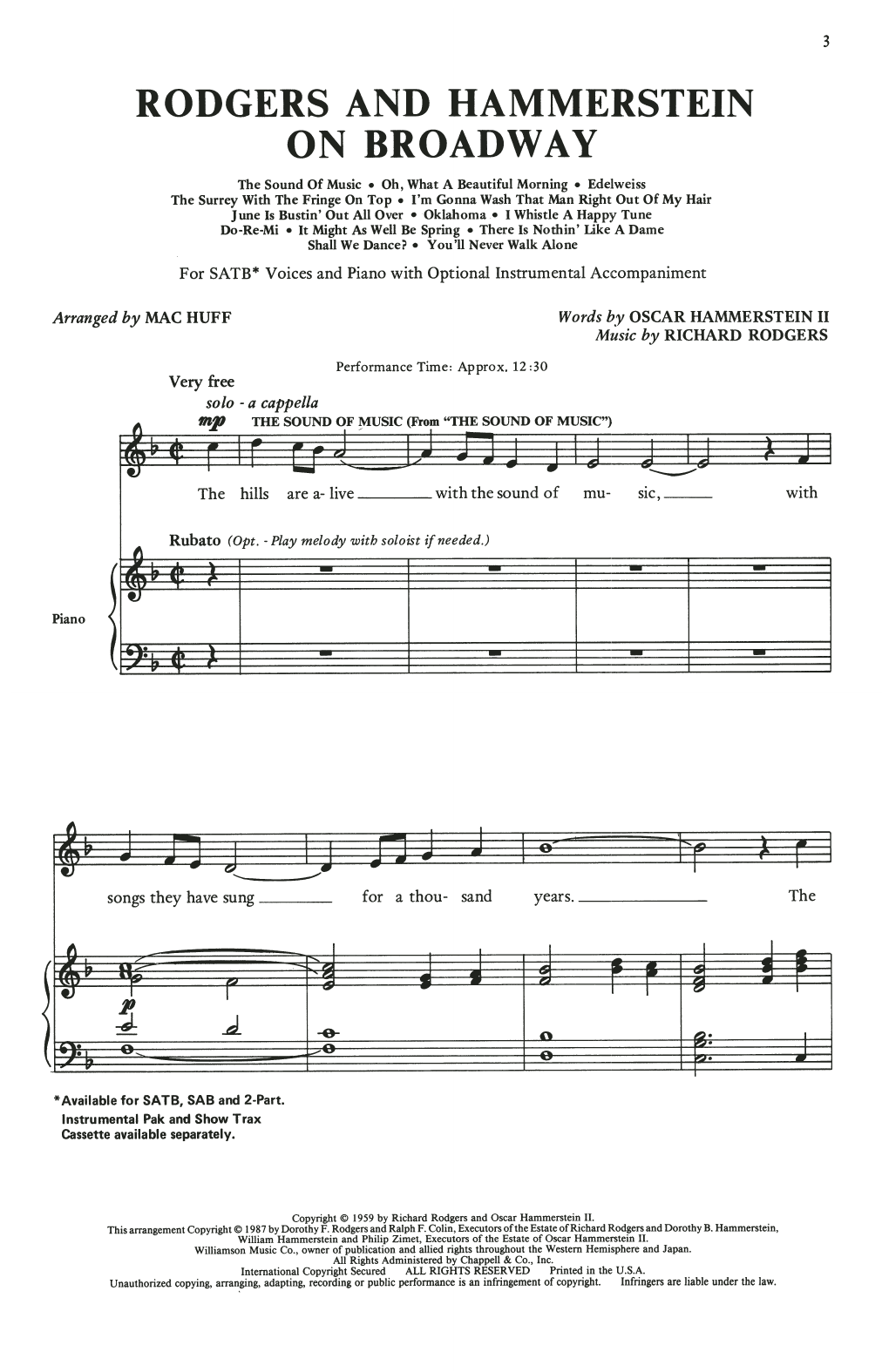
Rodgers and Hammerstein On Broadway (Medley) (arr. Mac Huff) Sheet Music Preview

Rodgers and Hammerstein On Broadway (Medley) (arr. Mac Huff): SATB Choral Octavo

By Rodgers Hammerstein / Arranged by Mac Huff

Item: 35-DS00475866

Digital Download
$4.75
Description

Rodgers and Hammerstein On Broadway (Medley) (arr. Mac Huff): SATB Choral Octavo isn't in MakeMusic Cloud just yet...but it could be. Let us know you'd like to see it, and you'll help shape what comes next. In the meantime, start a free trial and dive into thousands of interactive titles your students can play along with today.

Sample Audio
No sample audio found.
Sample Video
Additional Details
Publisher: Hal Leonard
Page Count: 37
SKU: 35-DS00475866

More about this title

About the Composer: Rodgers Hammerstein

Richard Rodgers and Oscar Hammerstein II revolutionized musical theater by treating songs as vehicles for character development and emotional truth. Their partnership, which began with Oklahoma! in 1943, established a new standard for how music and lyrics could serve the story. Their melodies became the gold standard of American songwriting, known for their singability, memorable contours, and emotional directness that continues to resonate across generations.

For choral directors, Rodgers and Hammerstein's catalog offers unparalleled material because their songs were built to showcase human voices. The melodies sit naturally in the voice, the harmonies support rather than complicate, and the emotional content reads immediately. These are songs that audiences recognize, singers enjoy performing, and students learn from because they understand what the music is trying to express.

Why we love this

Mac Huff's medley construction respects the individual identity of each song while building momentum across the entire arc. A 37-page arrangement that doesn't feel bloated is an achievement; each tune gets breathing room and a genuine moment before the next one arrives. Your singers will feel the payoff of performing music that shaped American popular song, and your audience will leave humming.

What to expect

Stepping into American musical theater history. Each melody carries the warmth and directness of its original context, whether that's the hope of a farmland wedding, the ache of unfulfilled romance, or the joy of simple connection. The arrangement honors what makes these songs beloved while letting your singers feel the satisfaction of bringing something substantial to life.

Who it's for

Intermediate to advanced choral programs looking for repertoire that audiences genuinely respond to. This works for groups with solid sight-reading skills and the maturity to balance showmanship with musicality. Any choir ready to spend real rehearsal time on something substantial will find this arrangement rewarding.

How to get the most out of it

  • Balance the melodic line across your soprano and alto sections on the verses; these melodies become iconic only when the audience hears them clearly without one voice overwhelming the others.
  • Treat each song in the medley as a mini-rehearsal challenge; work them individually to full performance quality before linking them, then focus on the transitions as your final step.
  • Lean on the emotional context of each tune rather than rushing tempos. Rodgers and Hammerstein wrote melodies that carry their own momentum; the arrangement will breathe when singers understand what each song is about.
  • Check the recorded accompaniment for pacing decisions, particularly how long the transitions hold. Mac Huff's orchestrations often suggest subtle timing choices that keep the medley feeling cohesive rather than episodic.

How to use it

This medley works as a concert centerpiece, especially in a program pairing it with lighter contemporary pop or heavier classical work. Consider programming it in the second half when your audience is fully settled. It also serves as an excellent spring concert closer or as part of a theater-focused concert where you want to acknowledge the roots of musical theater without programming a full show score.

Skills your students will build

  • Legit singing with sustained lyricism across multiple phrases and melodies
  • Balancing four-part SATB textures where the melody isn't always in the soprano
  • Understanding and executing musical theater style while maintaining classical choral discipline
  • Interpreting medley transitions and maintaining ensemble cohesion across stylistically similar but distinct songs
  • Reading and performing extended choral arrangements (37 pages) with structural clarity

You May Also Like