
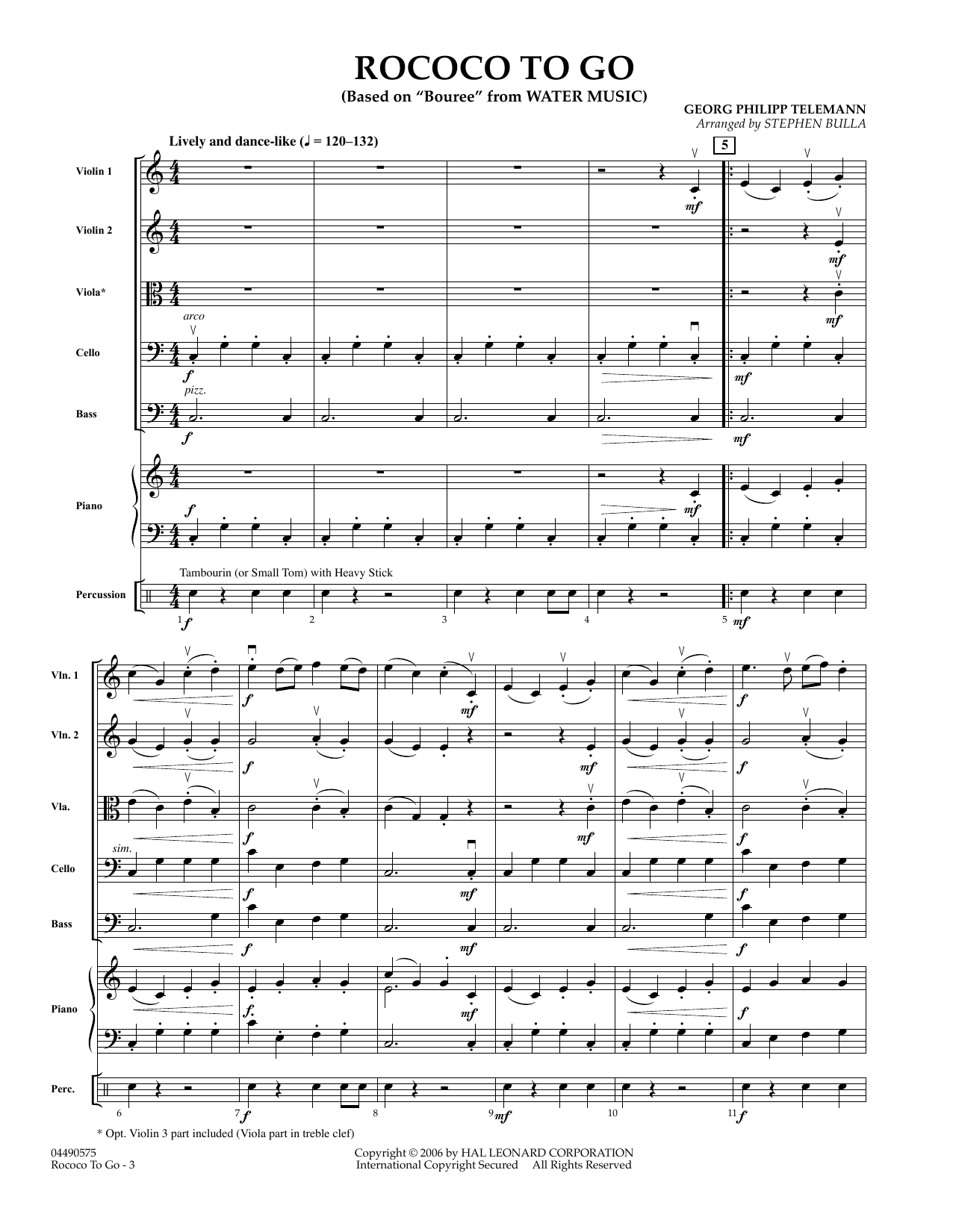

Rococo to Go: String Orchestra Conductor Score & Parts
By Georg Philipp Telemann / Arranged by Stephen Bulla
Grade: 2-3
Item: 35-PK00319657
$35.00
Pickup currently not available
Buy Extra Parts (Digital PDF Download)
| Product | Price | Quantity |
|---|---|---|
| Rococo to Go - Full Score | $6.00 | |
| Rococo to Go - Violin 1 | $7.00 | |
| Rococo to Go - Violin 2 | $7.00 | |
| Rococo to Go - Violin 3 (Viola T.C.) | $7.00 | |
| Rococo to Go - Viola | $7.00 | |
| Rococo to Go - Cello | $7.00 | |
| Rococo to Go - Bass | $7.00 | |
| Rococo to Go - Percussion | $7.00 | |
| Rococo to Go - Piano | $7.00 |
Parts Added to Cart!
Description
Rococo to Go


Rococo to Go: String Orchestra Conductor Score & Parts isn't in MakeMusic Cloud just yet...but it could be. Let us know you'd like to see it, and you'll help shape what comes next. In the meantime, start a free trial and dive into thousands of interactive titles your students can play along with today.
Request This Title
Tell us you want it.
Start Your Free Trial
Explore everything that's ready to play right now.
Sample Audio
No sample audio found.
Sample Video
No sample videos found.
Additional Details
Publisher:
Hal Leonard
SKU:
35-PK00319657
More about this title
About the Composer: Georg Philipp Telemann
Georg Philipp Telemann was one of the most prolific composers of the Baroque era, writing over 3,000 works across every major genre. A master of melody and orchestration, he held prestigious positions in Frankfurt, Paris, and Hamburg, where he directed the city's five main churches and founded one of Europe's first public concert series. His music balances formal structure with genuine accessibility, making it ideal for student musicians.
Telemann's genius lay in his ability to write music that satisfied both amateur and professional musicians without sacrificing craftsmanship. Unlike some of his contemporaries, he understood that graceful counterpoint and clear harmonic motion could coexist with straightforward, singable lines. This philosophy made his works fundamental to music education for centuries.
Why we love this
Stephen Bulla's arrangement captures the elegance of Telemann's original style while keeping the technical demands manageable for developing string sections. The rococo ornaments and light orchestration remain intact, giving students an authentic encounter with 18th century German taste rather than a watered-down version. You get real Baroque sensibility without the strain on younger players.
What to expect
Rococo grace with genuine wit. Telemann's melodic gift shines through in clean, memorable themes that dance across the strings without ever demanding heroic virtuosity. The whole experience feels like a conversation among friends rather than a formal presentation, with enough harmonic surprise to keep everyone listening.
Who it's for
String orchestras at the high school or advanced middle school level looking to expand beyond Baroque standards like Vivaldi and Handel. Conductors who want their students to experience the refinement and humor in Telemann's writing while still working at appropriate technical levels. This is equally valuable for youth orchestras aiming for concert programming with sophisticated musical content.
How to get the most out of it
- Shape the melodic lines with gentle phrase arcs rather than sitting flat on the beat; rococo style lives in the spaces between notes
- Balance the parts carefully so inner voices can sing through. Telemann counted on sophisticated part-writing to maintain interest
- Keep the tempo buoyant and consistent. Rococo music loses its wit when dragged
- Let the ornaments breathe naturally. They're decorative but purposeful, not fussy
How to use it
This works beautifully as an opening concert piece or a palate cleanser between heavier works. Consider pairing it with other Baroque string arrangements to build a mini-suite, or use it as a contrasting foil to a more dramatic Romantic era piece. It's also perfect for spring concerts where elegance and brevity feel right.
Skills your students will build
- Baroque articulation and phrasing conventions
- Listening for balance across multiple voice parts
- Understanding ornamental notation and execution
- Maintaining rhythmic precision in dance-like tempos
- Reading and interpreting figured bass-era harmonic language