Florence Price (1887-1953) was an American composer and pianist who broke racial and gender barriers in classical music during the early 20th century. Her works blend African American musical traditions with European classical forms, creating a distinctive voice that earned her recognition as a pioneering figure in American concert music.
Why we love this
Price's keyboard writing balances accessibility with genuine musical substance. This piece gives students authentic American repertoire to learn from a major composer, not a secondary figure, and the educational framing makes it approachable for intermediate players without sacrificing the character and harmonic interest that kept Price's works in concert halls.
What to expect
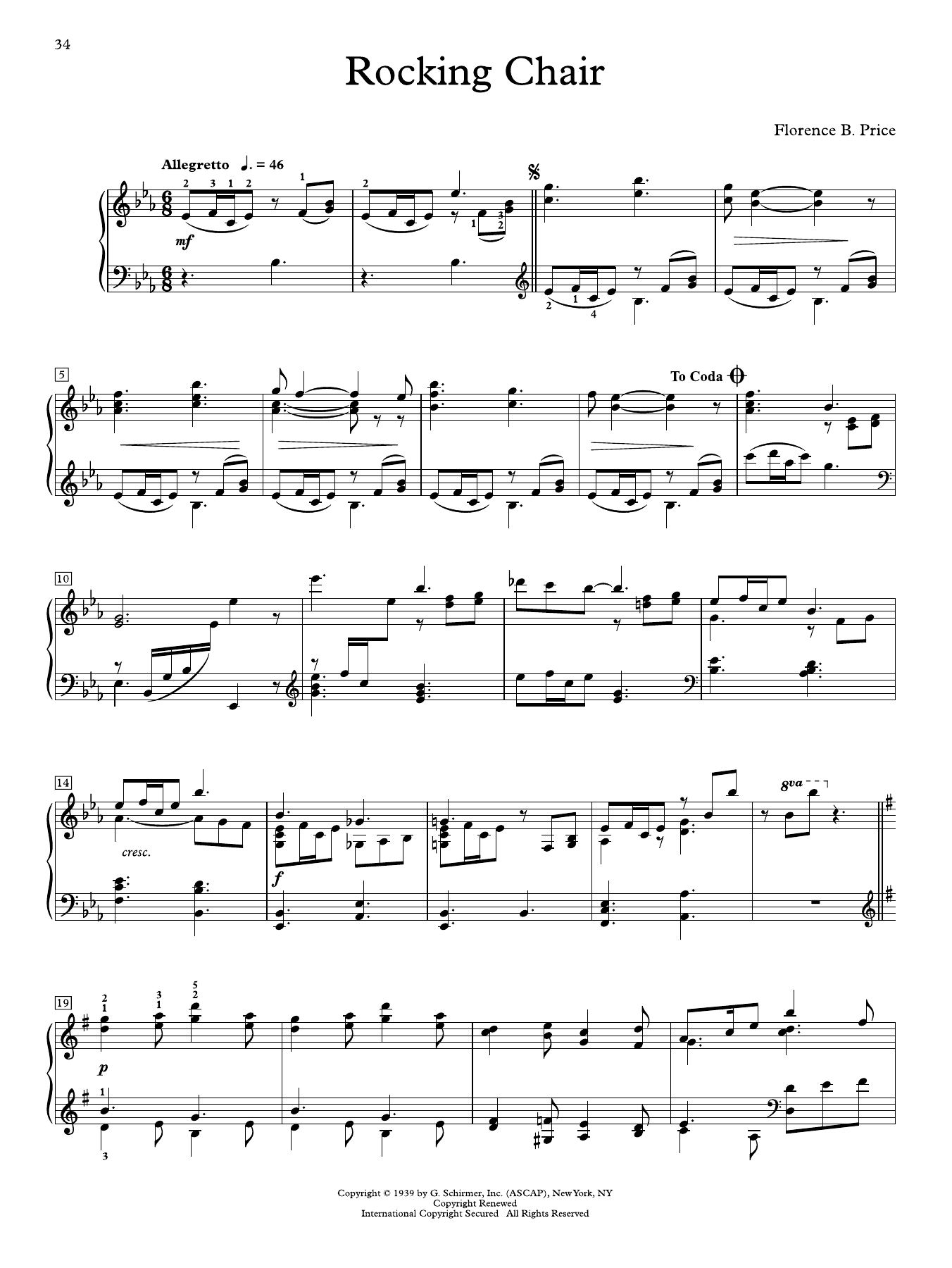
Rocking Chair evokes quiet reflection and gentle motion, as though settling into a moment of repose. The piece unfolds with understated elegance, blending lyrical melody with accompaniment patterns that suggest rhythmic ease rather than urgency.
Who it's for
Intermediate pianists ready to explore beyond the standard classical canon will find this piece both rewarding and manageable. Teachers seeking quality American concert repertoire for students at the intermediate level have found reliable material here.
How to get the most out of it
Capture the gentle, contemplative quality suggested by the title; resist the urge to rush the tempo even though the piece invites a relaxed character.
Pay close attention to phrase shapes and where Price sets up subtle dynamic peaks rather than relying on uniform dynamics throughout.
Balance melodic lines against accompaniment textures so the lyrical content stays forward without the supporting voices disappearing.
How to use it
Feature this alongside other American piano works to build a program celebrating 20th-century composers who shaped the national voice. It works equally well in a recital setting or as a teaching showcase of repertoire students study in technique classes.
Skills your students will build
Phrasing in lyrical contexts without conventional dramatic contrasts
Voice leading between melody and accompaniment textures
Interpretation of early 20th-century American classical style
Pedaling choices that clarify harmonic movement while sustaining tone
You May Also Like
Scan to Complete Your Purchase
Use your phone's camera to scan the code below
You'll log in on your phone and the order will be added to your account