Rockin' Robin Sheet Music Preview

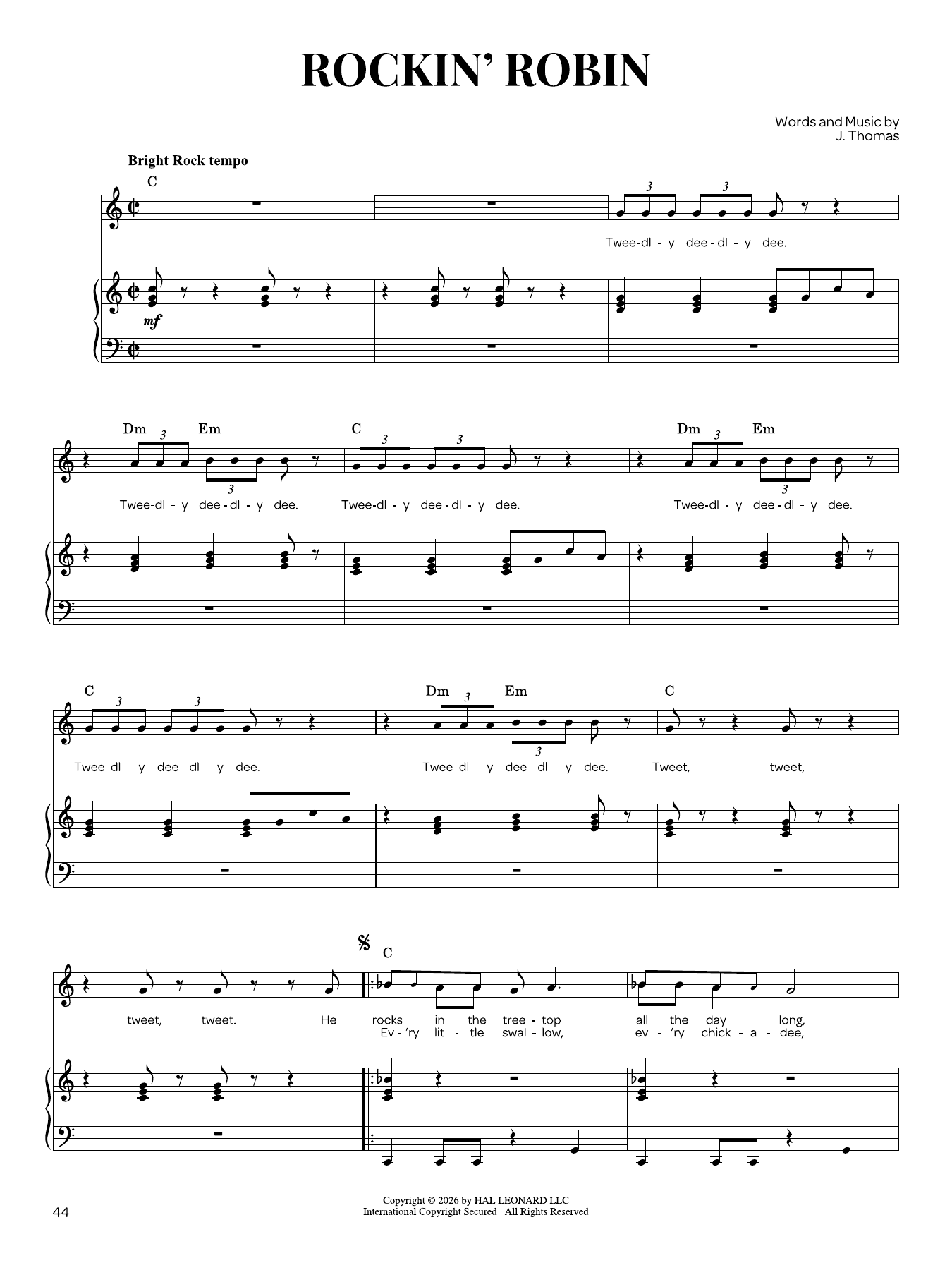
Rockin' Robin: Piano Vocal

As performed by Bobby Day / As performed by Michael Jackson

Item: 35-DS01914845

Digital Download
$5.99
Description

Rockin' Robin: Piano Vocal isn't in MakeMusic Cloud just yet...but it could be. Let us know you'd like to see it, and you'll help shape what comes next. In the meantime, start a free trial and dive into thousands of interactive titles your students can play along with today.

Sample Audio
No sample audio found.
Sample Video
Additional Details
Publisher: Hal Leonard
Page Count: 3
SKU: 35-DS01914845

More about this title

About the Artist: Bobby Day

Bobby Day wrote and recorded "Rockin' Robin" in 1958, crafting one of rock and roll's most enduring novelty hits with a simple, infectious melody and clever lyrics built around bird calls. His work bridged the gap between early rock and pop sensibilities, proving that a song didn't need complexity to achieve cultural staying power. The track became a staple of 1950s radio and has since been covered by artists across genres, most notably by Michael Jackson, whose 1972 version introduced the song to a new generation.

Why we love this

This arrangement captures the playful energy that made "Rockin' Robin" a crossover hit without requiring complex vocal gymnastics or instrumental virtuosity. The three-page format keeps rehearsal time manageable while the straightforward piano part leaves room for singers to focus on character, phrasing, and the rhythmic precision that makes this song swing. It's an ideal choice when you need something that delights audiences and doesn't demand weeks of preparation.

What to expect

Buoyant and mischievous, with an almost cartoonish charm that never tips into silliness. The melody bounces with the lightness of the original while the piano part grounds everything in a solid rock and roll shuffle, creating a piece that feels both fun and genuine.

Who it's for

Solo singers and small ensembles seeking accessible material that still requires musical maturity in phrasing and rhythm. Any pianist comfortable with straightforward accompaniment patterns and a tempo that demands steady timekeeping will succeed here.

How to get the most out of it

  • Keep the tempo steady and driving; this song lives in its rhythmic pocket rather than rubato or expressive tempo shifts.
  • Shape the vocal line with natural speech rhythm even though the melody is simple, giving the lyrics personality and preventing a flat delivery.
  • Balance the bird call interjections (the "tweet tweet" moments) so they sit as a textural element rather than overpowering the main melody.
  • Let the piano groove support the vocal rather than compete with it; the accompaniment works best when it feels like a steady foundation.

How to use it

Pair this with other 1950s standards in a program celebrating early rock and roll, or use it as a crowd-pleasing opener that immediately signals the tone of your concert. The accessibility and familiarity make it work well as a break between more demanding classical or art song repertoire.

Skills your students will build

  • Maintaining steady tempo in a rock and roll shuffle rhythm
  • Singing with character and comedic timing without losing musical integrity
  • Balancing vocal melody against a consistent accompaniment pattern
  • Interpreting a simple melody with mature phrasing choices

You May Also Like