
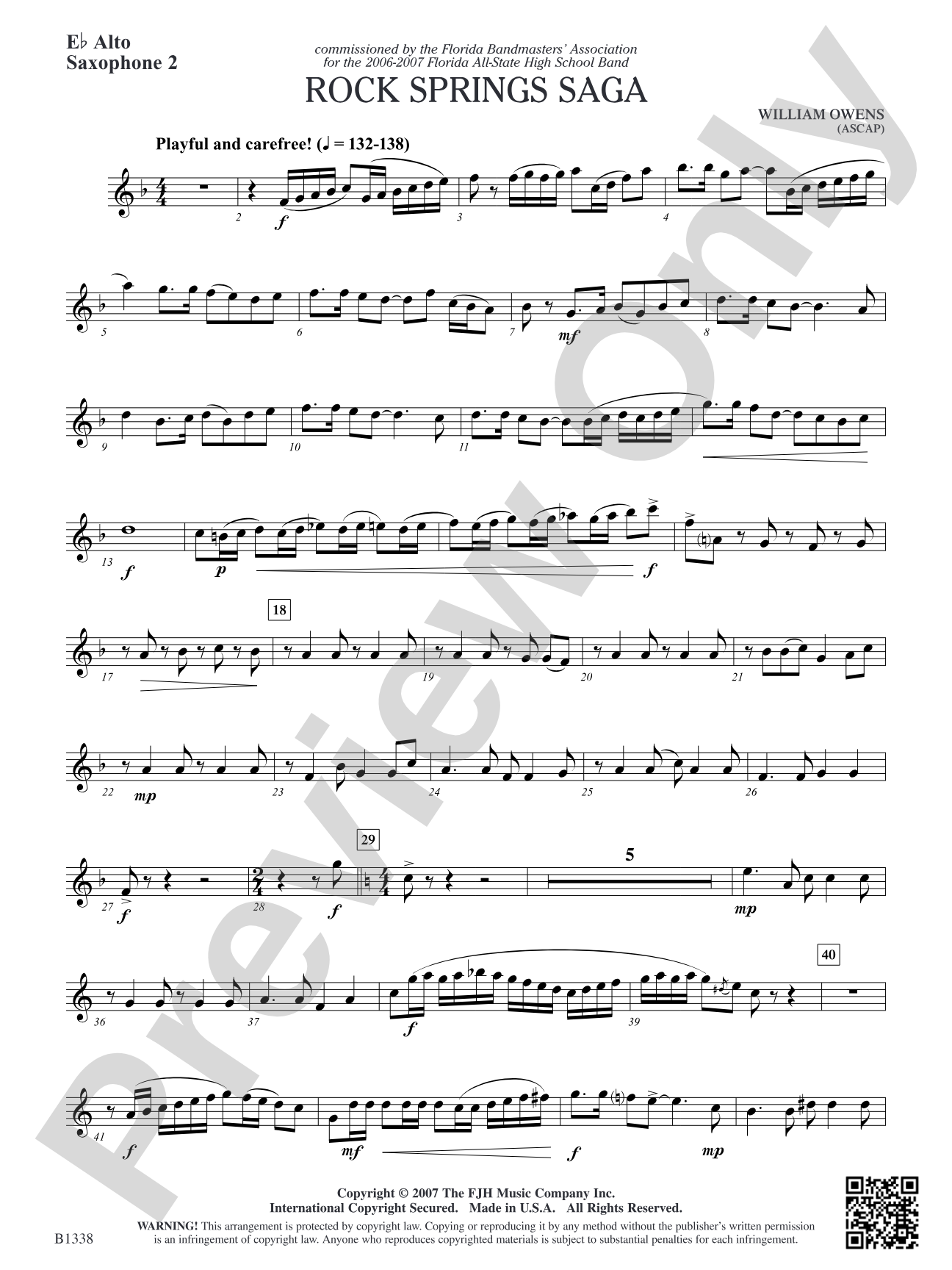

Rock Springs Saga: E-flat Alto Saxophone 2
By William Owens
Grade: 4.5;5
Item: 98-PC-DB1338_AX2
$7.00
Pickup currently not available
Description
Written largely in the Western genre, Rock Springs Saga begins with a brilliant fanfare, which recurs throughout the piece. A whimsical flurry of sounds and dancelike rhythms ensue before the music settles into a catchy Western melody that is passed throughout the ensemble. Just as it becomes familiar, the work bursts into a faster tempo before calming into a mysterious slower section. With the return of the opening tempo, a clever mixture of sounds and rhythms leads back to the opening theme as the piece ends in a whirlwind of sound. Sure to leave a lasting impression!


Rock Springs Saga: E-flat Alto Saxophone 2 isn't in MakeMusic Cloud just yet...but it could be. Let us know you'd like to see it, and you'll help shape what comes next. In the meantime, start a free trial and dive into thousands of interactive titles your students can play along with today.
Request This Title
Tell us you want it.
Start Your Free Trial
Explore everything that's ready to play right now.
Sample Audio
1
Audio File
--:--
0:00
0:00
Sample Video
No sample videos found.
Additional Details
Series:
FJH Symphonic Band
Publisher:
The FJH Music Company, Inc.
SKU:
98-PC-DB1338_AX2
More about this title
About the Composer: William Owens

William Owens grew up in Gary, Indiana and earned his degree from VanderCook College of Music in Chicago before establishing himself as one of the most prolific composers for young ensembles in North America. Over three decades of work as a band director in Texas, combined with extensive clinic and conducting experience across the continent, gave him deep insight into what young musicians need to grow and what audiences want to hear.
Since 1993, Owens has completed more than 300 compositions for concert band, string orchestra, and small ensemble. His work appears on state music festival lists nationwide and has been studied in educational texts as essential repertoire for developing bands. He holds membership in ASCAP, served leadership roles in the Texas Music Educators Association and American Bandmasters Association, and retired in 2014 as a Distinguished Alumnus of his college. He lives in Fort Worth, Texas.
Why we love this
Owens knows exactly how to construct a concert piece that keeps an ensemble engaged and an audience invested. Rock Springs Saga delivers the architectural satisfaction of classical form (opening theme, development, contrasting section, return) wrapped in Western Americana flavor, so students experience structure and storytelling at once. The rhythmic variety and tempo changes prevent this from ever feeling static, making it a smart choice for festivals where judges reward musical sophistication over technical flash alone.
What to expect
Rock Springs Saga captures the energy of the American West through musical storytelling. It opens with fanfare and swagger, shifts into bright, rhythmic vitality, then surprises with introspection before rushing back to triumph. The piece never lingers too long in one emotional space, keeping listeners on their toes while the Western idiom creates immediate, recognizable atmosphere.
Who it's for
This work suits Grade 4.5 to 5 concert bands that have solid fundamentals and are ready to explore longer architectural forms with distinct character sections. Bands preparing for festival competition or concert performance will find this rewarding because it sits at the sweet spot between technical accessibility and musical substance.
How to get the most out of it
- Establish the opening fanfare with precise articulation in the brass; this gesture returns as a structural anchor, so clarity here sets up the entire arc of the piece.
- Shape the Western melody when it emerges as the melodic anchor. Balance the individual instruments carrying it with ensemble support so listeners track it through the texture without losing musical flow.
- Contrast the dancelike middle section distinctly from the mysterious slower section. Use dynamic and tempo clarity to signal to the ensemble that the character has shifted, not just the speed.
- Lock the ensemble's rhythmic precision during the faster tempo section. Subdivide clearly in rehearsal so that the 'whirlwind of sound' at the close feels cohesive rather than chaotic.
How to use it
Program this as a strong opening or midpoint concert number when you want to energize the audience without starting your evening with balladic material. It also works well as a contest selection for bands in the 4.5-5 range seeking repertoire that sounds bigger than its technical requirements and has clear narrative arc. Pairing it with a contrasting lyrical piece or a classical work creates program balance.
Skills your students will build
- Recognizing and executing contrasting formal sections (fanfare, development, slower section, recapitulation)
- Sustaining rhythmic precision through tempo changes and syncopated figures
- Balancing melody with harmonic support across the ensemble
- Responding to stylistic cues (Western genre conventions, dynamic contrast for character definition)
- Maintaining articulation clarity in fast-moving passages and ensemble unison figures