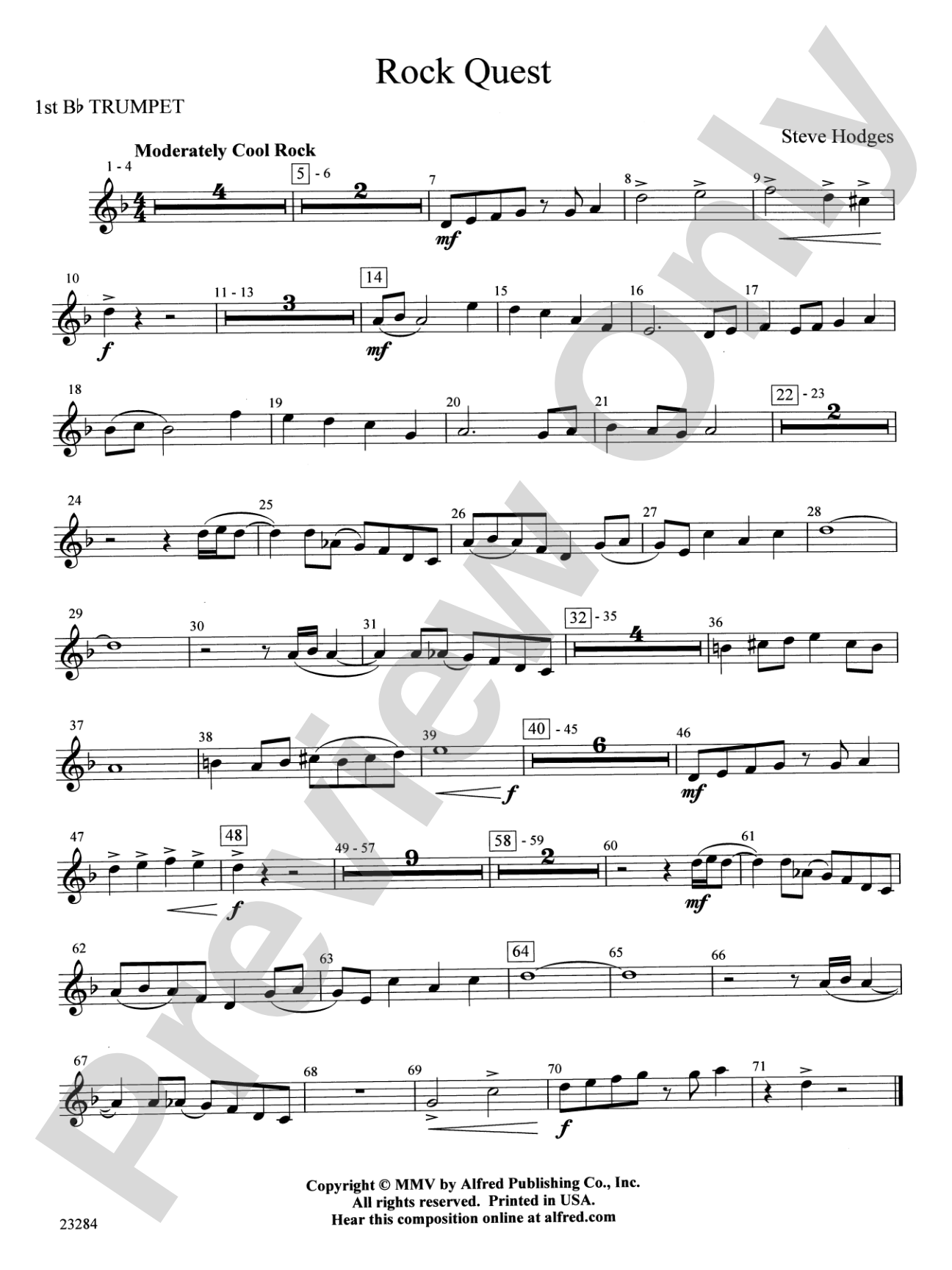
Rock Quest: 1st B-flat Trumpet Sheet Music Preview

Rock Quest: 1st B-flat Trumpet

By Steve Hodges

Grade: 1.5 (Easy)

Item: 00-PC-0000634_T1

Digital Download
$3.00
Description
Your band's desire for some "cool" music can be met with this new dynamic rock piece. An infectious bass line provides a solid foundation for the main theme which also features some nice "blues" licks between phrases. Everybody gets a turn playing the melody, and the harmony parts provide interest as well. A terrific tune to program at any concert!

Don't just read it, hear it, play along with it, and watch your students grow with it. In MakeMusic Cloud, Rock Quest: 1st B-flat Trumpet comes alive with professional accompaniment, adjustable tempo, and built-in practice tools that turn solo practice into real progress.

Sample Audio
0:00
0:00
Sample Video
Additional Details
Series: Challenger Band Series
Publisher: Alfred Music
Page Count: 128
SKU: 00-PC-0000634_T1

More about this title

About the Composer: Steve Hodges

Steve Hodges

Steve Hodges holds degrees from Western Oregon University (Bachelor of Science) and Central Washington University (Master of Music Education). After four decades directing band, choir, and small ensembles across public schools, he transitioned to full-time composition, publishing over 120 concert band works through Alfred Music since 1986.

His compositions have appeared at festivals and state conventions worldwide, with commissions from honor bands and schools spanning Virginia, Iowa, Winnipeg, British Columbia, Oregon, Washington, and North Carolina. Television networks including TBS and ESPN have licensed his music for broadcasts. A member of ASCAP, Hodges has received multiple standard awards and continues to compose from his home in The Dalles, Oregon, where he remains active in community music alongside his family.

Why we love this

Hodges understands exactly what makes a rock piece work for developing bands. The infectious bass line anchors everything, giving your ensemble a groove to lock into, while the melody rotates through the band so every section gets a moment in the spotlight. The blues licks between phrases add character without requiring advanced technique, making this feel like genuine rock rather than a simplified arrangement.

What to expect

Immediate groove and accessibility. The infectious bass line creates forward momentum from the opening measures, while the blues inflections give the piece soul and swing. Every section gets a turn with the main theme, building ownership and excitement across the band.

Who it's for

Concert bands at the 1.5 level looking for energetic, contemporary repertoire that engages students without overwhelming them technically. Directors programming a concert that needs a modern contrast alongside traditional wind band literature will find this accessible enough for developing ensembles while still satisfying audience expectations for excitement.

How to get the most out of it

  • Lock the rhythm section (bass line and percussion) first; once the low end is solid, the rest of the band will sit on the pocket naturally.
  • Shape each melodic entrance as a conversation between sections. When trombone has the main theme, let it breathe; when clarinets take over, give them their own character.
  • The blues licks aren't about speed; nail the articulation and phrasing to capture that authentic blues feel.
  • Keep the energy consistent throughout. Rock pieces live or die on groove, so maintain a steady feel even during the softer harmonic sections.

How to use it

Program this after a slower, lyrical opening piece to energize your concert midway through. The rock setting and relatively quick learning curve make it ideal for spring concerts when you want engaging music without extended rehearsal time, or use it to close a program on an uplifting, contemporary note.

Skills your students will build

  • Playing with a steady, groove-oriented pulse rather than metronomic precision
  • Blues phrasing and articulation (bent notes, slide approaches, rhythmic clarity)
  • Passing the melody confidently between sections while maintaining musical continuity
  • Balancing harmonic support with independence within a rock ensemble texture

You May Also Like