Rock On Cover Image

Rock On: Jazz Ensemble Conductor Score, Parts & CD

$69.00 USD
Sale price  $69.00 USD Regular price 
Skip to product information
Rock On Cover Image

Rock On: Jazz Ensemble Conductor Score, Parts & CD

By Jim Snidero / arr. Mike Titlebaum

Item: 01-ADV34009

$69.00
Shipped

One moment…

Description
"Rock On" is written in a medium-up tempo rock-boogaloo style. The solo section features the tenor saxophone but can be opened up for any instrument. The very easy solo changes and the style are ideal to encourage young players. Then the whole band continues with an impressive ensemble section and a short coda. "Rock On" is based on the etude with the same name from Jim Snidero's Easy Jazz Conception Series. First trumpet: F (top of staff).

Rock On: Jazz Ensemble Conductor Score, Parts & CD isn't in MakeMusic Cloud just yet...but it could be. Let us know you'd like to see it, and you'll help shape what comes next. In the meantime, start a free trial and dive into thousands of interactive titles your students can play along with today.

Sample Pages

Sample Audio

track 1

0:00
0:00
Sample Video
Additional Details
Series: Advance Music: Big Band Plus
Publisher: Advance Music
ISBN10: 3-892214-98-0
ISBN13: 978-3-892214-98-4
UPC: 805095340099
SKU: 01-ADV34009

More about this title

About the Composer: Jim Snidero
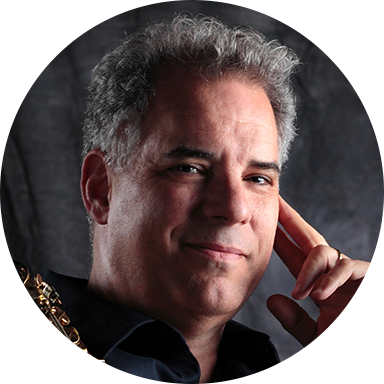
Jim Snidero

Jim Snidero has spent more than three decades establishing himself as a leading voice in jazz performance, composition, and education. As an alto saxophonist and bandleader, he has earned recognition from Downbeat Magazine as both a "master musician" and "alto saxophone virtuoso," with a placement in the 2017 Downbeat Critic's Poll that reflects his sustained influence on the international jazz scene.

Snidero's path to prominence began in Camp Springs, Maryland, where early musical training at home and in school led him to study with Phil Woods during his teenage years and later with Dave Liebman. After joining the One O'Clock Lab Band at the University of North Texas, he relocated to New York in 1981 and quickly became a sought-after sideman, recording with Brother Jack McDuff, the Mingus Big Band, the Toshiko Akiyoshi Jazz Orchestra, Eddie Palmieri, and others. His own recordings, beginning with On Time (1984), demonstrate a commitment to musical consistency and stylistic range. Beyond his work as a performer and recording artist, Snidero has become an influential educator and composer of accessible jazz literature for developing ensembles.

Why we love this

Rock On balances accessibility with genuine jazz style in a way that builds young players' confidence without compromising musicality. The flexible tenor saxophone solo expands naturally to any soloist in your section, making it an inclusive choice for mixed-ability groups, and the boogaloo rhythm is infectious enough to keep energy high while the straightforward changes give soloists room to succeed rather than struggle.

What to expect

Medium-up tempo energy with a tight, driving boogaloo pocket that makes you want to move. The solo section has the intimate feel of a conversation between one voice and the band, while the ensemble section kicks into a more unified, powerful groove that builds to a satisfying close.

Who it's for

Young jazz ensembles and developing big bands who are ready to tackle a real jazz style but need material with straightforward changes and a strong, repeatable groove. This work is ideal for student soloists building confidence in improvisation and for conductors looking to program accessible jazz that doesn't sound simplified.

How to get the most out of it

  • Lock the rhythm section tight on the boogaloo pocket; the groove is everything, so have your bass and drums anchor this feel before layering horns on top.
  • Encourage the tenor saxophone soloist (or your alternate soloist) to listen closely to the recorded example on the CD to internalize the style and phrasing, then step back and let them find their own voice within it.
  • Bring out the articulation contrast in the ensemble figures that punctuate the solo section; crisp tonguing will make the band's responses snap.
  • Keep the coda moving with momentum rather than rushing; the shortness of it means precision and clarity matter more than speed.

How to use it

Use this as a showcase feature on a concert that mixes classic big band with contemporary jazz repertoire, or as a stepping stone piece when introducing your ensemble to rock-influenced jazz styles. It works equally well as a second-semester offering for a developing jazz band or as a fun change-of-pace selection on a clinic or festival performance.

Skills your students will build

  • Boogaloo style and rock-influenced swing pocket
  • Solo improvisation over simple jazz changes
  • Section cohesion in ensemble figures and background parts
  • Listening and responding to soloists as a rhythm section and horn section
  • Stylistic phrasing and articulation specific to jazz-rock fusion

You May Also Like