Rock Island Trail: Flute Sheet Music Preview

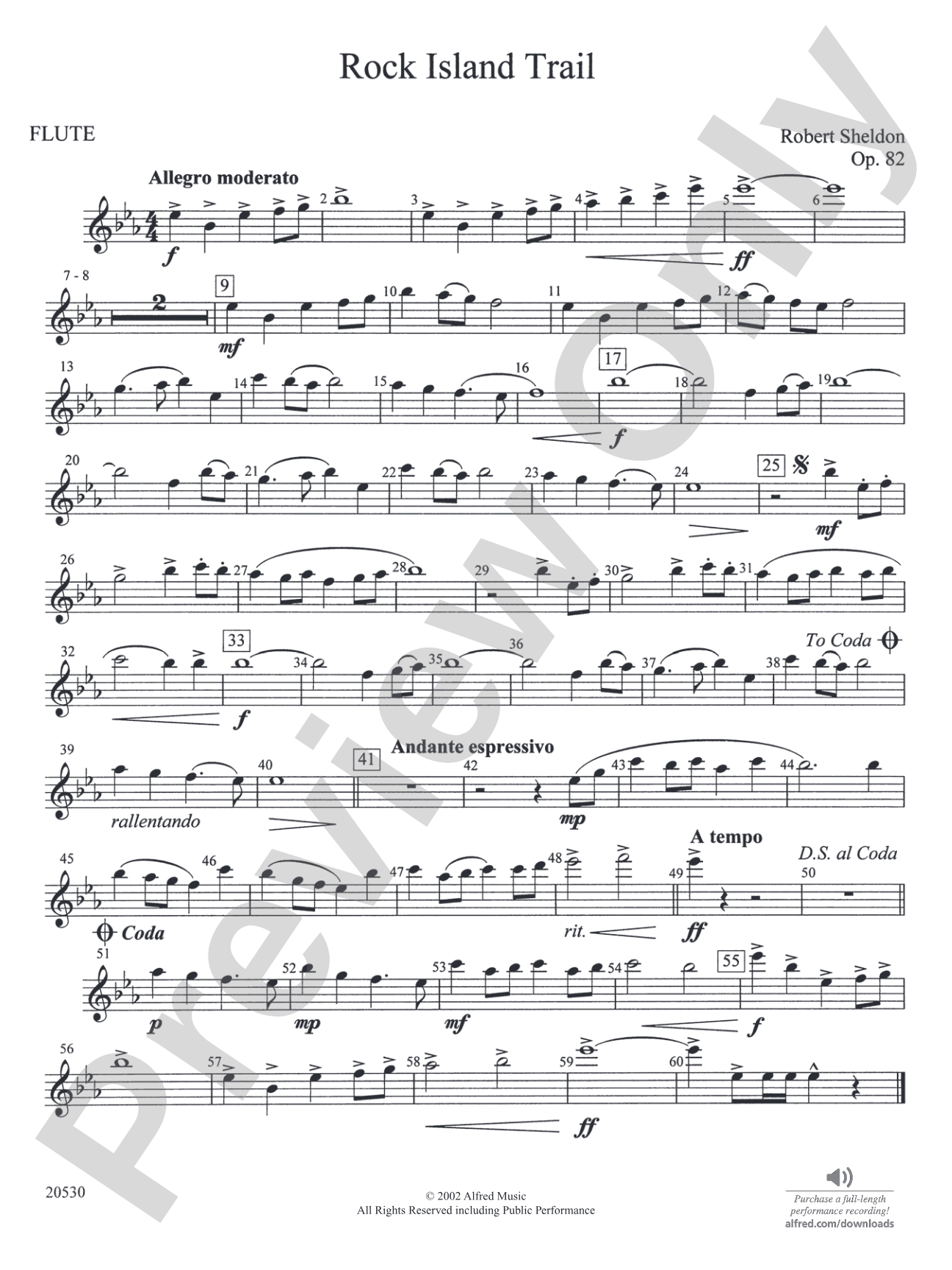
Rock Island Trail: Flute

Music by Robert Sheldon

Grade: 1.5 (Easy)

Item: 00-PC-0018747_F1

Digital Download
$3.00
Description
Grab your boots and get ready to take a voyage on the Rock Island Trail. Robert Sheldon has crafted a piece for your young band that sounds mature and complex. The rhythmic drive is kept alive in your percussion section, while the other sections play the well-crafted melodies. Another gem in the young band repertoire.

Rock Island Trail: Flute isn't in MakeMusic Cloud just yet...but it could be. Let us know you'd like to see it, and you'll help shape what comes next. In the meantime, start a free trial and dive into thousands of interactive titles your students can play along with today.

Sample Audio
0:00
0:00
Sample Video
Additional Details
Series: Challenger Band Series
Publisher: Alfred Music
Page Count: 120
SKU: 00-PC-0018747_F1

More about this title

About the Composer: Robert Sheldon

Robert Sheldon

Robert Sheldon's compositions appear on contest lists and concert programs across the globe, performed by thousands of ensembles each year. His awards from the American School Band Director's Association, Phi Beta Mu, and ASCAP reflect his sustained impact on wind band literature. Beyond composing, Sheldon co-authored Sound Innovations for Concert Band and maintains an active schedule as a guest conductor for honor bands and a clinician at universities and state music education conferences.

Sheldon has conducted his own works at Carnegie Hall, Orchestra Hall, Boston Symphony Hall, the Sydney Opera House, and the Kennedy Center. His work takes him regularly to Japan, Canada, Italy, Germany, Australia, and China. In 2020, VanderCook College of Music awarded him an honorary doctorate in recognition of his contributions to music education and composition.

Why we love this

Sheldon proves that Grade 1.5 repertoire doesn't require simplification to engage young musicians. The piece balances accessible writing with genuine musical substance: a rhythmic energy that lives in the percussion while other sections carry real melodic content. This is the kind of early-grade piece that makes students sound and feel more accomplished than they might expect.

What to expect

The piece evokes travel and forward momentum, with a rhythmic vitality that propels the ensemble forward. Melodies emerge clearly against a steady, driving backdrop, creating an experience that feels expansive and purposeful rather than mechanical or spare.

Who it's for

This score and parts set serves conductors of beginning concert bands, particularly those in grades 5-7 or early high school ensembles working at the Grade 1.5 level. The writing accommodates younger players while avoiding the thin sound typical of ultra-easy repertoire.

How to get the most out of it

  • Keep the percussion section locked and precise through the rhythmic figures. Sheldon counts on their consistency to anchor the ensemble while the melodic sections phrase above.
  • Shape the melodies with intentional phrasing rather than playing them straight through. Even at this grade level, singers in the brass and woodwinds will respond to clear direction about where phrases breathe.
  • Resist the urge to slow tempos where rhythmic patterns appear complex. The drive of the piece depends on confidence in the pulse; rehearse the tricky rhythms at performance tempo from the start.

How to use it

Rock Island Trail works well as an opening selection for a young band concert, setting an energetic tone without demanding technical brilliance. It also fits naturally alongside other Grade 1.5-2 selections on a mixed-repertoire program, offering a piece that sounds polished and complete without requiring extensive rehearsal time.

Skills your students will build

  • Maintaining rhythmic precision in ensemble contexts
  • Executing rhythmic patterns across multiple instrumental families simultaneously
  • Sustaining sustained tones while keeping melodic shape and direction
  • Balancing individual voice parts within a larger harmonic framework
  • Responding to conductor cues that shape phrase direction and musical intent

You May Also Like