
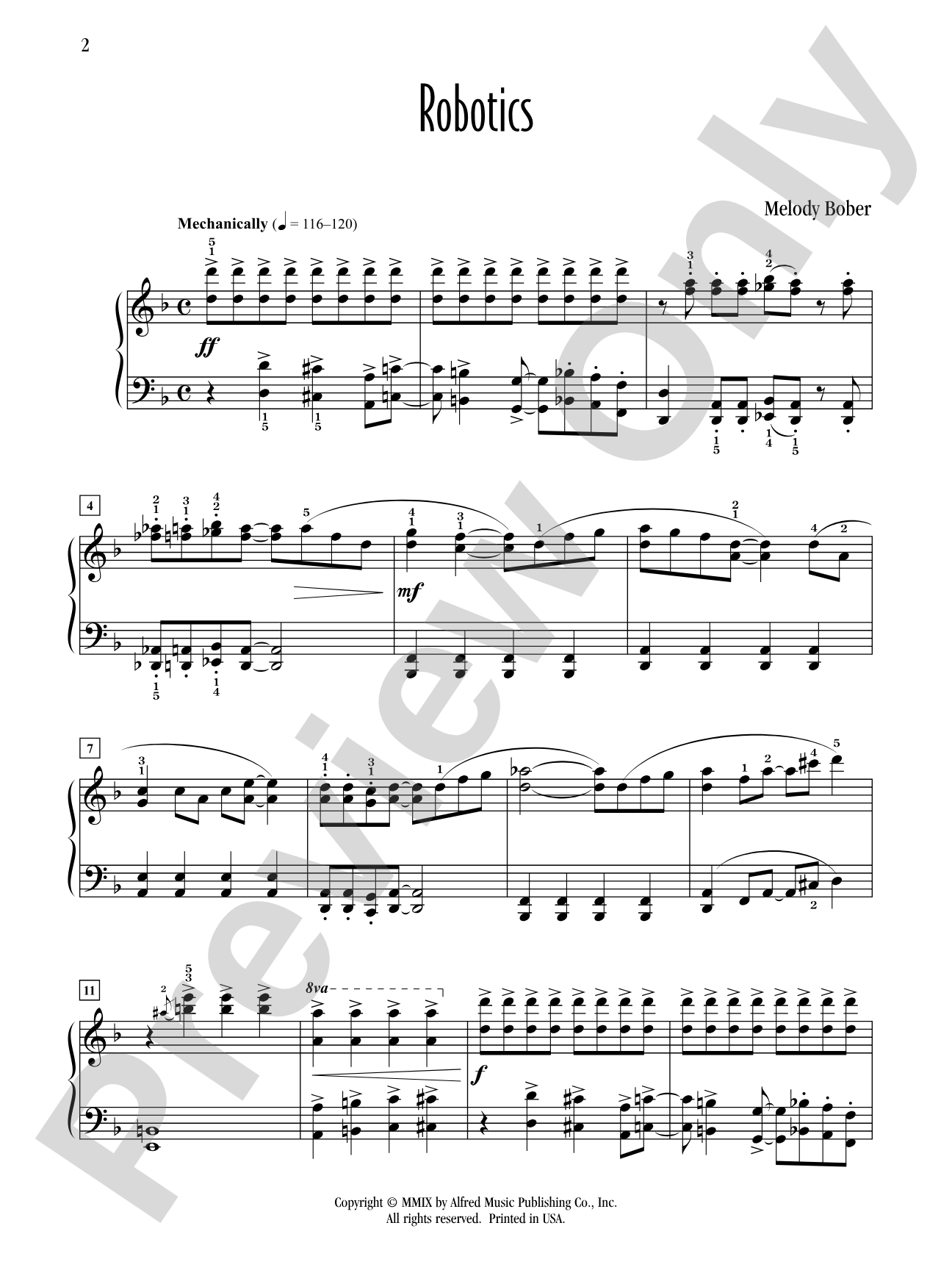

Robotics - Piano Solo: Piano
By Melody Bober
Level: Late Intermediate
Item: 00-PB-0000778
$3.50
Pickup currently not available
Related Items
Robotics: Piano Sheet |
$3.50
|
View |
Description
Turn your piano into a well-oiled machine with the sounds of octaves, accents, chromatics and mild dissonance. Written in D minor and 4/4 meter, this toccata will appeal to students with its big sound and "show-off" style that includes two glissandi. This one is sure to be a hit at recitals and contests! A Federation Festivals 2016-2020 selection. A Federation Festivals 2020-2024 selection.


Robotics - Piano Solo: Piano isn't in MakeMusic Cloud just yet...but it could be. Let us know you'd like to see it, and you'll help shape what comes next. In the meantime, start a free trial and dive into thousands of interactive titles your students can play along with today.
Request This Title
Tell us you want it.
Start Your Free Trial
Explore everything that's ready to play right now.
Sample Audio
1
Robotics
--:--
Robotics
0:00
0:00
Sample Video
No sample videos found.
Additional Details
Series:
Signature Series
Publisher:
Alfred Music
Page Count:
4
SKU:
00-PB-0000778
More about this title
About the Composer: Melody Bober

Melody Bober holds degrees in music education from the University of Illinois at Urbana-Champaign and in piano performance from Minnesota State University, Moorhead. Her training under pianists Joel Shapiro and Andrew Froelich, alongside music educator Mary Hoffman and jazz pianist Tony Caramia, shaped her distinctive approach to composition.
Bober brings two decades of public school teaching experience and university-level instruction to her work as a clinician, composer, and private studio instructor. Active as a church pianist and former music director, she has built a reputation across North America for creating motivational piano pieces that deepen students' musical understanding. Her compositions appear regularly on festival selections and competition programs.
Why we love this
Robotics delivers the mechanical precision and theatrical flair that late intermediate students crave, with enough technical flash to feel genuinely impressive at recital or festival. The writing is scrupulously crafted to maximize sound without requiring advanced hand independence or extreme fingering challenges, making it rewarding to learn and thrilling to perform. Bober's use of octaves, strategic dissonance, and two glissandi creates a memorable "show-off" moment that audiences remember long after the final chord.
What to expect
Robotics pulses with mechanical energy and controlled power, evoking the precise, repetitive motion of machinery in motion. The D minor tonality gives it a slightly edgy character that pairs well with the driving rhythm, while the glissandi and occasional dissonance keep listeners engaged and slightly off-balance in the best way.
Who it's for
Late intermediate pianists preparing for a recital or festival competition will find this toccata perfectly calibrated to their level. The piece rewards solid technique and musicality without requiring virtuosic skill, making it ideal for students ready to step into more sophisticated repertoire with immediate payoff.
How to get the most out of it
- Shape the octave passages with consistent weight and clarity; they form the harmonic backbone, so each note must speak without muddiness even at tempo.
- Land the accents with precision but avoid excessive force; they should punch through the texture, not overshadow the melodic line.
- Execute both glissandi with control and intention. Practice the glissandi slowly to internalize the exact starting and landing pitches, then add speed gradually to keep them clean and confident.
- Allow the chromatic passages to breathe slightly in the approach; clarity here prevents the mild dissonance from sounding accidental rather than compositional.
How to use it
Slot this into a recital as a standout solo piece that gives variety and excitement to a program of traditional classical or romantic works. Its contemporary compositional voice and competitive appeal make it especially strong for festival entries where technical display and memorable performance earn recognition.
Skills your students will build
- Octave independence and evenness across both hands
- Accent placement and dynamic shaping within a consistent tempo
- Chromatic passage clarity and finger independence
- Controlled glissando technique with accurate pitch targeting
- Maintaining rhythmic precision in 4/4 meter with syncopated accent patterns
- Performance confidence and theatrical presence under pressure