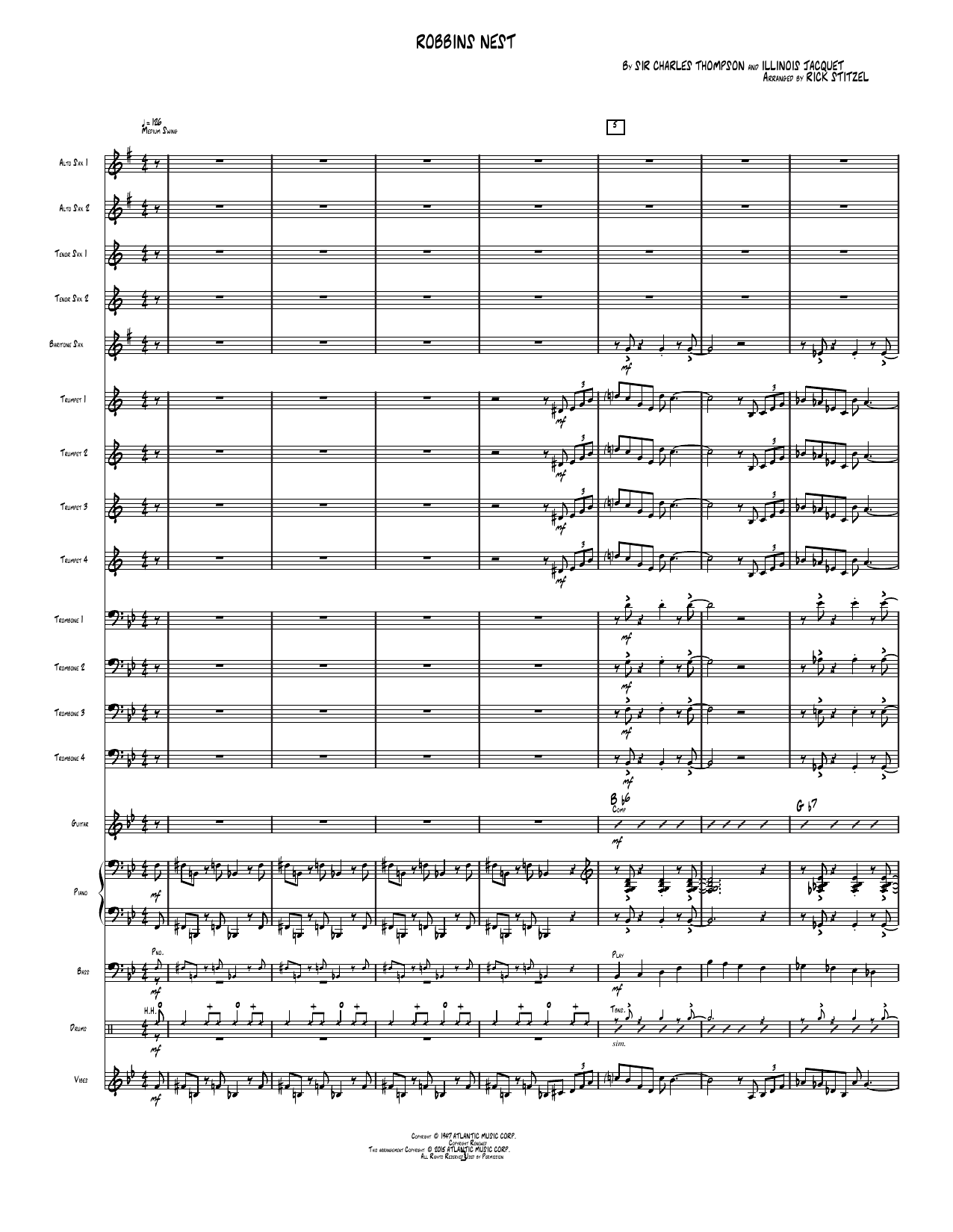
Robbins Nest Sheet Music Preview

Robbins Nest: Jazz Ensemble Conductor Score & Parts

By Illinois Jacquet / By Sir Charles Thompson / As performed by Count Basie / Arranged by Rick Stitzel

Grade: 3

Item: 35-PK00426975

Digital Download
$45.00

Buy Extra Parts (Digital PDF Download)

Product Price Quantity
Robbins Nest - Full Score $45.00

Parts Added to Cart!

Description
Robbins Nest

Robbins Nest: Jazz Ensemble Conductor Score & Parts isn't in MakeMusic Cloud just yet...but it could be. Let us know you'd like to see it, and you'll help shape what comes next. In the meantime, start a free trial and dive into thousands of interactive titles your students can play along with today.

Sample Audio
No sample audio found.
Sample Video
Additional Details
Publisher: Hal Leonard
SKU: 35-PK00426975

More about this title

About the Composer: Illinois Jacquet

Illinois Jacquet emerged as one of the most influential tenor saxophonists of the swing and early bebop eras, known for his powerfully expressive tone and rhythmically inventive solos. His 1942 recording of "Flying Home" became a landmark moment in jazz history, establishing him as a virtuoso capable of thrilling audiences with both technical command and emotional directness. Jacquet spent decades as a bandleader and session musician, collaborating with Count Basie, Lionel Hampton, and countless others while remaining a tireless advocate for jazz education.

Why we love this

Rick Stitzel's arrangement captures the infectious groove and straightforward swing sensibility that made "Robbins Nest" a favorite among Basie's big band, while keeping it accessible for developing ensemble players. The orchestration balances showcase moments for soloists with solid ensemble passages that require careful listening and section blend rather than technical gymnastics. Directors appreciate arrangements that deliver authentic jazz idiom without sacrificing pedagogical value, and this one delivers both.

What to expect

The piece radiates the confidence and joy of a tune that swings naturally, never forcing the groove. There's a lightness to it even when the ensemble builds in volume, giving players room to breathe and find their pocket without fighting the arrangement.

Who it's for

Jazz ensembles at the intermediate level who are ready for standard repertoire with real swing history behind it, as well as directors seeking material that connects to the Count Basie legacy without overwhelming young players. This arrangement works equally well for students learning to improvise and those who simply want to experience authentic big band writing.

How to get the most out of it

  • Establish a relaxed but driving feel by keeping the tempo steady and letting the rhythm section lock the groove before worrying about dynamic shape. Rushing or dragging will undermine the swing pocket.
  • Balance the melody line against the background figures in the saxes and trombones; soloists should stand out clearly but never sound separated from the ensemble context.
  • Shape solo sections by maintaining the written dynamics and articulations even when taking individual liberty with phrasing. Jacquet's style invited expression, not indulgence.
  • Attend to section intonation during the ensemble hits and unison passages. Brass and reeds blending on these moments requires tuning precision that mirrors what the classic Basie sound demanded.

How to use it

Pair this with other Basie-era standards to build a concert set that celebrates the swing era on its own terms, or use it as a centerpiece for a unit on big band history and the transition from swing to bebop. The Grade 3 difficulty makes it ideal for mid-season programming when fundamentals are solid and players are ready to tackle style and interpretation.

Skills your students will build

  • Swing eighth-note feel and rhythmic precision within an ensemble context
  • Listening to and balancing against background figures while playing a melody or solo
  • Intonation adjustments in brass and reed blend during ensemble sections
  • Interpretation of jazz articulation and phrasing as written in the score
  • Understanding of big band voicing and sectional roles

You May Also Like