
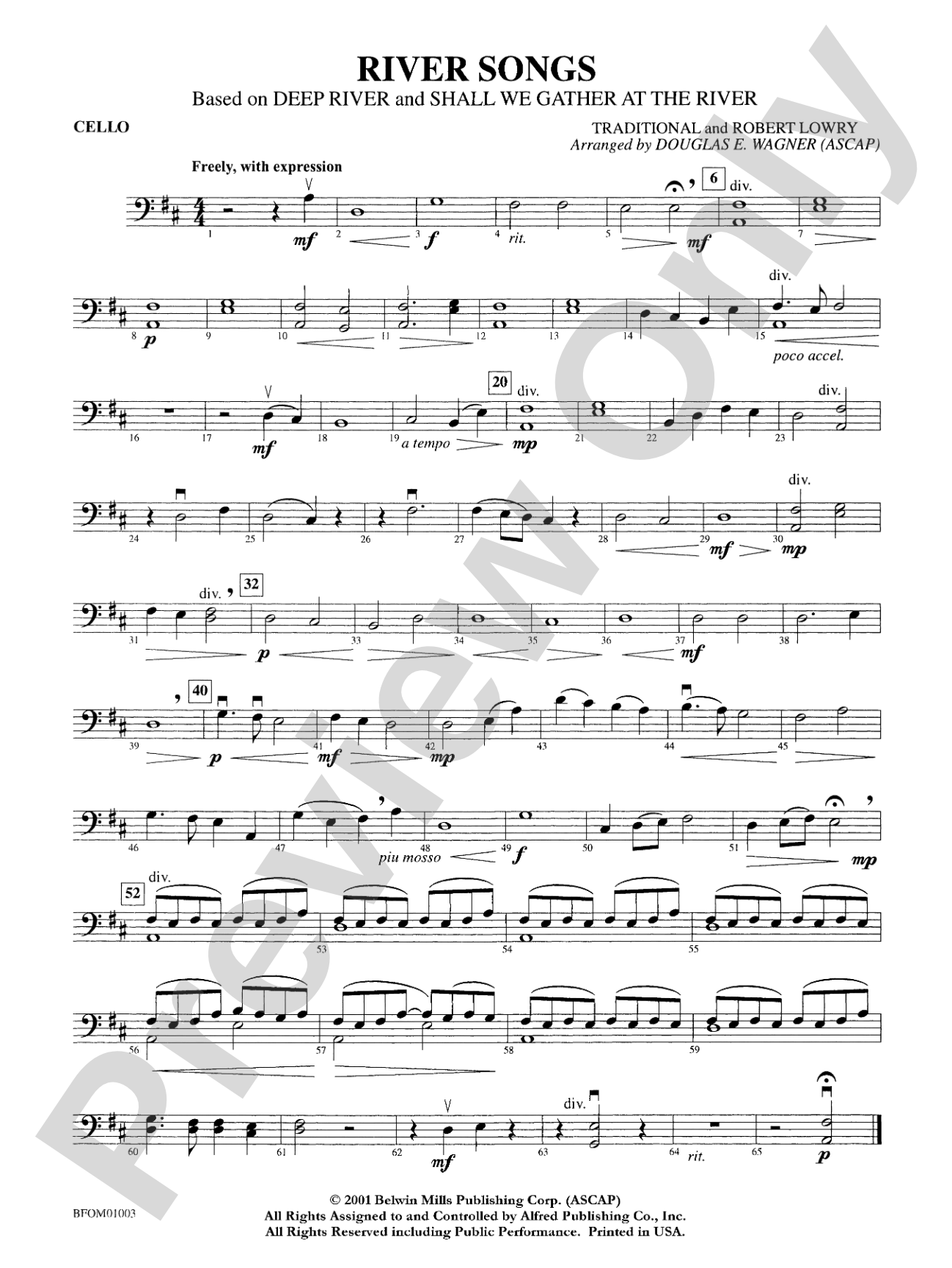

River Songs (based on "Deep River" and "Shall We Gather at the River"): Cello
Arr. Douglas E. Wagner
Grade: 2.5
Item: 00-PC-0002224_VC1
$3.00
Pickup currently not available
Description
Two appropriate works, "Deep River" and "Shall We Gather at the River," were chosen as musical witnesses to our common bonds in this life and beyond. A stirring arrangement for intermediate orchestra, characterized with flowing melodic lines traveling throughout the orchestra. The arrangement can be performed by strings alone or with any combination of winds. Most memorable.


Don't just read it, hear it, play along with it, and watch your students grow with it. In MakeMusic Cloud, River Songs (based on "Deep River" and "Shall We Gather at the River"): Cello comes alive with professional accompaniment, adjustable tempo, and built-in practice tools that turn solo practice into real progress.
Open in the Player
Jump straight in and assign it today.
Start Your Free Trial
Open this title and explore the full library in minutes.
Sample Audio
1
Audio File
--:--
0:00
0:00
Sample Video
No sample videos found.
Additional Details
Series:
Belwin Intermediate String/Full Orchestra
Publisher:
Alfred Music
Page Count:
110
SKU:
00-PC-0002224_VC1
More about this title
About the Arranger: Douglas E. Wagner

Douglas E. Wagner began his career as a high school music director and administrator in Chicago before transitioning to full-time composition. He holds degrees from Butler University and spent three decades in the classroom before devoting himself entirely to writing and arranging music.
Since 1973, Wagner has published more than 3,500 works across virtually every ensemble type: school and church choirs, concert bands, orchestras, handbell ensembles, organ, piano, and vocal music. His output has reached well over seventeen million copies worldwide, with performances documented on radio, television, and concert stages throughout the United States and internationally. He now resides in Indianapolis with his wife, Sandy.
Why we love this
Wagner's gift for moving melodies across the full orchestra shines here, creating lines that feel organic whether you're performing with strings alone or adding winds gradually. The pairing of these two spirituals gives you a single work that works equally well at festival adjudication or as part of a memorial concert, a spring pops program, or a holiday season performance. The Grade 2.5 difficulty never feels compromised; this arrangement respects the depth of the source material while remaining accessible.
What to expect
Contemplative and grounded. The flowing melodic lines create a sense of continuity and connection, moving unhurried through space without ever feeling static. There's an underlying dignity in the way these melodies unfold, inviting the ensemble and audience into something larger than the moment.
Who it's for
Orchestras with a solid Grade 2.5 foundation, especially those balancing festival requirements with concert repertoire that carries emotional weight. It works equally well for directors building mixed instrumentation rehearsals and those with committed string sections looking for spiritual content beyond the standard classical canon.
How to get the most out of it
- Balance the primary melody across sections rather than letting it lodge in one choir. The piece gains its character from seeing how each instrumental color carries the tune forward.
- Take time with the transitions between the two spirituals. A slight ritardando into the new section helps audiences recognize the shift without disrupting the contemplative mood.
- Encourage wind players to enter gradually if you're building from strings alone. Stagger the additions of woodwinds, then brass, so the texture expands naturally rather than arriving all at once.
- Shape the phrases through dynamic contour, not tempo change. These melodies breathe best when your ensemble traces the arc of each line together.
How to use it
Nest this alongside other Wagner orchestral arrangements for a complete concert, or use it as an anchor for a thematic program about American spirituals and their place in concert music. It also serves as an ideal contest selection when festivals request intermediate-level sacred music with substance.
Skills your students will build
- Balancing melody across multiple instrumental choirs
- Sustaining longer phrases without losing direction
- Blending strings with winds in graduated instrumental combinations
- Shaping phrasing through dynamic contour rather than tempo manipulation
- Maintaining ensemble unity across contrasting sections and tempo areas