
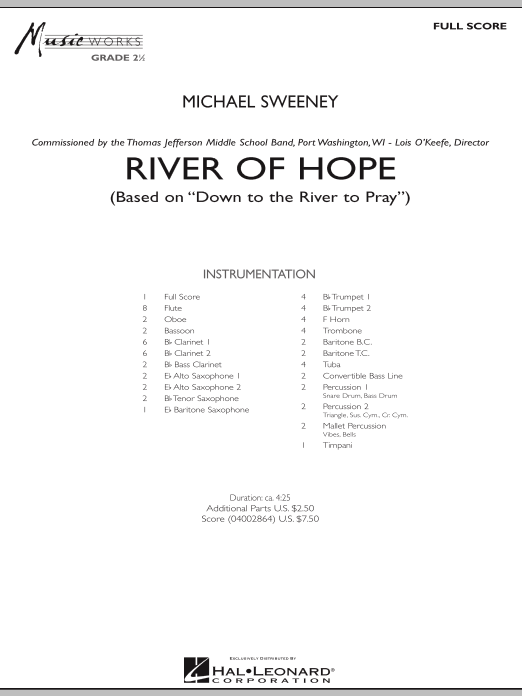

River of Hope: Concert Band Conductor Score & Parts
By Michael Sweeney
Grade: 2.5
Item: 35-PK00125280
$60.00
Pickup currently not available
Buy Extra Parts (Digital PDF Download)
| Product | Price | Quantity |
|---|---|---|
| River of Hope - Full Score | $10.00 | |
| River of Hope - Flute | $6.00 | |
| River of Hope - Oboe | $6.00 | |
| River of Hope - Bassoon | $6.00 | |
| River of Hope - Bb Clarinet 1 | $6.00 | |
| River of Hope - Bb Clarinet 2 | $6.00 | |
| River of Hope - Bb Bass Clarinet | $6.00 | |
| River of Hope - Eb Alto Saxophone 1 | $6.00 | |
| River of Hope - Eb Alto Saxophone 2 | $6.00 | |
| River of Hope - Bb Tenor Saxophone | $6.00 | |
| River of Hope - Eb Baritone Saxophone | $6.00 | |
| River of Hope - Bb Trumpet 1 | $6.00 | |
| River of Hope - Bb Trumpet 2 | $6.00 | |
| River of Hope - F Horn | $6.00 | |
| River of Hope - Trombone | $6.00 | |
| River of Hope - Baritone B.C. | $6.00 | |
| River of Hope - Baritone T.C. | $6.00 | |
| River of Hope - Tuba | $6.00 | |
| River of Hope - Convertible Bass Line | $6.00 | |
| River of Hope - Percussion 1 | $6.00 | |
| River of Hope - Percussion 2 | $6.00 | |
| River of Hope - Mallet Percussion | $6.00 | |
| River of Hope - Timpani | $6.00 |
Parts Added to Cart!
Description
The centerpiece of this work for band is the memorable Appalachian folk hymn "Down to the River to Pray," which was featured in the 2000 film "O Brother, Where Art Thou?" Interspersed with this melody is a faster original theme that provides a complementary yet contrasting tone to the emotional statements of the folk hymn. Richly scored and flowingly beautiful. Dur: 4:25


River of Hope: Concert Band Conductor Score & Parts isn't in MakeMusic Cloud just yet...but it could be. Let us know you'd like to see it, and you'll help shape what comes next. In the meantime, start a free trial and dive into thousands of interactive titles your students can play along with today.
Request This Title
Tell us you want it.
Start Your Free Trial
Explore everything that's ready to play right now.
Sample Audio
No sample audio found.
Sample Video
No sample videos found.
Additional Details
Publisher:
Hal Leonard
SKU:
35-PK00125280
More about this title
About the Composer: Michael Sweeney
Michael Sweeney has built a reputation as one of the most prolific and inventive composers for school bands. His gift for balancing accessibility with sophisticated orchestration makes his music equally rewarding to teach and perform, whether the ensemble is competitive or community focused.
Sweeney's deep knowledge of band instrumentation allows him to write idiomatically for every section while maintaining clarity of texture. His arrangements and original compositions consistently find their way into festival programs and concert halls because they honor both the capability and the potential of young musicians.
Why we love this
The juxtaposition of a sacred folk melody with a contrasting original theme gives you two distinct musical worlds to explore, yet they coexist naturally within a single unified work. At Grade 2.5, Sweeney provides rewarding material for developing ensembles without sacrificing musical substance; the rich scoring demands careful balance and attention to phrasing rather than technical flash.
What to expect
The opening carries the quiet dignity of a community gathered to pray, with hymnal harmonies that feel timeless and rooted. When the faster original theme enters, it brings forward momentum and energy without losing the contemplative undercurrent. Throughout, there's a sense of hope embedded in the familiar melody, amplified by modern orchestration that respects tradition while refreshing it.
Who it's for
Concert bands working at the intermediate level who want substantive repertoire with emotional resonance. This work appeals equally to ensembles seeking programming with a spiritual or folk music orientation and to directors hunting for material that develops musicianship without excessive technical demands.
How to get the most out of it
- Allow the Appalachian hymn to breathe. The melody's power comes from its simplicity, so resist the urge to rush or add unnecessary articulation. Let your woodwinds and brass play with a singing quality.
- The original theme offers a chance to explore contrast in tempo and character. Make sure the transition between sections feels intentional, not abrupt; this clarity helps audiences understand the architectural design.
- Voice the richer harmonic textures carefully. With four minutes and twenty-five seconds of music, subtle dynamic shaping across phrases prevents the arrangement from feeling static.
- Attend to balance when multiple melodic lines occur simultaneously. Sweeney's scoring often layers material, so sectional rehearsal focused on whose voice leads in each moment pays dividends.
How to use it
This piece fits naturally into a program exploring American roots music or spiritual traditions, pairing well with other folk-based arrangements or original works in the same vein. Its four-and-a-half-minute length makes it ideal as an opening number that sets a reflective tone for the concert, or as a centerpiece that shifts the emotional landscape between lighter and heavier works.
Skills your students will build
- Legato phrasing and lyrical singing quality on a sustained melody
- Sectional balance when multiple melodic lines occur simultaneously
- Tempo flexibility and understanding contrast between related thematic material
- Dynamic shaping across longer phrases to maintain listener engagement