
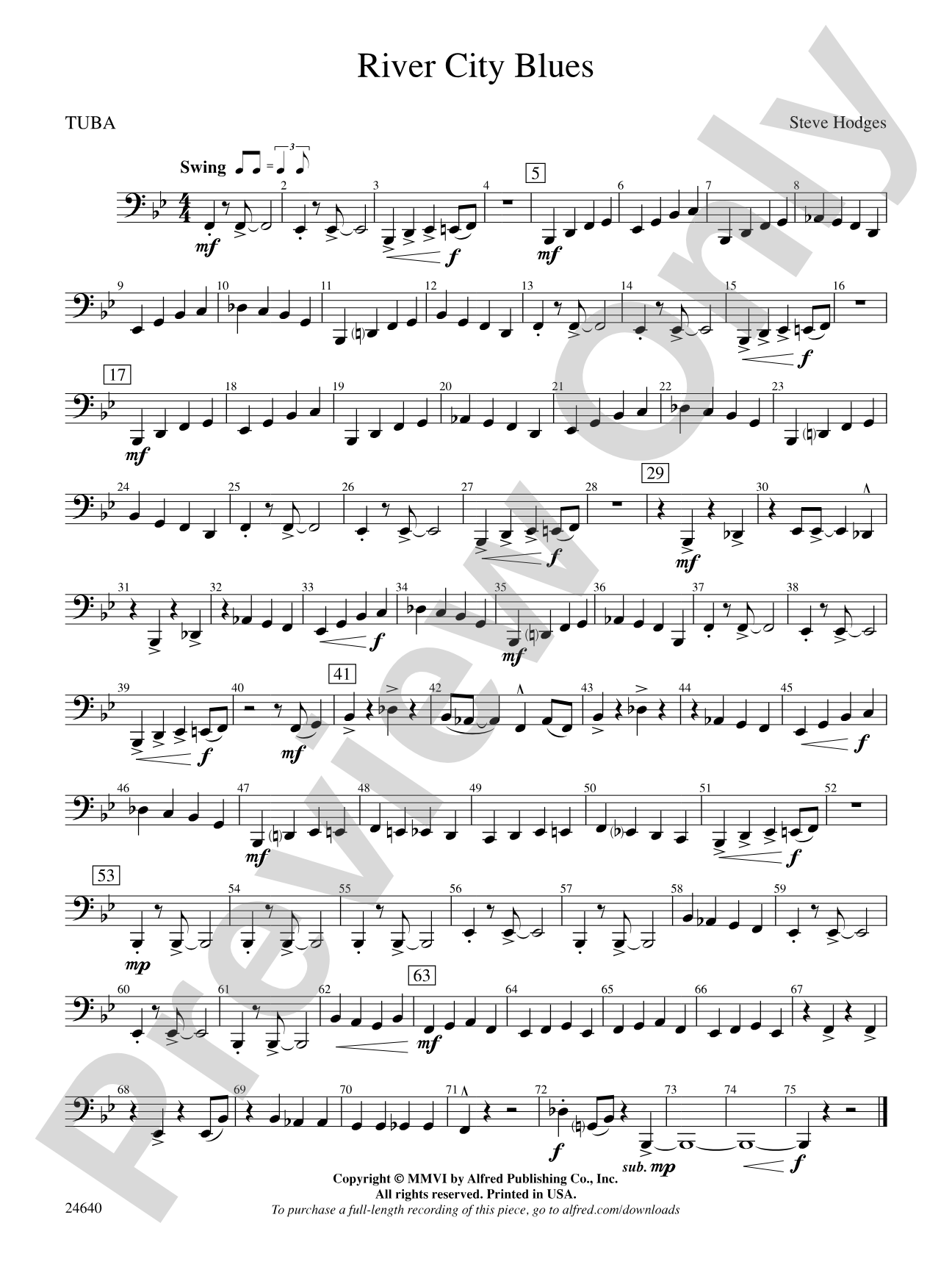

River City Blues: Tuba
By Steve Hodges
Grade: 1.5 (Easy)
Item: 00-PC-0000808_TB1
$3.00
Pickup currently not available
Description
Here is an effective way to introduce some standard jazz band elements to your concert band. Featuring a walking bass line, call and response, percussion fills, blues scale patterns, dynamic contrasts and 'sectional solo lines,' River City Blues will be a piece that your band will thoroughly enjoy working up. A great change of pace for any concert!


Don't just read it, hear it, play along with it, and watch your students grow with it. In MakeMusic Cloud, River City Blues: Tuba comes alive with professional accompaniment, adjustable tempo, and built-in practice tools that turn solo practice into real progress.
Open in the Player
Jump straight in and assign it today.
Start Your Free Trial
Open this title and explore the full library in minutes.
Sample Audio
1
Audio File
--:--
0:00
0:00
Sample Video
No sample videos found.
Additional Details
Series:
Challenger Band Series
Publisher:
Alfred Music
Page Count:
60
SKU:
00-PC-0000808_TB1
More about this title
About the Composer: Steve Hodges

Steve Hodges holds degrees from Western Oregon University (B.S.) and Central Washington University (M.M. Education). After four decades directing bands, choirs, and small ensembles across public school levels, he retired to focus on composition and arrangement, having since created over 120 concert band works published by Alfred Music alongside choral arrangements for Staff Music and Shawnee Press.
His compositions have appeared at festivals and state music conventions worldwide, with commissions from honor bands and schools spanning Virginia, Iowa, Winnipeg, British Columbia, Oregon, Washington, and North Carolina. His work has also been featured on TBS and ESPN broadcasts. Hodges holds ASCAP membership and has received multiple recognitions for his contributions to music education. He remains active in community music in The Dalles, Oregon, alongside his family.
Why we love this
Hodges writes with a genuine understanding of what bands at this level need to stay engaged. River City Blues introduces authentic jazz vocabulary without overwhelming young players; the walking bass, call-and-response passages, and sectional solos give every section something meaningful to play rather than relegating anyone to filler parts. The blues framework feels natural to teach, and the contrast between swung sections and straighter passages keeps rehearsals fresh.
What to expect
River City Blues swings with a relaxed, easygoing groove that feels more like a jam session than a concert march. The walking bass and percussion fills give it infectious energy, while the blues scale patterns and call-and-response moments create a conversational, playful atmosphere that audiences immediately recognize and enjoy.
Who it's for
Directors working with Grade 1.5 bands who want to expand repertoire beyond traditional concert band idioms. This piece is ideal for ensembles with solid fundamentals but limited experience in jazz or blues styles, allowing players to learn jazz-specific elements in a supported, accessible arrangement.
How to get the most out of it
- Isolate the walking bass line early and lock it in with the drum kit before layering harmonies. This foundation makes everything else click into place.
- Emphasize the call-and-response sections as conversations between sections. Cue the "response" entrances clearly so players understand they're answering, not just playing their next note.
- Shape the sectional solo lines with dynamics and phrasing that match the blues aesthetic. Encourage players to bend articulations slightly and lean into the swing feel rather than playing mechanically.
- Balance the percussion fills so they enhance rather than overwhelm the band. These moments are chances to showcase your rhythm section without burying the melody.
How to use it
Program this as a change-of-pace concert closer or early second-half selection to reset audience energy without the weight of a major work. It pairs well on the same program as a classical piece, giving audiences a fuller picture of your band's versatility and keeping young musicians energized during rehearsals with a style they hear in popular music.
Skills your students will build
- Understanding and performing walking bass lines
- Playing call-and-response passages with rhythmic precision
- Swing eighth-note articulation and phrasing
- Blues scale patterns and improvisation-adjacent melodic thinking
- Reading and executing percussion fill notation
- Sectional balance and conversation between instrumental groups
- Dynamic contrast and expression within a groove-based idiom