Rites of Tamburo: Tuba Sheet Music Preview

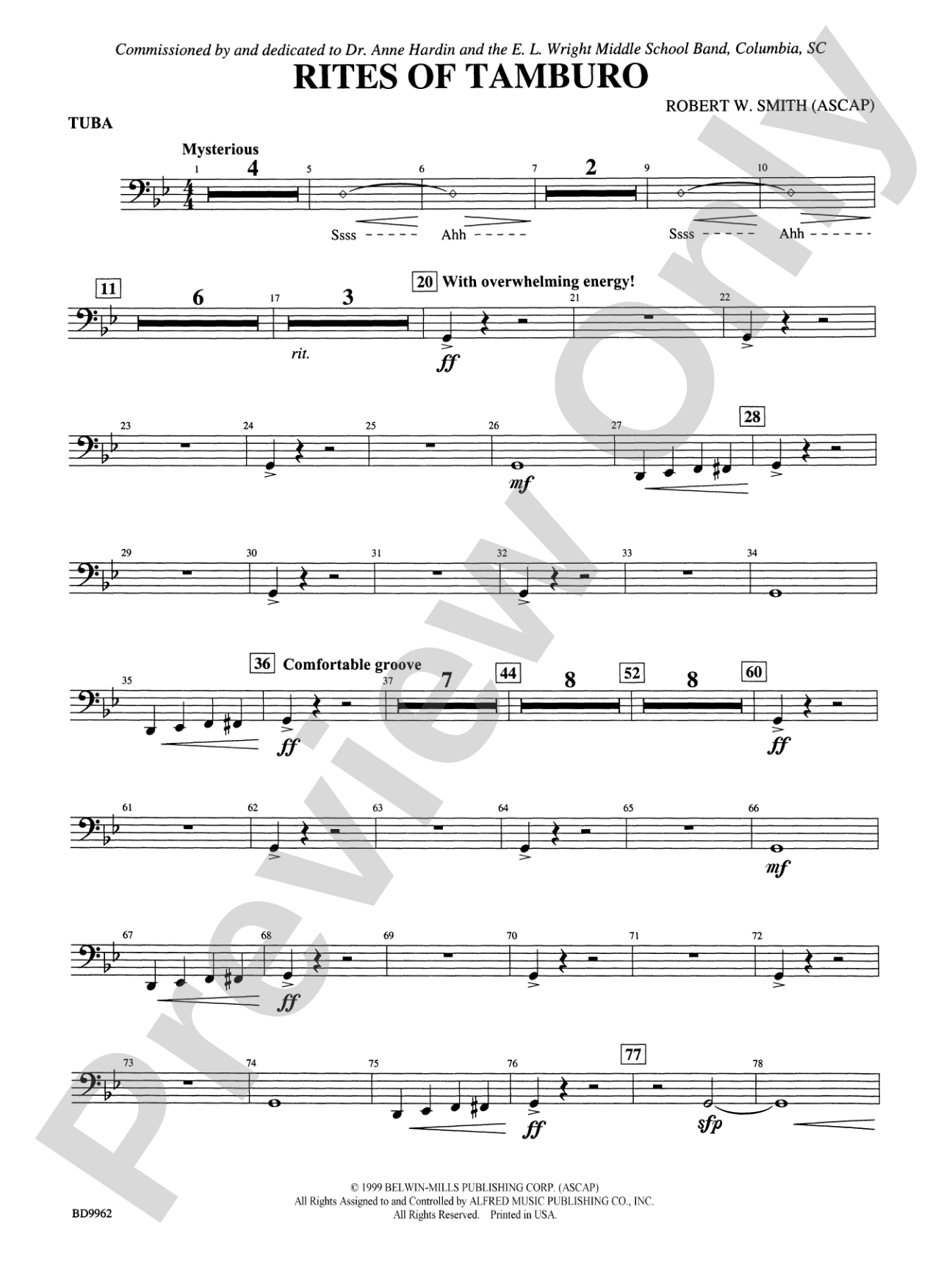
Rites of Tamburo: Tuba

By Robert W. Smith

Grade: 2 (Easy)

Item: 00-PC-0014663_TB1

Digital Download
$3.00
Description
Throughout the ages, man has created ceremonies, both liturgical and secular, to celebrate human existence. Fueled by the driving force of the percussion section, this work investigates an eclectic blend of musical styles drawn from many cultural roots. The pile-driving rhythms underscore the melodic and harmonic content. Fascinating instrumental colors add richness and vibrance to this powerful new work. Soaring! (3:45) This title is available in MakeMusic Cloud.

Don't just read it, hear it, play along with it, and watch your students grow with it. In MakeMusic Cloud, Rites of Tamburo: Tuba comes alive with professional accompaniment, adjustable tempo, and built-in practice tools that turn solo practice into real progress.

Sample Audio
No sample audio found.
Sample Video
Additional Details
Series: Belwin Young Band
Publisher: Alfred Music
Page Count: 260
SKU: 00-PC-0014663_TB1

More about this title

About the Composer: Robert W. Smith

Robert W. Smith

Robert W. Smith stands among the most frequently performed composers of concert band and orchestral music in the United States. His catalog exceeds 400 works, the majority published by Alfred Music, and his compositions have traveled from North America to Europe, Australia, and Asia. He holds degrees from Troy State University (Alabama) and the University of Miami (Florida).

Smith's orchestral works, including his symphonies The Divine Comedy and The Odyssey, have achieved lasting prominence in concert halls worldwide. His band compositions for developing ensembles, particularly The Tempest, now anchor standard repertoire lists. Beyond the concert hall, his music has graced Olympic ceremonies, network television broadcasts, the Macy's Thanksgiving Day Parade, and Opening Day at Dodger Stadium. As a conductor and clinician, he has worked extensively across the United States, Canada, Japan, Australia, and Europe.

Why we love this

Smith crafts rhythmic momentum that engages young musicians without sacrificing musical substance. The percussion-driven architecture gives emerging bands a concrete structural anchor while the layered instrumental colors reward careful listening and nuanced sectional balance. This is the kind of Grade 2 work that doesn't condescend to its performers.

What to expect

Ceremonial energy pulses through this piece. Thundering percussion anchors the foundation while soaring melodic passages rise above, creating waves of intensity that ebb and flow like ritual processions across cultures. The harmonic language feels both modern and timeless, drawing from diverse musical roots to build something that feels urgent and celebratory at once.

Who it's for

Grade 2 bands ready to tackle a work with real compositional ambition. Players need solid fundamental technique but not advanced facility; the writing sits comfortably in the middle of each instrument's range and uses straightforward rhythmic figures. This is equally at home in contest rotation or as a concert centerpiece.

How to get the most out of it

  • Lock the rhythm section early. The driving pulse in the percussion defines everything else; secure that foundation before worrying about the melodic lines.
  • Balance the pile-driving rhythms against the soaring passages. These contrasts only register if listeners hear both the weight and the lift.
  • Highlight the cultural instrumental colors Smith uses. Each orchestration choice serves the work's ceremonial journey; spotlighting those shifts makes the piece's arc audible.
  • Shape the arc across the full 3:45 duration. Resist the urge to play it all at the same energy level; the drama lives in the push and release.

How to use it

Open a concert with this if you want immediate engagement from your audience. The 3:45 duration and high-impact character make it an excellent contest selection for Grade 2 bands seeking repertoire that demonstrates both polish and presence. It also pairs well on programs where you want to show your ensemble's rhythmic precision and color control without programming something that competes for attention with chamber works or lighter fare.

Skills your students will build

  • Maintaining clarity within complex percussion-driven textures
  • Balancing rhythmic precision with lyrical phrasing
  • Reading and responding to clear sectional leadership cues
  • Shaping dynamic arcs across longer formal structures
  • Executing sixteenth-note figures and syncopation with accuracy

You May Also Like