
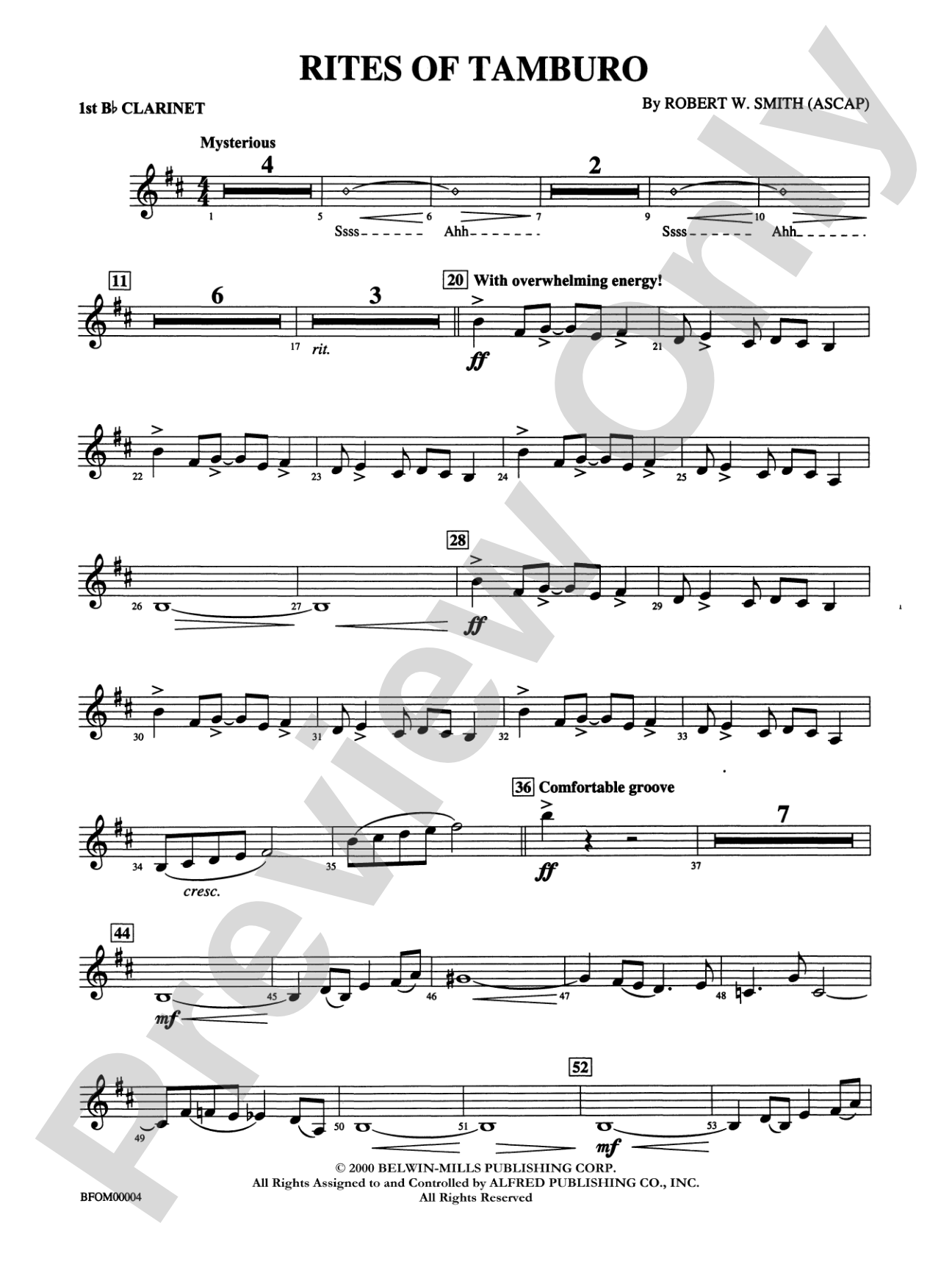

Rites of Tamburo: 1st B-flat Clarinet
By Robert W. Smith
Grade: 2.5
Item: 00-PC-0002219_C1
$3.00
Pickup currently not available
Description
Throughout the ages, man has created ceremonies, both liturgical and secular, to celebrate human existence. Driving rhythms are underscored by the melodic and harmonic content and combined with unique tone colors. This work investigates an eclectic blend of musical styles drawn from many cultural roots. Rich and vibrant, it's a powerful new work for orchestra. A Federation Festivals 2020-2024 selection.


Don't just read it, hear it, play along with it, and watch your students grow with it. In MakeMusic Cloud, Rites of Tamburo: 1st B-flat Clarinet comes alive with professional accompaniment, adjustable tempo, and built-in practice tools that turn solo practice into real progress.
Open in the Player
Jump straight in and assign it today.
Start Your Free Trial
Open this title and explore the full library in minutes.
Sample Audio
1
Audio File
--:--
0:00
0:00
Sample Video
Additional Details
Series:
Belwin Intermediate Full Orchestra
Publisher:
Alfred Music
Page Count:
316
SKU:
00-PC-0002219_C1
More about this title
About the Composer: Robert W. Smith

Robert W. Smith stands among America's most performed composers for band and orchestra, with over 400 works in circulation. His education at Troy State University and the University of Miami shaped a compositional voice that balances accessibility with sophistication, making his works staples in rehearsal rooms across North America, Europe, Australia, and Asia.
Smith's catalog includes two symphonies (The Divine Comedy and The Odyssey) that have resonated globally, alongside works like The Tempest that define the developing ensemble repertoire. Beyond concert halls, his music has accompanied major cultural moments: opening ceremonies in Japan, Olympic Games broadcasts, and the Macy's Thanksgiving Day Parade. His work as a conductor and clinician has taken him across the United States, Canada, Japan, Australia, and Europe, where he continues to advocate for quality orchestral writing that serves musicians at all levels.
Why we love this
Smith crafts orchestral textures that feel contemporary without demanding virtuosity from developing ensembles. The program notes hint at something ambitious here: an investigation of world music styles and ceremonial traditions that keeps the melodic and harmonic content the real focal point, with the driving rhythms as a vehicle rather than a gimmick. For a Grade 2.5 work that's also a Federation selection, that balance is exactly what educators need.
What to expect
A ceremonial procession that moves through multiple worlds. Rich, layered, and driven by pulse without feeling mechanical; the piece has the kind of gravitas that makes players sit straighter and audiences lean in. You'll hear colors and combinations that feel fresh for the grade level, grounded in accessible melodies that students can own.
Who it's for
Orchestras ready to tackle something with more sophistication than standard Grade 2 fare but still well within reach for younger or developing musicians. Directors programming festival season will find a work that satisfies adjudicators while giving students a genuine musical experience rather than a technical checklist.
How to get the most out of it
- Balance the rhythmic energy across sections; Smith layers percussion and lower voices to create momentum, but the melodic lines above need room to breathe and sing through the texture.
- Approach the cultural references without stereotyping. The eclectic blend Smith describes should feel unified by the conducting gesture and phrasing choices, not by literal style imitation.
- Mark cue points clearly for students who double on multiple instruments or sit in the back of the section. The layered orchestration means entrances matter as much as balance.
- Let the tone colors develop gradually. Smith's use of instrumentation to shift the emotional temperature works best when players understand they're part of a larger sonic journey, not just hitting their parts.
How to use it
Pair this as a centerpiece for a concert exploring cultural traditions or ritual in music. Its Federation Festivals pedigree makes it a natural choice for spring competition seasons, but it's equally effective as an opener or concert closer that leaves the audience satisfied and the orchestra energized. The 316-page score suggests substantial orchestration; schedule rehearsal time accordingly and build anticipation gradually.
Skills your students will build
- Balancing melodic lines against rhythmic and harmonic accompaniment layers
- Maintaining ensemble cohesion across culturally diverse musical styles and time signatures
- Responding to conducting gestures that shift between pulse-driven and lyrical phrasing
- Reading and executing articulations and tone color changes that define sectional identity
- Understanding how orchestration creates emotional architecture across a longer form