Rite of Passage: Tuba Sheet Music Preview

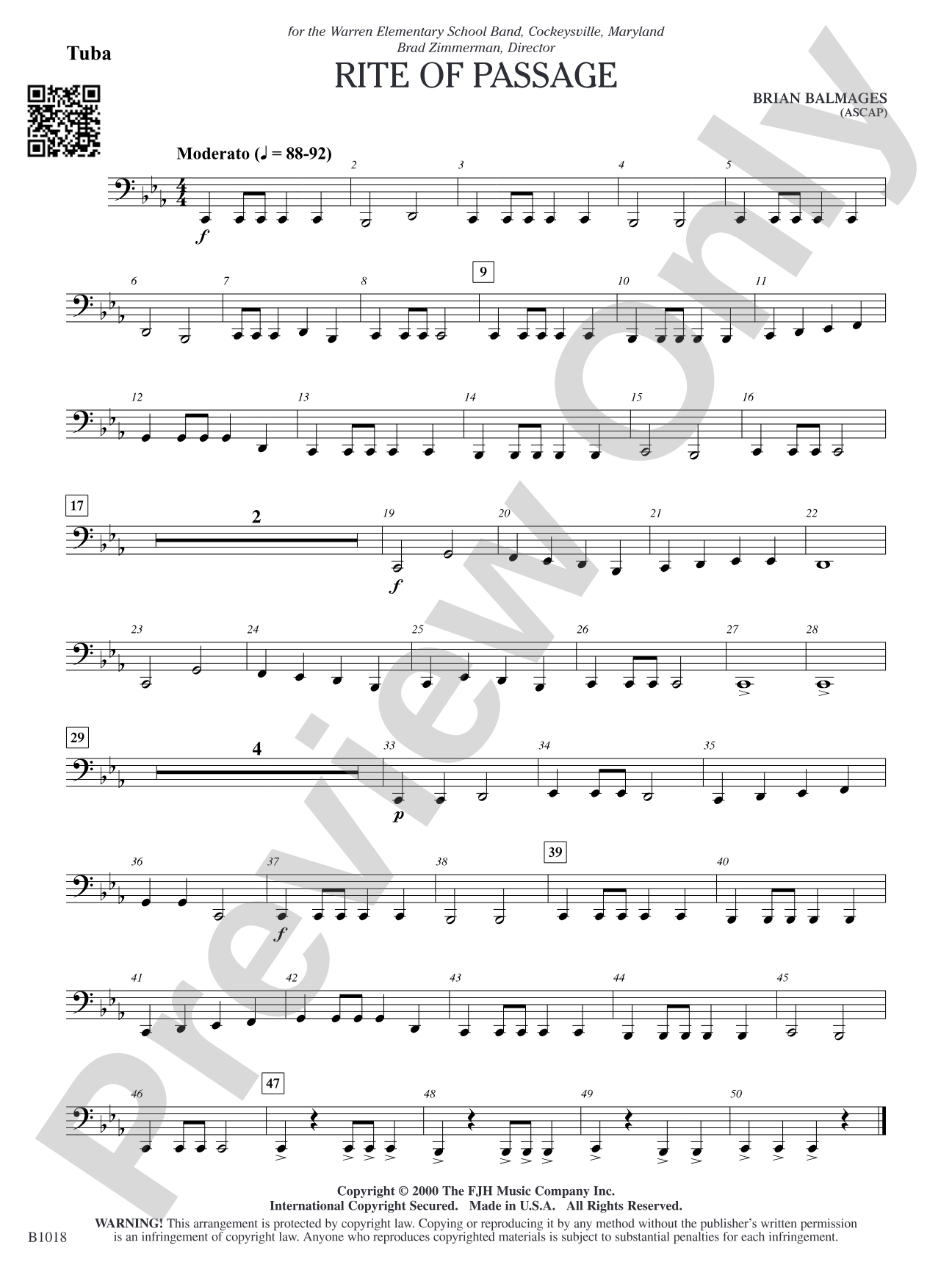
Rite of Passage: Tuba

By Brian Balmages

Grade: 1

Item: 98-PC-DB1018_TB1

Digital Download
$7.00
Description
A beginning band piece limited to a 6-note range, Rite of Passage will have your band playing together in very little time. Utilizing smaller chamber sections as well as the full band, this is an excellent teaching piece. With no clarinets over the break and no trumpets higher than a written A, this is a very easy Grade 1 concert march. (2:00)

Rite of Passage: Tuba isn't in MakeMusic Cloud just yet...but it could be. Let us know you'd like to see it, and you'll help shape what comes next. In the meantime, start a free trial and dive into thousands of interactive titles your students can play along with today.

Sample Audio
0:00
0:00
Sample Video
Additional Details
Series: FJH Beginning Band
Publisher: The FJH Music Company, Inc.
SKU: 98-PC-DB1018_TB1

More about this title

About the Composer: Brian Balmages

Brian Balmages

Brian Balmages has established himself as a composer and conductor with work across orchestral, band, and chamber music. His compositions have been performed by ensembles ranging from professional orchestras to elementary school bands in venues including Carnegie Hall, the Kennedy Center, and the Sydney Opera House. He received the A. Austin Harding Award from the American School Band Directors Association and won the 2020 NBA William D. Revelli Composition Contest for Love and Light. He is an elected member of the American Bandmasters Association and holds the inaugural James Madison University Distinguished Alumni Award from the School of Visual and Performing Arts.

Balmages remains active as a guest conductor with all-state, regional, university, and professional ensembles worldwide, with notable appearances at the Midwest Clinic, Western International Band Clinic, and the College Band Directors Conference. He was commissioned by the University of Miami to compose music for the inauguration of the institution's 6th president, and his work was performed at the 2013 Presidential Inaugural Prayer Service. He currently serves as Director of MakeMusic Publications and Digital Education for Alfred and MakeMusic.

Why we love this

Balmages understands the reality of getting a beginning band to sound unified quickly. By staying out of the extreme register and using strategic ensemble voicing, this march gives your students genuine success in their first weeks together. The combination of chamber sectionals and full band moments creates natural teaching opportunities while keeping the ensemble focused on ensemble blend rather than individual difficulty.

What to expect

Rite of Passage has the straightforward dignity of a traditional march without overwhelming technical demands. The modest range and clean orchestration create an open, accessible sound that allows young players to hear their own contribution and feel the satisfaction of playing as one unit.

Who it's for

This piece is designed for beginning concert bands in their first year of study. With a 6-note range and Grade 1 difficulty, it works well for groups at the elementary or middle school level who are still building fundamental ensemble skills.

How to get the most out of it

  • Lock in a steady tempo during the opening unison passage. Young ensembles benefit from hearing and feeling the pulse established right away.
  • Balance the full band section carefully. With limited instrumentation ceiling, any one player can dominate; listen for a unified sound across the low and middle voices.
  • Bring out the character changes between chamber sections and full ensemble passages. These shifts provide visual and musical landmarks for students still learning to track the conductor.

How to use it

This piece works exceptionally well as an early-season or festival offering when your band is still solidifying basic ensemble skills. Its two-minute length and beginning difficulty make it ideal for standalone performances or as a warm-up to more demanding repertoire on the same concert.

Skills your students will build

  • Playing in unison and simple harmonic textures
  • Maintaining steady tempo with a conductor
  • Blending across the ensemble within a limited range
  • Transitioning cleanly between chamber and full band writing
  • Responding to dynamic and articulation cues

You May Also Like