
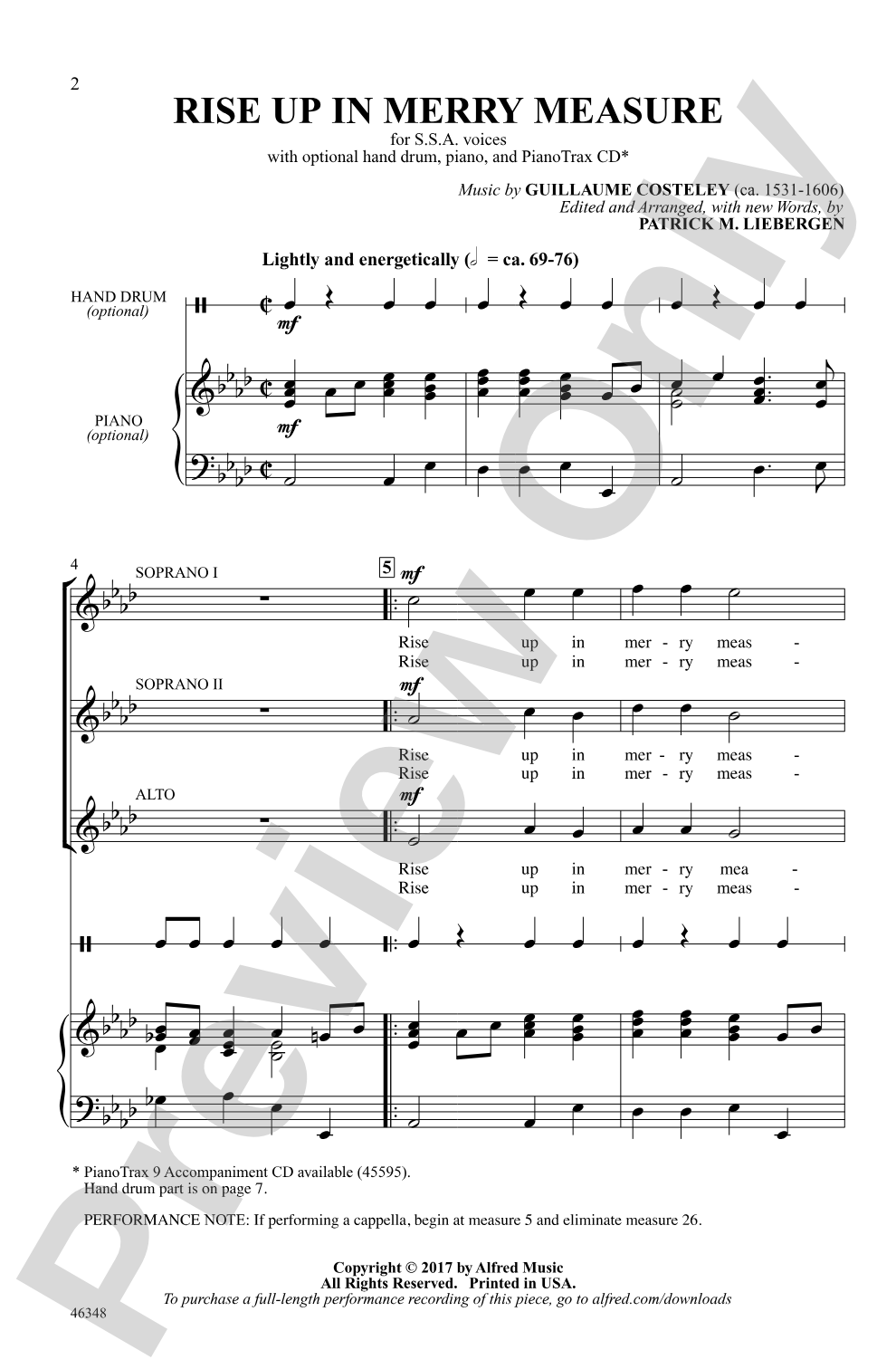
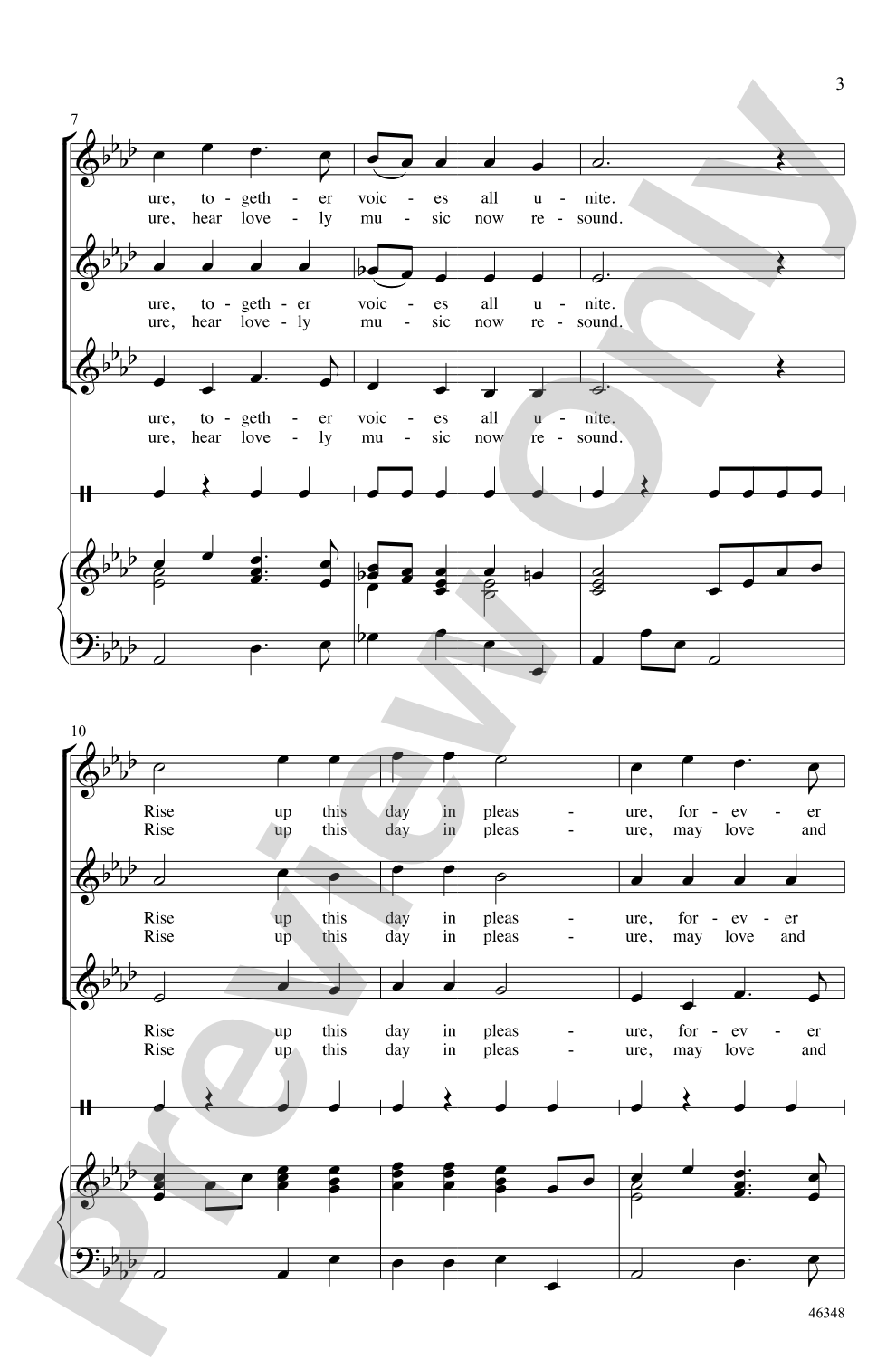

Rise Up in Merry Measure: SSA Choral Octavo
Music by Guillaume Costeley / ed. and arr., with new words, by Patrick M. Liebergen
Item: 00-PO-0005600
$1.90
Minimum order quantity: 20 copies
Pickup currently not available
Description
Enjoy this lighthearted Renaissance-era madrigal highlighting resonant treble sonorities, terraced dynamics, and accessible homophonic voice parts. Consider adding the optional piano accompaniment, optional hand drum part, or perform entirely a cappella.


Rise Up in Merry Measure: SSA Choral Octavo isn't in MakeMusic Cloud just yet...but it could be. Let us know you'd like to see it, and you'll help shape what comes next. In the meantime, start a free trial and dive into thousands of interactive titles your students can play along with today.
Request This Title
Tell us you want it.
Start Your Free Trial
Explore everything that's ready to play right now.
Sample Audio
1
Audio File
--:--
0:00
0:00
Sample Video
Additional Details
Series:
Alfred Choral Designs
Publisher:
Alfred Music
Page Count:
8
SKU:
00-PO-0005600
Instrumentation:
Opt. Piano or Hand Drum
More about this title
About the Composer: Guillaume Costeley
Guillaume Costeley (1531-1606) was a French Renaissance composer and music theorist whose works bridged the late polyphonic tradition and emerging homophonic styles of the 16th century. He served in royal courts and as a canon at the cathedral in Évreux, composing chansons, motets, and madrigals that were widely published and performed across Europe during his lifetime.
Why we love this
Costeley's original madrigal translates beautifully to SSA voices, and Liebergen's arrangement preserves the Renaissance character while making it genuinely singable for treble choirs. The terraced dynamics and mostly homophonic texture keep the focus on text clarity and ensemble cohesion, while the optional percussion and piano allow you to expand the sound without complicating the score.
What to expect
Bright and buoyant, with the kind of sprightly charm that makes Renaissance madrigals feel timeless. The resonant treble sonorities float easily, and the accessible harmony invites singers to focus on character and expression rather than technical survival.
Who it's for
SSA choirs seeking engaging Renaissance repertoire that builds confidence in part-singing without demanding extreme ranges or complex counterpoint. The piece works equally well for high school treble choirs, adult community choirs, and select middle school advanced groups with solid fundamental skills.
How to get the most out of it
- Shape the terraced dynamics deliberately rather than letting them happen accidentally; mark your score to show exactly where dynamic shifts occur and rehearse each section's target level separately before combining.
- Lighten the articulation in homophonic passages to keep the piece dancing forward; over-legit singing will drain the Renaissance character and make the madrigal feel plodding.
- If using the optional hand drum, have the percussionist mark a chart with clear cues tied to specific text or harmonic arrivals rather than relying on counting alone.
- Maintain consistent vowel shapes across the three parts during sustained notes, especially in passages where voices move in parallel motion; blend is built on unified resonance, not just balance.
How to use it
Program this as a concert opener or a pops-style interlude to lighten a heavier set. It pairs naturally with other Renaissance secular works or serves as a palate cleanser between more austere sacred repertoire, and its optional instrumental parts make it flexible enough for festival showcases or intimate chamber performances.
Skills your students will build
- Singing in homophonic texture with clear text projection
- Responding to terraced dynamics as an ensemble
- Blending treble sonorities across three parts
- Interpreting Renaissance performance conventions in a modern context
- Coordinating with optional instrumental accompaniment or percussion