
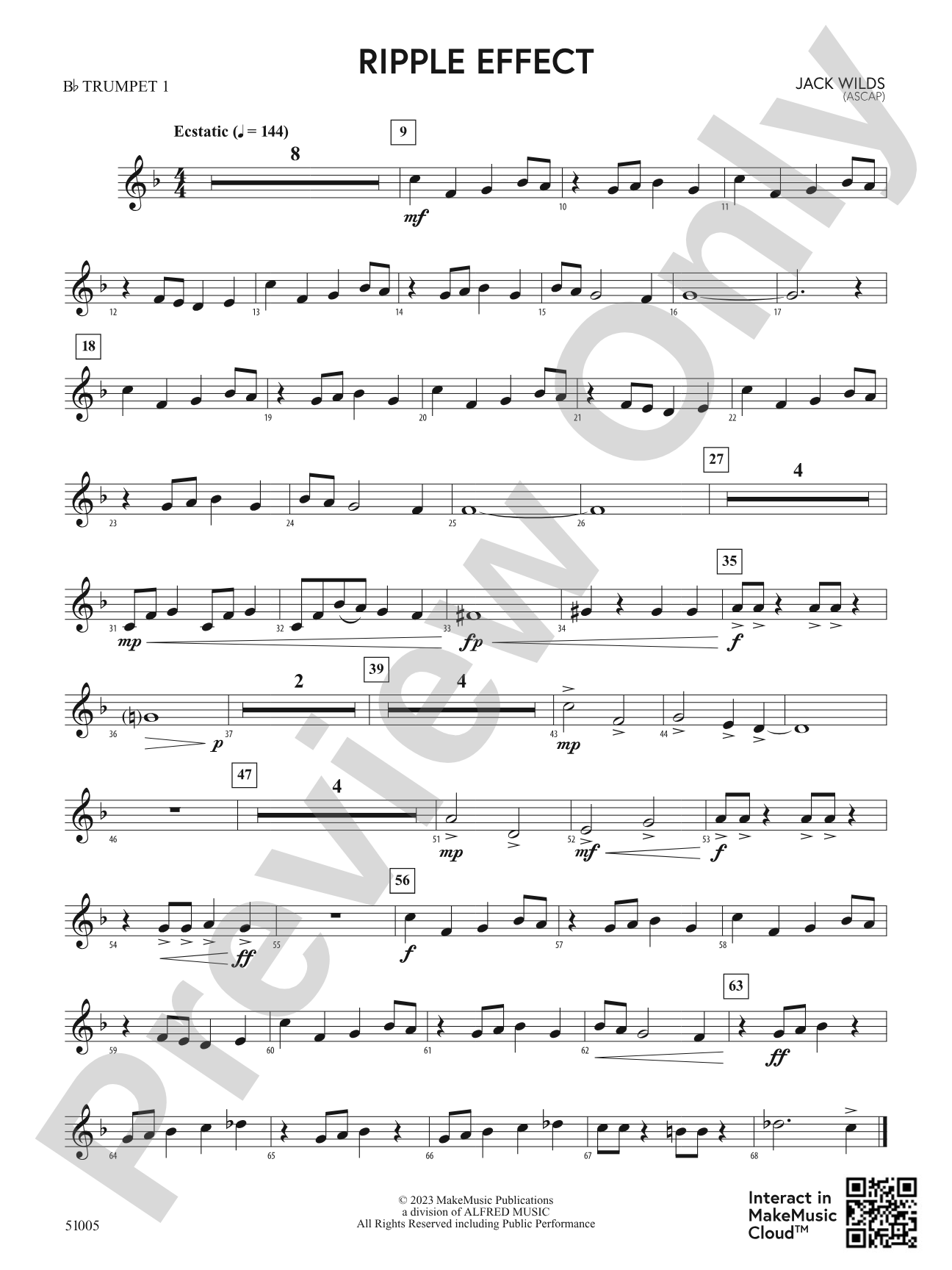

Ripple Effect: 1st B-flat Trumpet
By Jack Wilds
Grade: 1.5-2
Item: 00-PC-0019219_T1
$5.99
Pickup currently not available
Description
This exciting opener by Jack Wilds is brimming with energy as the main motive bursts onto the scene. Written to honor a teacher's legacy, the piece uses colorful orchestration, active percussion writing, and creative motivic development to portray the endless ripple effect generated by a single master teacher. (2:00)


Don't just read it, hear it, play along with it, and watch your students grow with it. In MakeMusic Cloud, Ripple Effect: 1st B-flat Trumpet comes alive with professional accompaniment, adjustable tempo, and built-in practice tools that turn solo practice into real progress.
Open in the Player
Jump straight in and assign it today.
Start Your Free Trial
Open this title and explore the full library in minutes.
Sample Audio
1
Audio File
--:--
0:00
0:00
Sample Video
Additional Details
Series:
MakeMusic Developing Band
Publisher:
MakeMusic Publications
SKU:
00-PC-0019219_T1
More about this title
About the Composer: Jack Wilds

Jack Wilds composes for ensembles spanning early childhood through professional levels, drawing creative impulses from visual art, literature, philosophy, and pure musical structure. His catalog includes over 40 works for developing wind musicians, many of which appear on festival required repertoire lists across multiple continents. His chamber music has been performed by ensembles including the Attacca Quartet and members of the New York Philharmonic and Atlanta Symphony.
A former public school band director, Wilds brings classroom experience directly into his compositional voice. He teaches composition, theory, and music technology at Texas State University and serves as Co-Director of Music at First Presbyterian Church in San Marcos. His work as a clinician and adjudicator takes him regularly across the country, and he has studied composition with Michael Ippolito, Chris Trapani, and Donald Grantham.
Why we love this
The piece opens with genuine dramatic impact, which is harder to achieve at this level than it sounds. Wilds crafts an opener that feels substantial and purposeful without requiring virtuosic execution, making it ideal for setting a powerful first impression at festivals or concerts. The thematic coherence throughout keeps the piece rewarding to rehearse; each section develops the opening motive in ways that reveal new detail with every listen.
What to expect
Energy radiates from the first note as the main motive bursts forward with purpose and momentum. The orchestration is vibrant and layered, creating visual richness that keeps the ear engaged across the two-minute arc. The piece builds an emotional arc around a single transformative idea, much like a ripple spreading outward from a single point of impact.
Who it's for
Directors seeking a concert opener that excites both student musicians and audiences at the 1.5-2 level. The piece works equally well as a contest selection or a festival performance, delivering strong musical moments without excessive technical demands.
How to get the most out of it
- Establish the opening motive crisply across all sections; precision of articulation here sets the tone for the entire piece and makes the subsequent development feel intentional rather than chaotic.
- Balance the colorful orchestration by checking that secondary instruments (woodwind counterlines, brass fills) are audible without overpowering the main melodic strand.
- Shape the motivic development phrases so that each repetition of the main idea feels fresh; slight dynamic and tempo flexibility helps listeners follow the 'ripple' concept that drives the piece.
- Engage the percussion as full contributors rather than timekeepers; their active role in texture and color development is essential to the piece's overall effect.
How to use it
Program this as your concert opener to establish energy and command attention from the first moments. It pairs well with contrasting middle repertoire and serves as an effective contest selection, where its clear structure and engaging development demonstrate student musicianship across the ensemble.
Skills your students will build
- Articulation clarity and precision in fast-moving passages
- Following motivic development across phrases and sections
- Ensemble balance with multiple independent lines
- Dynamic shaping of thematic material
- Rhythmic accuracy in texturally active sections