
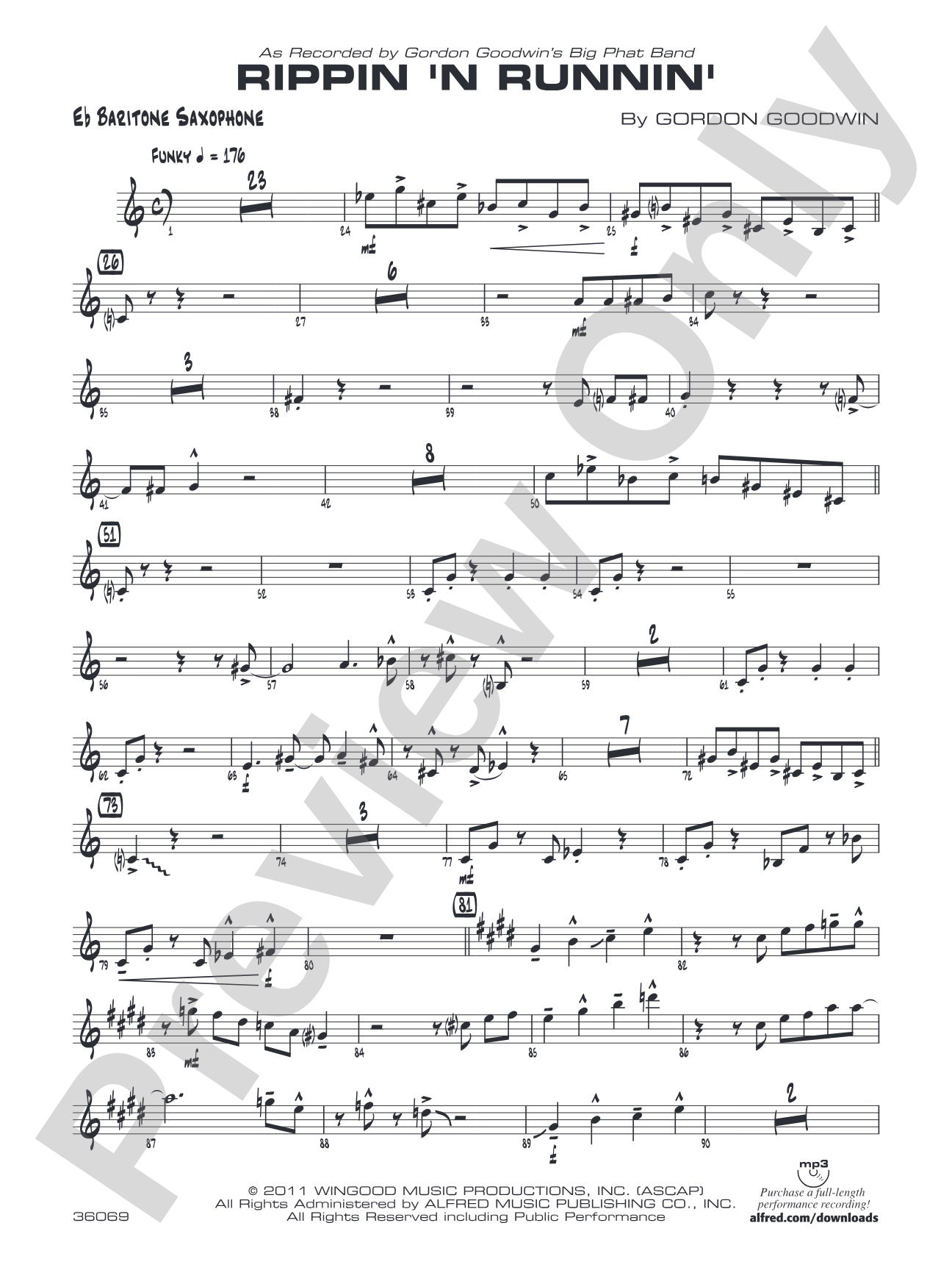

Rippin' 'n Runnin': E-flat Baritone Saxophone
By Gordon Goodwin
Grade: 6 (Professional / Very Advanced)
Item: 00-PC-0017205_BTX
$3.00
Pickup currently not available
Description
This funky chart, at 176 BPM, contains a classic Goodwin piano introduction---challenging, but extremely rewarding. Solo space for alto 1, tenors 1 and 2, trumpet 4, and trombone 1. The chart has an auxiliary percussion part and lead trumpet range is to written high F. As recorded by Gordon Goodwin's Big Phat Band on the CD That's How We Roll on Telarc International. This title is available in MakeMusic Cloud.


Don't just read it, hear it, play along with it, and watch your students grow with it. In MakeMusic Cloud, Rippin' 'n Runnin': E-flat Baritone Saxophone comes alive with professional accompaniment, adjustable tempo, and built-in practice tools that turn solo practice into real progress.
Open in the Player
Jump straight in and assign it today.
Start Your Free Trial
Open this title and explore the full library in minutes.
Sample Audio
1
Audio File
--:--
0:00
0:00
Sample Video
No sample videos found.
Additional Details
Series:
Gordon Goodwin Series
Publisher:
Alfred Music
Page Count:
102
SKU:
00-PC-0017205_BTX
More about this title
About the Composer: Gordon Goodwin

Gordon Goodwin's compositional voice emerged fully formed from childhood. By age five, he was transcribing complete compositions rather than fragments, and at thirteen he wrote his first big band chart, Hang Loose. This precocious talent caught the attention of film and television producers, launching a career that has earned him three Emmy Awards and two Grammy nominations for his orchestrations on films including Bad Boys II, Con Air, Remember the Titans, and Star Trek: Nemesis.
Beyond Hollywood, Goodwin has written for and performed alongside artists ranging from Christina Aguilera to Ray Charles, and has conducted major symphony orchestras across North America and Europe. Since establishing Gordon Goodwin's Big Phat Band in 2000, he has positioned himself as a leading voice in contemporary big band jazz, with his ensemble's recordings garnering consistent Grammy recognition and critical acclaim.
Why we love this
Goodwin's writing for ensemble is instantly recognizable: harmonically sophisticated, rhythmically propulsive, and architecturally sound. Rippin' 'n Runnin' exemplifies why his charts dominate the professional big band repertoire. The opening piano statement alone commands attention and establishes the level of execution required, setting a high bar that propels the ensemble forward through a chart that rewards precision, ensemble listening, and rhythmic commitment.
What to expect
Funky, propulsive, and urbane. At 176 BPM, Rippin' 'n Runnin' maintains relentless forward momentum, but Goodwin's sophisticated harmonies and call-and-response voicings keep the chart from feeling simple. The groove is deep and immediately recognizable; the musicality is layered and rewarding.
Who it's for
This conductor score and parts are designed for professional or semi-professional jazz ensembles, college big band programs at the advanced level, and experienced community big bands with strong soloist resources. The Grade 6 difficulty, combined with the range demands and harmonic language, requires musicians with serious jazz fundamentals and solo maturity.
How to get the most out of it
- Lock the rhythm section (piano, bass, drums, auxiliary percussion) before addressing the horns. Goodwin's charts depend on absolute groove coherence; small deviations in pocket create cascading timing issues across the ensemble.
- The lead trumpet part demands both technical security and musicality. High F is within range, but approach it as a musical destination, not a technical hurdle. Goodwin writes for that altitude intentionally; respect the phrase contour that leads into it.
- Balance solo voices against ensemble hits. Alto 1, both tenor chairs, trumpet 4, and trombone 1 each need space to breathe, but Goodwin's tutti sections are dense and require confident, unified articulation to cut through.
- The classic piano introduction sets the tone for the entire chart. If your pianist rushes or loses the harmonic sophistication of that opening, the ensemble struggles to find the groove. Schedule focused rehearsal time on this passage.
How to use it
Feature this chart as a centerpiece on a concert devoted to contemporary big band writing or as part of a program celebrating composers who bridge jazz and film scoring. Its recorded legacy (via That's How We Roll on Telarc) also makes it a natural choice when programming music that audiences may already know by ear, creating immediate engagement.
Skills your students will build
- Reading and executing complex big band articulations and phrasing at 176 BPM
- Soloing with confidence and harmonic awareness in a professional-level ensemble context
- Ensemble cohesion in rhythmically intricate charts with dense voice leading
- Interpreting lead trumpet range to written high F with musicality and security
- Responding to nuanced dynamic and rhythmic shaping in contemporary jazz compositions