Ring of Fire (arr. Deke Sharon) Sheet Music Preview

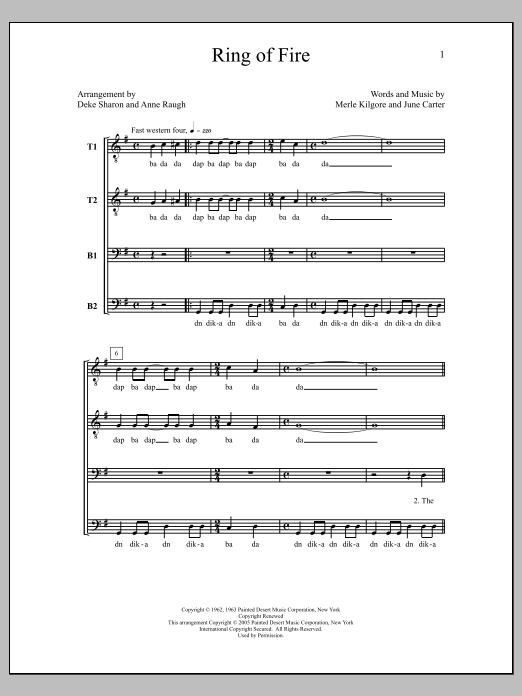
Ring of Fire (arr. Deke Sharon): TTBB Choral Octavo

As performed by Johnny Cash / As performed by June Carter / As performed by Merle Kilgore / As performed by Anne Raugh / Arranged by Deke Sharon

Item: 35-DS00299494

Digital Download
$2.99
Description

Ring of Fire (arr. Deke Sharon): TTBB Choral Octavo isn't in MakeMusic Cloud just yet...but it could be. Let us know you'd like to see it, and you'll help shape what comes next. In the meantime, start a free trial and dive into thousands of interactive titles your students can play along with today.

Sample Audio
No sample audio found.
Sample Video
Additional Details
Publisher: Hal Leonard
Page Count: 8
SKU: 35-DS00299494

More about this title

About the Artist: Johnny Cash

Johnny Cash was a country music icon whose influence stretched far beyond Nashville. His deep, distinctive baritone and unflinching approach to songwriting made him a crossover figure who earned respect from rock, folk, and pop audiences alike. Cash's catalog spans decades of songwriting that explored themes of redemption, struggle, and American life with equal parts grit and compassion.

Why we love this

Deke Sharon's arrangement captures the infectious energy of the original while making it a genuine showcase for four-part male voices. The song's relentless momentum and singable melodic hook mean your singers will connect with the material immediately, and that immediate engagement translates to focused rehearsals and confident performances. Programming this gives you a piece that feels contemporary and fun without sacrificing musical substance.

What to expect

The arrangement crackles with restless forward motion and sunny defiance. There's an almost spoken-word quality to how the melody sits in the voices, paired with harmonic support that feels both simple and satisfying, creating something that sounds effortless even though it demands tight ensemble work.

Who it's for

Male or mixed choirs looking for a contemporary arrangement with genuine crossover appeal. This works equally well for men's groups seeking repertoire with personality and for mixed ensembles that want to spotlight their male voices on a memorable selection.

How to get the most out of it

  • Lean into the rhythmic precision of the accompaniment phrasing. The arrangement's power comes from lock-tight ensemble timing, so mark beat divisions in rehearsal and count through any syncopated moments.
  • Shape the dynamic arc section by section rather than thinking of this as relentlessly loud. The best performances find moments of restraint that make the climactic passages land harder.
  • Encourage the lower voices to sit solidly on their parts; the bass and baritone lines anchor the whole sound, and a weak foundation will undercut the energy.

How to use it

Consider programming this in the second half of a concert where you need an energy reset. It pairs naturally with other secular material and provides a welcome tonal shift if preceded by classical or sacred works. The accessibility and recognition factor also makes this an excellent closer for casual concerts or community performances.

Skills your students will build

  • Rhythmic precision in syncopated ensemble passages
  • Sustaining forward momentum across repeated sections
  • Balancing rhythmic independence with harmonic cohesion in four-part writing
  • Singing contemporary popular music with musical intention

You May Also Like