
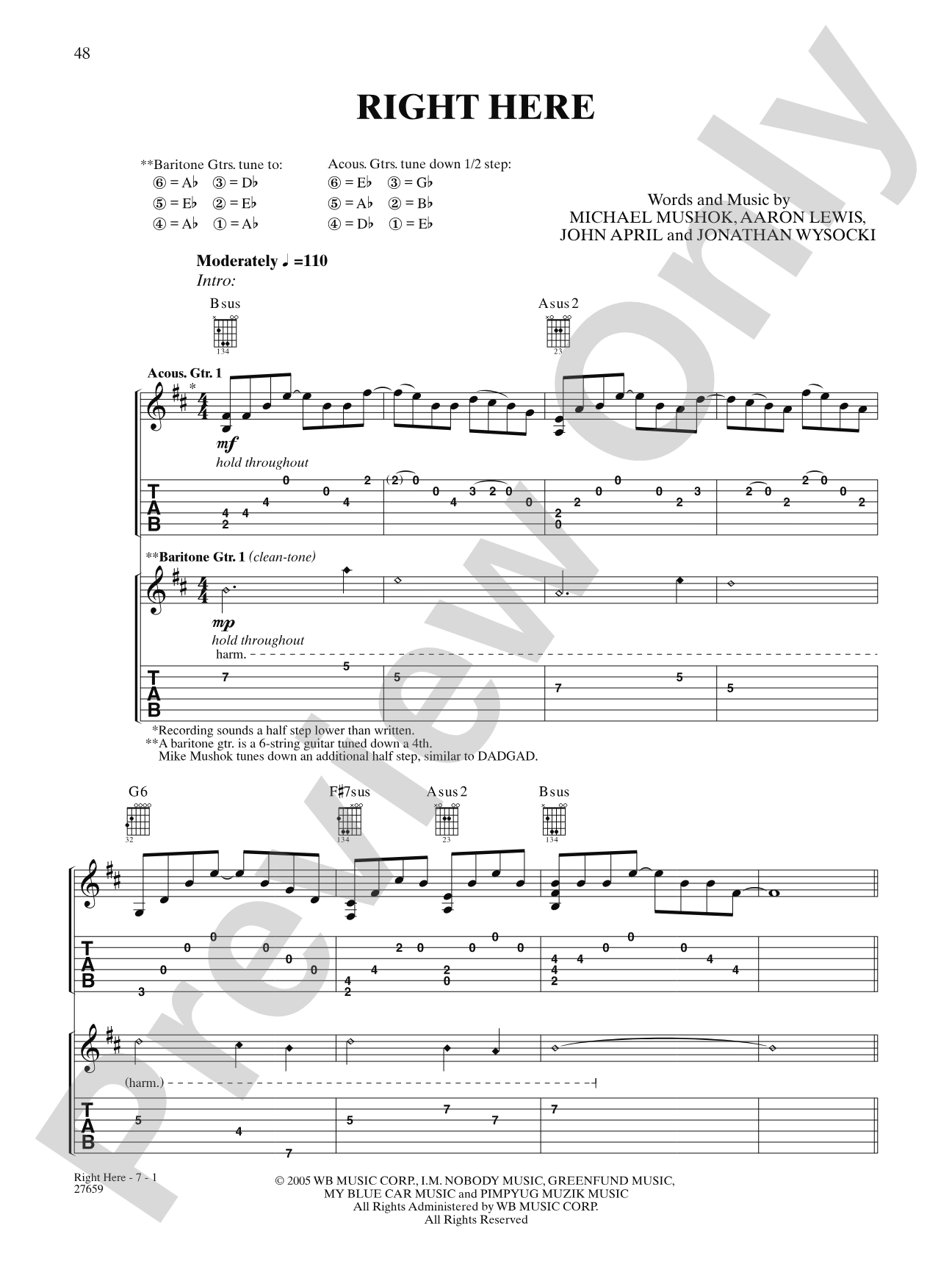
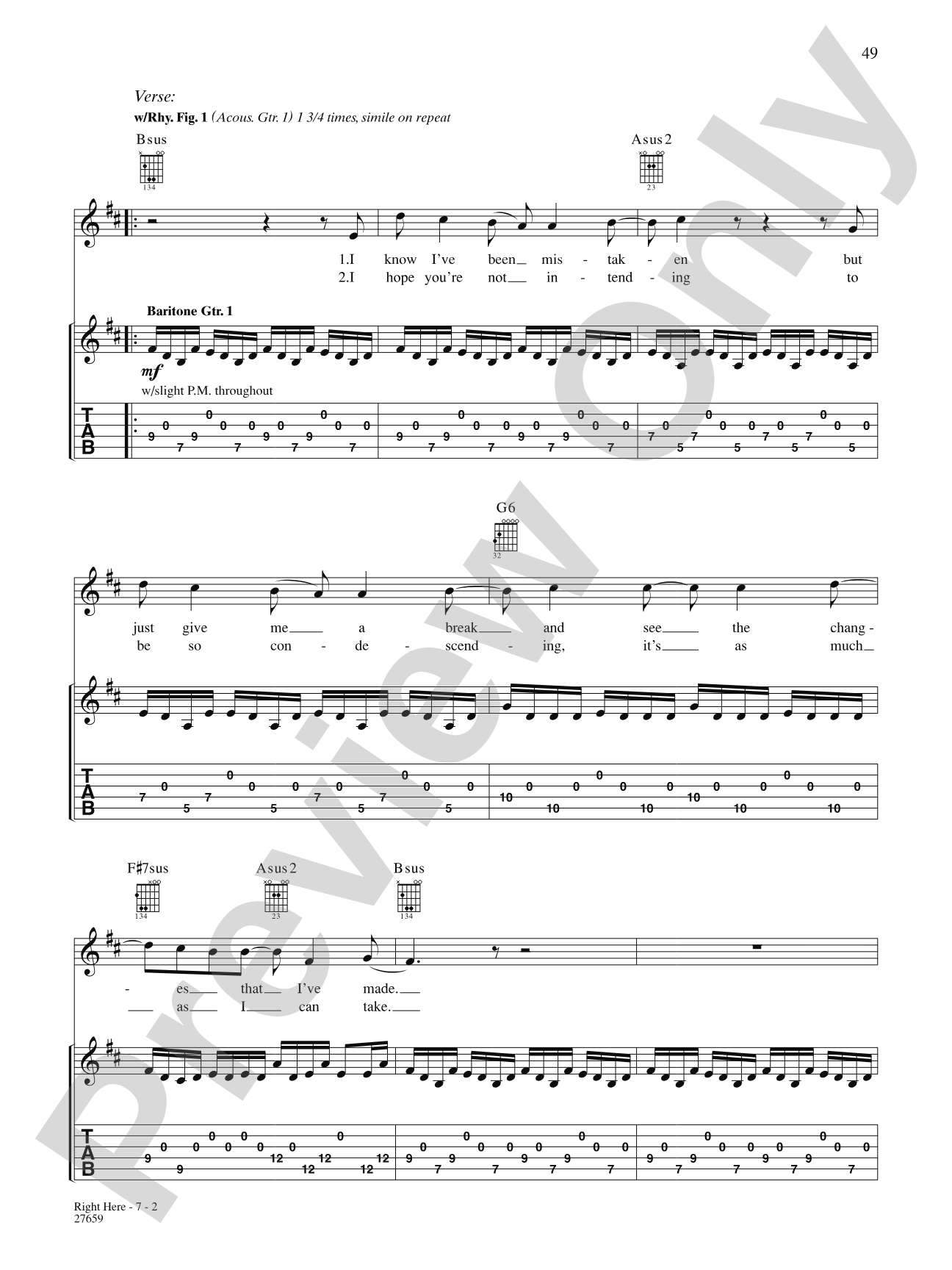

Right Here: Authentic Guitar TAB
Staind
Item: 00-PSG-000732
$5.99
One moment…
Related Items
Come Again: Authentic Guitar TAB |
$5.99
|
View | |
Everything Changes: Authentic Guitar TAB |
$5.99
|
View | |
Falling: Authentic Guitar TAB |
$9.99
|
View | |
Home: Authentic Guitar TAB |
$4.99
|
View | |
Mudshovel: Authentic Guitar TAB |
$4.99
|
View | |
Price To Play: Authentic Guitar TAB |
$4.99
|
View | |
Zoe Jane: Authentic Guitar TAB |
$4.99
|
View |
Description
Over 10 years, Staind have produced four platinum albums and sold in excess of 12,000,000 units! Now, for the first time, all their greatest hits are available on the CD The Singles 1996-2006. This book provides authentic guitar TAB for all the songs on the record.
Titles: Price to Play * Come Again (remix) * Mudshovel * Home * It's Been Awhile * Epiphany * For You * Outside (Family Values Live Version) * So Far Away * Price to Play * Zoe Jane * Right Here * Falling * Everything Changes (live acoustic) * Sober (live acoustic) * Nutshell (live acoustic) * Comfortably Numb (live acoustic).


Titles: Price to Play * Come Again (remix) * Mudshovel * Home * It's Been Awhile * Epiphany * For You * Outside (Family Values Live Version) * So Far Away * Price to Play * Zoe Jane * Right Here * Falling * Everything Changes (live acoustic) * Sober (live acoustic) * Nutshell (live acoustic) * Comfortably Numb (live acoustic).
Right Here: Authentic Guitar TAB isn't in MakeMusic Cloud just yet...but it could be. Let us know you'd like to see it, and you'll help shape what comes next. In the meantime, start a free trial and dive into thousands of interactive titles your students can play along with today.
Request This Title
Tell us you want it.
Start Your Free Trial
Explore everything that's ready to play right now.
Sample Audio
No sample audio found.
Sample Video
No sample videos found.
Additional Details
Publisher:
Alfred Music
Page Count:
92
SKU:
00-PSG-000732
More about this title
About the Artist: Staind
Staind emerged from Springfield, Massachusetts, in the mid-1990s and became one of the defining voices of post-grunge rock. The band's introspective lyrics, dynamics that shift between heavy riffs and sparse acoustic passages, and Aaron Lewis's distinctive vocal delivery resonated with millions of listeners across multiple generations. Between 1996 and 2006, Staind released four platinum albums and established themselves as a significant force in rock radio, known for songs that moved seamlessly between distorted power and intimate vulnerability.
Their work demonstrates how alternative rock can balance commercial appeal with genuine emotional depth. The band's approach to arrangement and production influenced a generation of rock musicians and continues to appear in guitar education contexts for its technical accessibility and emotional clarity.
Why we love this
This collection captures a band at the intersection of heavy riffs and acoustic introspection, giving guitarists a chance to study how power and restraint function in the same songwriting vocabulary. The mix of live acoustic versions alongside studio tracks reveals how the same songs transform across different arrangements, making this resource especially valuable for understanding arrangement choices and production thinking. Students will engage with guitar parts that are musically sophisticated without requiring extreme technical virtuosity.
What to expect
These songs sit in a space of introspective intensity, moving between moments of quiet vulnerability and full-bodied rock momentum. The guitar work supports lyrics about relationships, loss, and self-examination while maintaining accessibility that doesn't sacrifice substance. You'll encounter riffs that breathe and acoustic passages that demand precision, all anchored in melodies that stay with you.
Who it's for
Guitar students drawn to 1990s and 2000s rock music who want to learn from songs built on strong melodic and harmonic foundations. Players working toward a repertoire that balances technical growth with emotional expression will find these transcriptions engaging and achievable. Instructors teaching alternative rock history or students exploring how to arrange songs for different ensemble configurations will value the acoustic and studio versions side by side.
How to get the most out of it
- Study the dynamic shifts in full-band tracks like "Mudshovel" and "Home" by mapping where the guitar texture thickens or opens up; these moments define the song's emotional arc.
- When tackling the live acoustic versions ("Everything Changes," "Sober," "Nutshell," "Comfortably Numb"), focus on clean articulation and consistent tone rather than distortion; these arrangements expose every technical choice.
- Use the remix version of "Come Again" to understand how guitar parts adapt when a song's foundational groove changes; notice what stays essential versus what shifts.
- Reference the original album recordings while learning from the TAB to hear how backing vocals, keyboards, and drums interact with the guitar line; this context sharpens your sense of arrangement.
How to use it
Integrate these transcriptions into a rock history or contemporary songwriting unit where students analyze how a single band evolved its approach across a decade. Use the acoustic versions as a foundation for a semester focusing on stripped-down arrangements and fingerstyle technique. These songs also work well in mixed-level settings where advanced players can tackle full arrangements while newer guitarists focus on core melodies and basic chord voicings.
Skills your students will build
- reading standard notation and guitar TAB in parallel
- identifying and executing power chord shapes and transitions
- understanding song structure through verse-chorus-bridge organization
- listening for arrangement differences between studio and acoustic versions
- developing consistent pick technique for both rhythmic and lead passages
- recognizing how dynamic changes (distortion on/off, palm muting) affect a song's emotional impact