
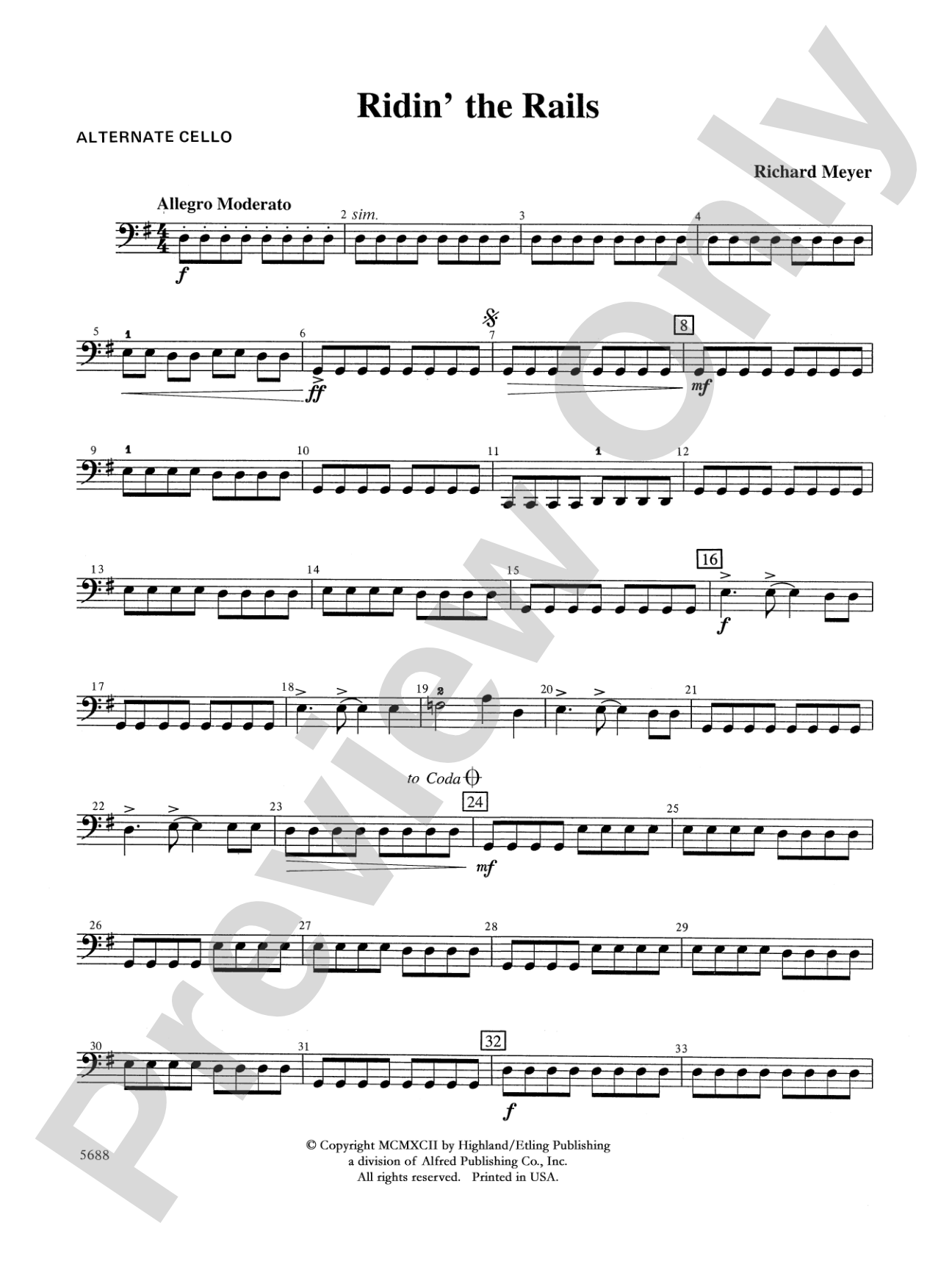

Ridin' the Rails: Alternate Cello
By Richard Meyer
Grade: 3
Item: 00-PC-0001913_ALTVC
$5.99
Pickup currently not available
Description
Another very clever and entertaining novelty piece from Richard Meyer. Kids will surely enjoy the programmatic train ride effects and learn valuable syncopated rhythm patterns at the same time. Left hand technique is closer to a grade 2, but the rhythms will be a challenge to all. Positions are limited to first with advanced fingering options built into the parts. Have a ball with this one!


Don't just read it, hear it, play along with it, and watch your students grow with it. In MakeMusic Cloud, Ridin' the Rails: Alternate Cello comes alive with professional accompaniment, adjustable tempo, and built-in practice tools that turn solo practice into real progress.
Open in the Player
Jump straight in and assign it today.
Start Your Free Trial
Open this title and explore the full library in minutes.
Sample Audio
No sample audio found.
Sample Video
No sample videos found.
Additional Details
Series:
Highland/Etling String Orchestra
Publisher:
Alfred Music
Page Count:
180
SKU:
00-PC-0001913_ALTVC
More about this title
About the Composer: Richard Meyer

Richard Meyer brings three decades of string teaching experience into every composition he writes. He spent 22 years building the orchestra program at Oak Avenue Intermediate School in Temple City, California, expanding it from 29 students to 200, and directed the Pasadena Youth Symphony Orchestra for 16 years, taking ensembles on international tours to Vienna, Australia, and Canada. Beyond the podium, he has guest-conducted All-State orchestras across multiple states and led clinics at the A.S.T.A. National Conference and major universities.
As a composer and arranger, Meyer has published over 190 works and served 16 years as string editor for Alfred Publishing Company. He is the co-author of the String Explorer Series and Sight-read It for Strings, educational tools used in schools nationwide. Meyer also created the "Giving Bach" program, an innovative concert initiative that brings orchestral music to special needs and underserved students throughout Southern California. He lives in Sierra Madre, California with his wife, Rose.
Why we love this
Meyer's gift for writing entertaining pieces that teach solid musical concepts without feeling like lessons makes this an instant favorite with middle school orchestras. The programmatic train narrative keeps every section engaged while the syncopated rhythms slip in real rhythmic challenges that build ensemble precision and style. Contest festivals love programming novelty pieces with substance, and this one delivers both fun and musical growth.
What to expect
Climbing aboard a musical train, complete with chugging rhythms, whistles, and the steady acceleration of wheels on track. The piece captures the energy and charm of a bygone rail journey, with orchestral colors painting each station stop and the playful syncopation keeping everyone alert and moving forward together.
Who it's for
String orchestras at the middle school level will find this piece perfectly suited to their developing technique and appetite for fun, engaging repertoire. It works well for ensembles ready to tackle syncopation and internal rhythmic independence without requiring advanced positions or complex fingering patterns.
How to get the most out of it
- Establish a clear pulse before introducing the syncopated figures; isolate the rhythm patterns in sectionals so students understand the relationship between the train's movement and the actual beat.
- Layer the train sound effects gradually during rehearsal rather than adding them all at once; let students discover which sections carry the "wheels" or "whistle" and own those responsibilities.
- Balance the programmatic storytelling with ensemble precision; the entertainment value works only if the rhythmic accuracy is tight, so drill the tricky passages at tempo.
- Encourage expressive left hand work even within first position; the "closer to grade 2" technique should sound intentional and musical, not tentative.
How to use it
This is an ideal choice for a spring concert where you want to balance weightier repertoire with something that showcases your students' personality and rhythmic maturity. It also programs beautifully in a contest or festival setting, offering judges a clear window into your ensemble's precision, style control, and ability to execute programmatic storytelling without sacrificing musical integrity.
Skills your students will build
- Syncopated rhythm patterns in ensemble context
- Rhythmic independence and internal pulse
- Left hand technique and control in first position
- Expressive articulation and dynamic shaping in a programmatic narrative
- Ensemble balance and blend while maintaining distinct musical colors