Ride A Cock Horse Sheet Music Preview

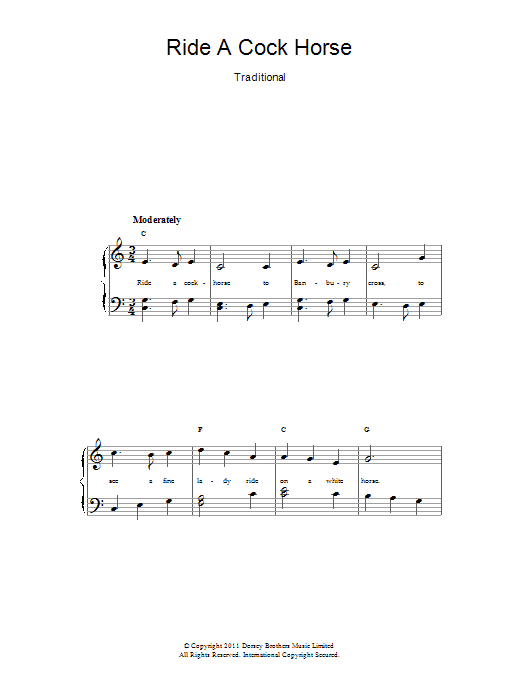
Ride A Cock Horse: Piano Vocal

As performed by Traditional

Item: 35-DS00205503

Digital Download
$5.99
Description

Ride A Cock Horse: Piano Vocal isn't in MakeMusic Cloud just yet...but it could be. Let us know you'd like to see it, and you'll help shape what comes next. In the meantime, start a free trial and dive into thousands of interactive titles your students can play along with today.

Sample Audio
No sample audio found.
Sample Video
Additional Details
Publisher: Hal Leonard
Page Count: 2
SKU: 35-DS00205503

More about this title

About the Artist: Traditional

Traditional nursery rhymes represent the collective wisdom of early childhood music education, passed down through generations of caregivers, teachers, and families. These songs emerge from oral traditions and carry the pedagogical values of their time: simple melodies that lodge in memory, lyrics that teach language patterns, and rhythms that support physical development.

Why we love this

This arrangement captures everything that makes nursery rhymes effective in the studio: a melody straightforward enough for young singers to own quickly, yet structured enough to teach real musicianship. The piano part supports without overwhelming, letting the voice remain the star while giving accompanists something meaningful to play.

What to expect

Bright and purposeful, with the charm of something lived in by countless children. There's a playful energy beneath the simplicity, and the repetitive structure invites singers to play with tone color and subtle interpretation rather than relying on technical difficulty.

Who it's for

Young singers building confidence with solo material, school music programs introducing traditional repertoire, and voice teachers seeking reliable, accessible arrangements for primary-grade students. This also works for community ensembles or family performances where accessibility matters.

How to get the most out of it

  • Encourage singers to find the natural speech rhythm within the melody rather than forcing rigid meter; the text should always drive the phrasing.
  • Keep the tempo conversational. This isn't a march; it's a child telling a story, so allow room for playful dynamics and slight flexibility.
  • Balance the piano accompaniment so it sits behind the vocal line; the instrument is there to anchor, not compete.

How to use it

Open a family concert or children's recital with this; its familiarity puts young audiences at ease while setting a warm tone. It pairs well with other traditional material in a themed program about folk songs or childhood across cultures, and it's sturdy enough to anchor a longer solo set without demanding the singer's full technical arsenal.

Skills your students will build

  • Sustained legit tone in the middle register
  • Shaping simple melodies with textual intention
  • Maintaining steady phrasing across repeated phrases
  • Collaborative balance between voice and accompaniment
  • Natural interpretation of material rooted in speech patterns

You May Also Like