
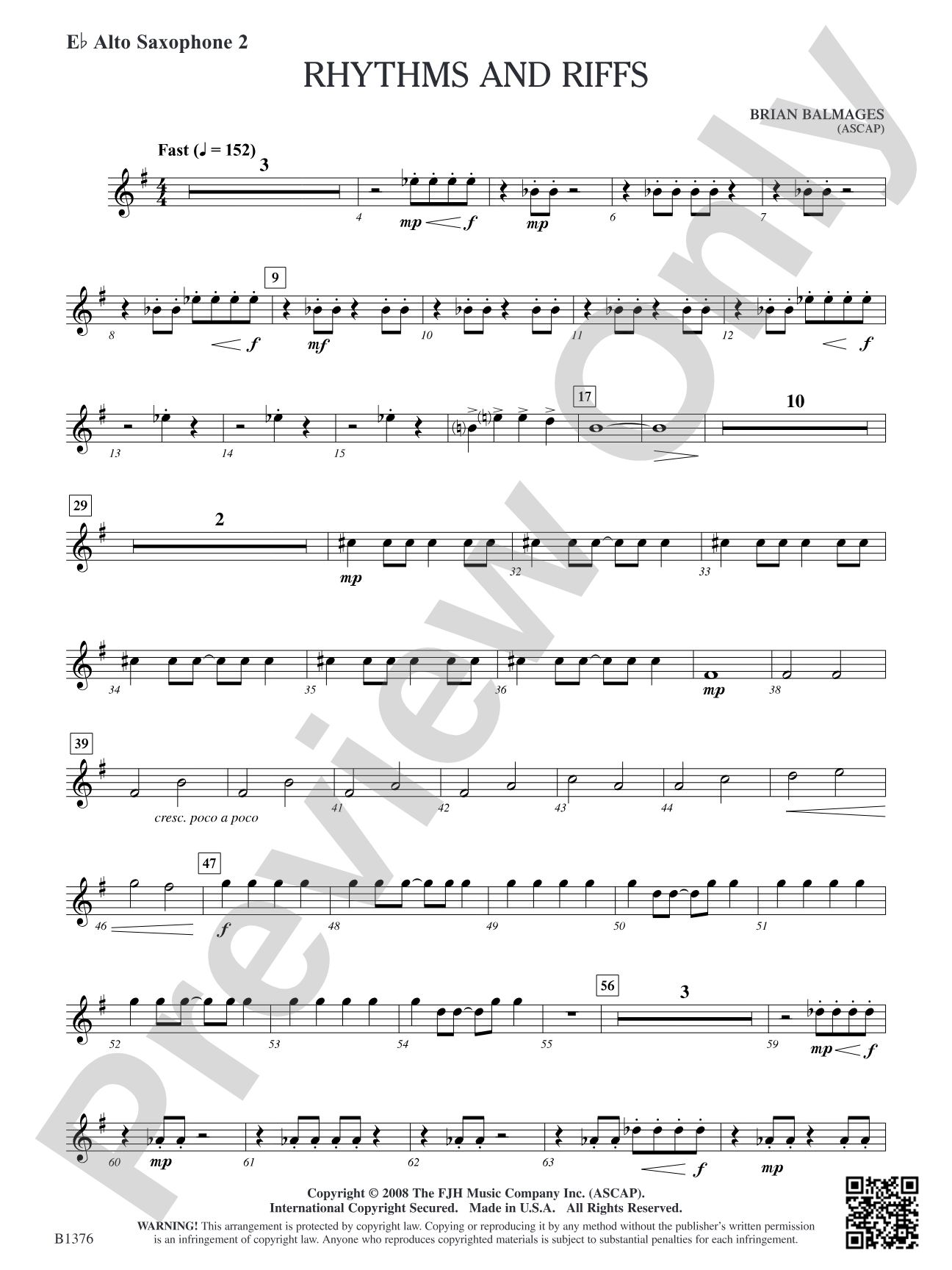

Rhythms and Riffs: E-flat Alto Saxophone 2
By Brian Balmages
Grade: 2.5;3
Item: 98-PC-DB1376_AX2
$7.00
Pickup currently not available
Description
Rhythm becomes the focus of this contemporary work that is extremely suitable for contest or festival. As the title suggests, various grooves and riffs are built into the ensemble throughout as the piece develops harmonically, melodically, and rhythmically. Extremely interesting and a welcome approach for bands at this level, this contemporary work is likely to be the most memorable portion of your concert or festival performance.


Don't just read it, hear it, play along with it, and watch your students grow with it. In MakeMusic Cloud, Rhythms and Riffs: E-flat Alto Saxophone 2 comes alive with professional accompaniment, adjustable tempo, and built-in practice tools that turn solo practice into real progress.
Open in the Player
Jump straight in and assign it today.
Start Your Free Trial
Open this title and explore the full library in minutes.
Sample Audio
1
Audio File
--:--
0:00
0:00
Sample Video
No sample videos found.
Additional Details
Series:
FJH Young Band
Publisher:
The FJH Music Company, Inc.
SKU:
98-PC-DB1376_AX2
More about this title
About the Composer: Brian Balmages

Brian Balmages has established himself as a composer and conductor whose work reaches across orchestral, band, and chamber music spheres. His compositions have been heard in spaces like Carnegie Hall, the Kennedy Center, and Sydney Opera House, performed by ensembles ranging from professional orchestras to school groups. He received the A. Austin Harding Award from the American School Band Directors Association and won the 2020 NBA William D. Revelli Composition Contest for Love and Light. As an elected member of the American Bandmasters Association, Balmages has been recognized with the inaugural James Madison University Distinguished Alumni Award and a commission from the University of Miami for presidential inauguration music.
As a conductor, Balmages maintains a schedule of guest appearances with all-state and regional ensembles, university groups, and professional orchestras worldwide. His conducting engagements have included the Midwest Clinic, Western International Band Clinic, College Band Directors Conference, and numerous other venues internationally. Currently, he serves as Director of MakeMusic Publications and Digital Education for Alfred and MakeMusic.
Why we love this
Balmages understands what captures young musicians' attention: grooves and riffs that make them want to play. The piece builds momentum through rhythmic development while maintaining melodic and harmonic interest, ensuring the band stays engaged section by section rather than simply executing standard concert fare. At Grade 2.5–3, this work delivers genuine substance without overwhelming players, making it an ideal choice for directors seeking contemporary repertoire that holds its own at festival adjudication.
What to expect
The piece pulses with contemporary energy, built on grooves that feel natural to young players rather than imposed or artificial. As different rhythmic and melodic ideas stack and interact, the band discovers how grooves can evolve without losing their core identity, creating a sense of forward motion and purpose throughout.
Who it's for
Grade 2.5–3 concert bands preparing for festival or contest performance will find this piece both accessible and musically rewarding. Directors looking to program contemporary work that genuinely engages young musicians without sacrificing musical quality will appreciate Balmages' approach to rhythm and orchestration.
How to get the most out of it
- Lock in the rhythmic foundation by having the rhythm section (drums, bass, and keyboard if available) rehearse their grooves separately before full ensemble rehearsals. Consistency here allows the rest of the band to build confidence in the evolving riffs.
- Emphasize the contrast between rhythmic sections. When the piece shifts grooves or introduces new riffs, mark those transitions clearly in rehearsal so the ensemble understands the architecture and doesn't treat every moment the same.
- Pay attention to balance within the riffs themselves. Balmages layers complementary rhythmic ideas across different sections; make sure inner voices cut through rather than disappear, particularly in passages where sustained notes support moving figures.
How to use it
Program this as a centerpiece in a contest or festival set where you want to showcase the band's rhythmic precision and contemporary musical taste. The piece works equally well as the anchor of a concert themed around modern band literature or as a bridge between classical and more experimental works in your season.
Skills your students will build
- Executing syncopated rhythmic figures within a steady pulse
- Maintaining groove integrity across multiple ensemble sections
- Distinguishing and performing complementary rhythmic layers (ostinato, riff, and countermelody)
- Responding to harmonic changes while locked into a rhythmic pattern
- Balancing rhythmic and sustained voices in a contemporary ensemble texture