
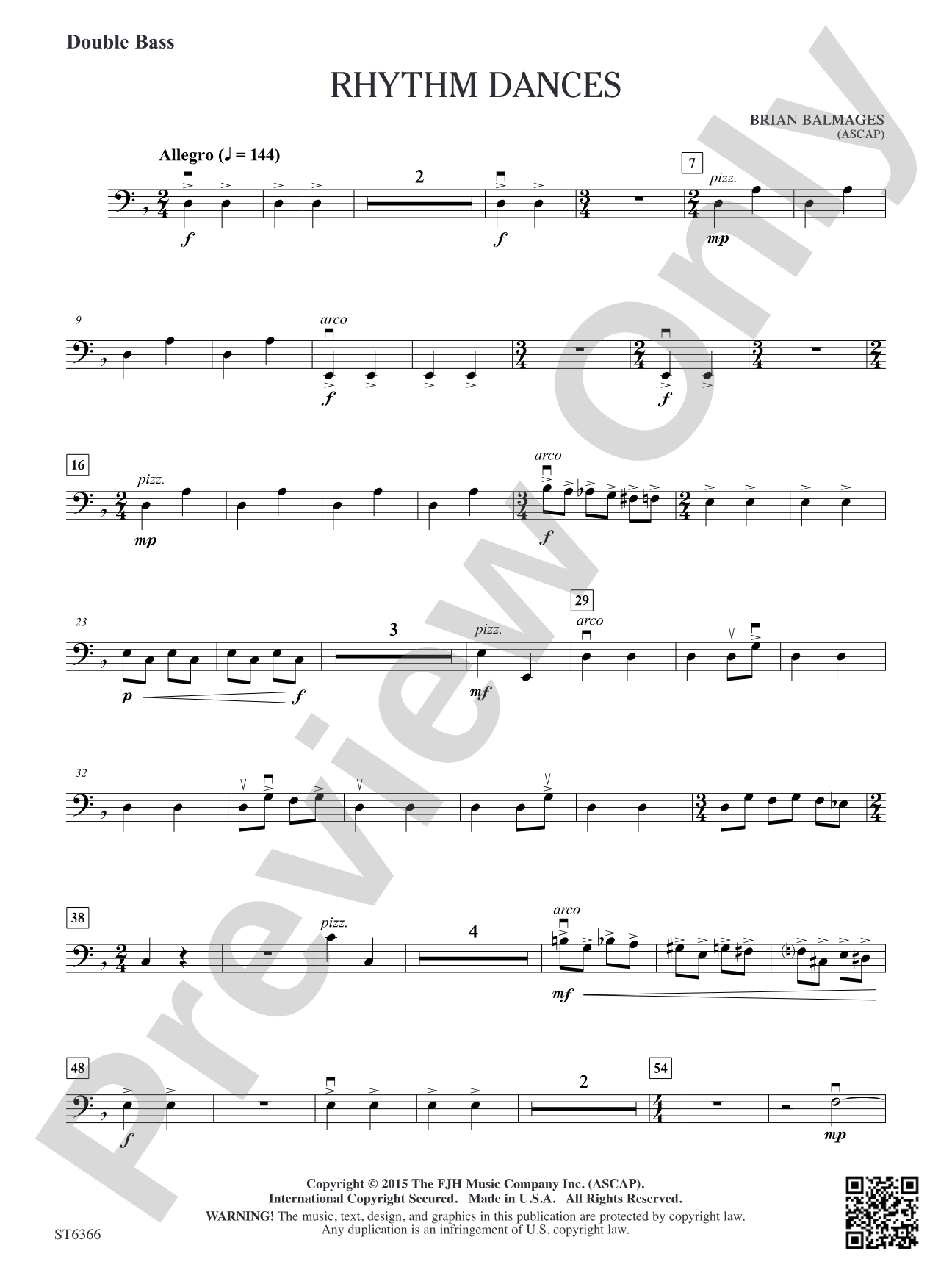

Rhythm Dances: Double Bass
By Brian Balmages
Grade: 4
Item: 98-PC-DST6366_SB
$7.00
Pickup currently not available
Description
Unleash your orchestra with this wild dance that includes moments of lightheartedness, unabashed lyricism, and intense rhythmic outbursts. A riveting performance will take an audience on an emotional roller coaster as the musical lines trot, stumble, float, run, and eventually barrel into the dynamic conclusion. A definite burst of energy!


Don't just read it, hear it, play along with it, and watch your students grow with it. In MakeMusic Cloud, Rhythm Dances: Double Bass comes alive with professional accompaniment, adjustable tempo, and built-in practice tools that turn solo practice into real progress.
Open in the Player
Jump straight in and assign it today.
Start Your Free Trial
Open this title and explore the full library in minutes.
Sample Audio
1
Audio File
--:--
0:00
0:00
Sample Video
No sample videos found.
Additional Details
Series:
FJH String Orchestra
Publisher:
The FJH Music Company, Inc.
SKU:
98-PC-DST6366_SB
More about this title
About the Composer: Brian Balmages

Brian Balmages has established himself as a composer and conductor working fluidly across orchestral, band, and chamber repertoires. His works have been commissioned and performed by ensembles ranging from elementary school orchestras to professional symphony orchestras in prestigious venues including Carnegie Hall, the Kennedy Center, and Sydney Opera House. He received the A. Austin Harding Award from the American School Band Directors Association and won the 2020 NBA William D. Revelli Composition Contest. His music was performed at the 2013 Presidential Inaugural Prayer Service.
Balmages maintains an active conducting schedule with all-state ensembles, university orchestras, and professional groups worldwide, and has guest conducted at the Midwest Clinic, Western International Band Clinic, and numerous state music conferences. He holds distinguished alumni recognition from James Madison University and was commissioned by the University of Miami to compose for the inauguration of the institution's president. Currently, he serves as Director of MakeMusic Publications and Digital Education for Alfred and MakeMusic.
Why we love this
Balmages gives you genuine contrasts without sacrificing coherence: the piece swings between reflective, soaring passages and kinetic rhythmic energy in ways that keep student musicians engaged and audiences invested. The writing sits comfortably in the Grade 4 range while demanding real musicianship, particularly in the lyrical sections where intonation and phrase shape matter deeply.
What to expect
The piece is kinetic and theatrical, with instrumental lines that move as if they have physical weight. Quiet, singing moments provide genuine relief before the ensemble barrels forward again, building toward a conclusion that feels earned rather than imposed.
Who it's for
Grade 4 string orchestras looking for a contest or festival piece that delivers emotional range without requiring advanced technique. Directors who want their students to experience real storytelling through orchestration and character work will find this accessible yet musically rewarding.
How to get the most out of it
- Shape the opening carefully by emphasizing the different character of each musical gesture. The trotting figures need buoyancy, while the floated passages require space and legit tone production.
- Balance the rhythmic outbursts so they feel explosive but not uncontrolled. Mark rehearsal letters prominently and lock the ensemble's sense of forward momentum well before the final barrel-in conclusion.
- Use the score's dynamic markings as architecture rather than decoration. The contrast between the gentle, lyrical writing and the intense passages relies on players respecting both extremes.
How to use it
This works exceptionally well in a competition or festival setting where you want to showcase your orchestra's range of expression and energy control. It also pairs naturally on a concert program with a larger symphonic work, where it can serve as a shorter, high-impact contrast or warm-up performance.
Skills your students will build
- Articulation control across multiple characters (staccato, legato, marcato within a single piece)
- Dynamic contrast and the physical discipline of executing subtle versus intense passages
- Rhythmic independence within ensemble textures, particularly during syncopated or uneven rhythmic figures
- Phrasing and intonation in lyrical passages where musical line takes priority over technical display