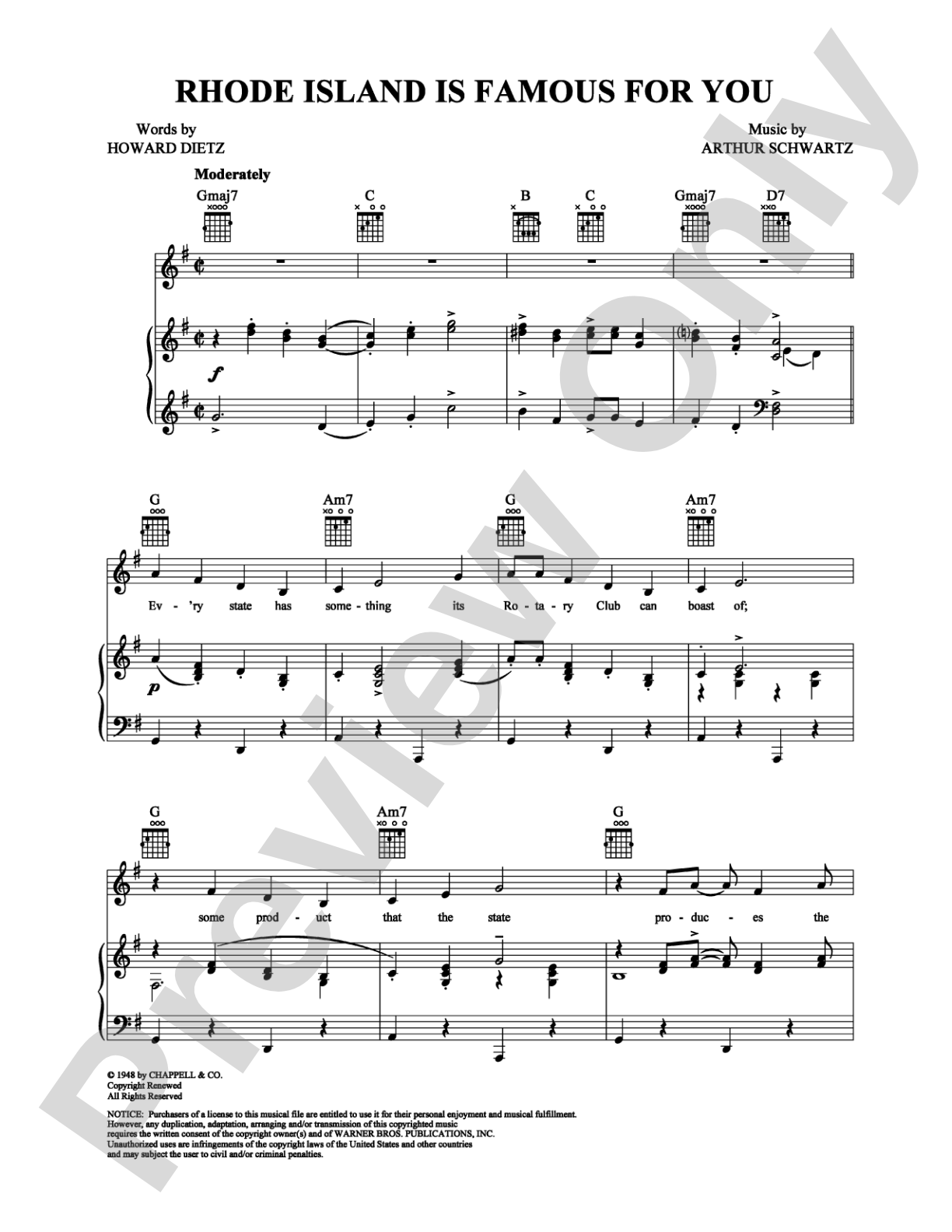
Rhode Island Is Famous for You: Piano/Vocal/Chords Digital Sheet Music

Rhode Island Is Famous for You: Piano/Vocal/Chords Digital Sheet Music

Arthur Schwartz, Michael Feinstein

Item: 00-PS-0004574

Digital Download
$3.99
Description

Rhode Island Is Famous for You: Piano/Vocal/Chords Digital Sheet Music isn't in MakeMusic Cloud just yet...but it could be. Let us know you'd like to see it, and you'll help shape what comes next. In the meantime, start a free trial and dive into thousands of interactive titles your students can play along with today.

Sample Audio
No sample audio found.
Sample Video
Additional Details
SKU: 00-PS-0004574

More about this title

About the Artist: Michael Feinstein

Michael Feinstein is a pianist and vocalist renowned for his interpretations of the Great American Songbook. His career spans decades of concert performances, recordings, and television appearances, establishing him as a leading interpreter of standards and American popular song. Feinstein's approach to this repertoire emphasizes both technical mastery and emotional clarity, making him a trusted voice for musicians learning these essential works.

Why we love this

Feinstein's interpretation of this standard provides a reliable vocal guide for performers learning the song. The piano/vocal/chord format gives you everything needed for rehearsal, performance, or student learning without requiring a separate accompaniment recording.

What to expect

This Rhode Island standard carries the warmth and wit of mid-century American songwriting, with a melody that sits comfortably in the middle range and lyrics that land with gentle humor. The harmonic language is sophisticated without being dense, creating a piece that feels both accessible and distinctly crafted.

Who it's for

Vocalists studying American standards and pianists preparing to accompany singers in this repertoire will find this format essential. Music educators programming recitals or jazz standards units benefit from having a trusted artist's interpretation in score form.

How to get the most out of it

  • Pay attention to how Feinstein phrases the lyric; his phrasing choices can clarify where to breathe and how to shape the melodic line across longer phrases.
  • Use the chord symbols to inform your harmonic interpretation and to support a pianist learning the accompaniment.
  • Balance the vocal line with the piano part to ensure the melody sits naturally in the texture rather than fighting against the accompaniment.

How to use it

Place this in a set of American standards for a jazz recital, cabaret-style concert, or standards showcase. It works equally well as a teaching piece for vocal students or as a rehearsal score for an accompanist preparing for performance.

Skills your students will build

  • Interpreting jazz and pop-influenced phrasing in a vocal line
  • Reading chord symbols and understanding harmonic progressions
  • Balancing vocal and piano textures in chamber music contexts
  • Styling a conversational, lyric-driven melody

You May Also Like