
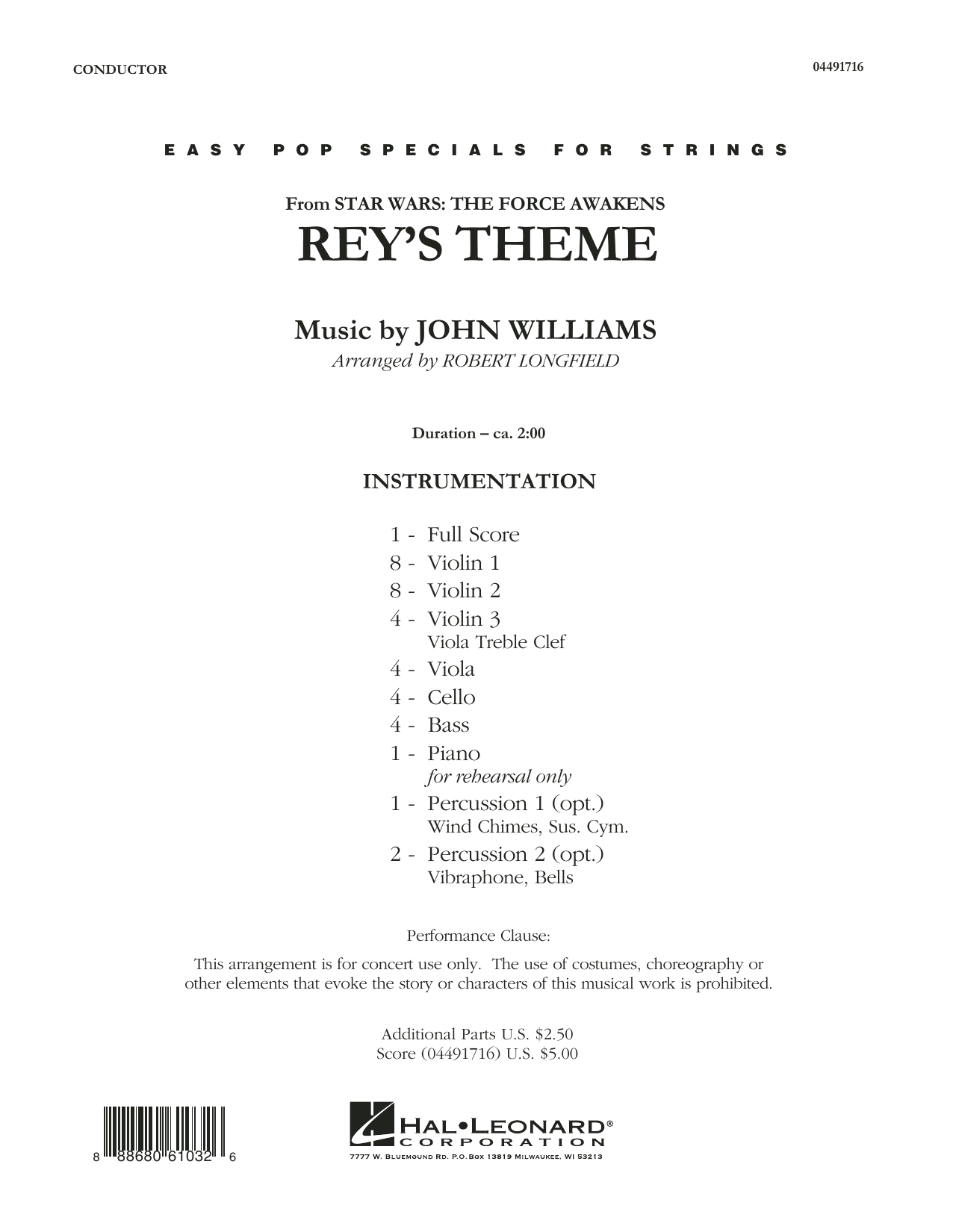

Rey's Theme (from Star Wars: The Force Awakens): String Orchestra Conductor Score & Parts
By John Williams / Arranged by Robert Longfield
Grade: 3
Item: 35-PK00324257
$50.00
Pickup currently not available
Buy Extra Parts (Digital PDF Download)
Parts Added to Cart!
Description
Dur: 2:00


Rey's Theme (from Star Wars: The Force Awakens): String Orchestra Conductor Score & Parts isn't in MakeMusic Cloud just yet...but it could be. Let us know you'd like to see it, and you'll help shape what comes next. In the meantime, start a free trial and dive into thousands of interactive titles your students can play along with today.
Request This Title
Tell us you want it.
Start Your Free Trial
Explore everything that's ready to play right now.
Sample Audio
No sample audio found.
Sample Video
No sample videos found.
Additional Details
Publisher:
Hal Leonard
SKU:
35-PK00324257
More about this title
About the Composer: John Williams
John Williams stands as one of the most prolific and celebrated film composers in history, with a career spanning over six decades. His work across Star Wars, Indiana Jones, Jaws, Schindler's List, and countless other franchises has shaped how generations experience cinema, while his concert works and arrangements have become staples of orchestral repertoire worldwide.
Beyond the screen, Williams' compositions have fundamentally influenced music education. His film scores introduce students to sophisticated orchestration, memorable thematic development, and the expressive possibilities of the orchestra. Teachers at every level draw on his work to engage students who might otherwise feel disconnected from classical music, proving that accessibility and artistic depth are not mutually exclusive.
Why we love this
This arrangement brings one of the most inspiring themes from recent cinema into the rehearsal room at a level that genuinely works. The Grade 3 scoring respects the melodic integrity of Williams' original while keeping the technical demands reasonable, making it possible for student orchestras to sound polished and confident rather than strained. You'll find your ensemble connecting emotionally to the music within a few rehearsals, which creates the kind of momentum that carries through your season.
What to expect
The theme radiates resilience and quiet determination, building gradually from introspective opening statements toward moments of swelling hope. There's an emotional directness to the writing that avoids sentimentality while remaining deeply expressive, making it feel both contemporary and timeless.
Who it's for
String orchestras at the intermediate level will find this arrangement immediately playable without sacrificing the character of the original. Directors looking for repertoire that excites students while remaining pedagogically sound will appreciate how cleanly this works with younger ensembles.
How to get the most out of it
- Shape the main theme with a singing tone; this melody carries the emotional weight of the entire piece, so encourage your first violins to think of it as a vocalist would
- Balance the accompaniment so that sustained harmonic voices support without obscuring the melody, particularly in the middle section
- Maintain steady tempo throughout the two minutes; any fluctuation will disrupt the forward momentum that makes this theme so effective
- Use the dynamic markings as structural signposts; they guide the arc of the piece and help students understand where energy should build and recede
How to use it
This works beautifully as a bridge between traditional classics and contemporary film music on a concert, giving your audience a familiar touchstone while demonstrating your students' ability to handle meaningful modern material. It's compact enough to pair with other shorter works, yet substantial enough to stand alone as a featured selection.
Skills your students will build
- Phrasing and shaping longer melodic lines across multiple phrases
- Balancing sustained harmonic accompaniment with forward-moving melody
- Maintaining rhythmic precision while responding to dynamic and expressive markings
- Ensemble cohesion in a piece where emotional communication matters as much as technical accuracy
- Reading string-specific articulations and bowing directions