
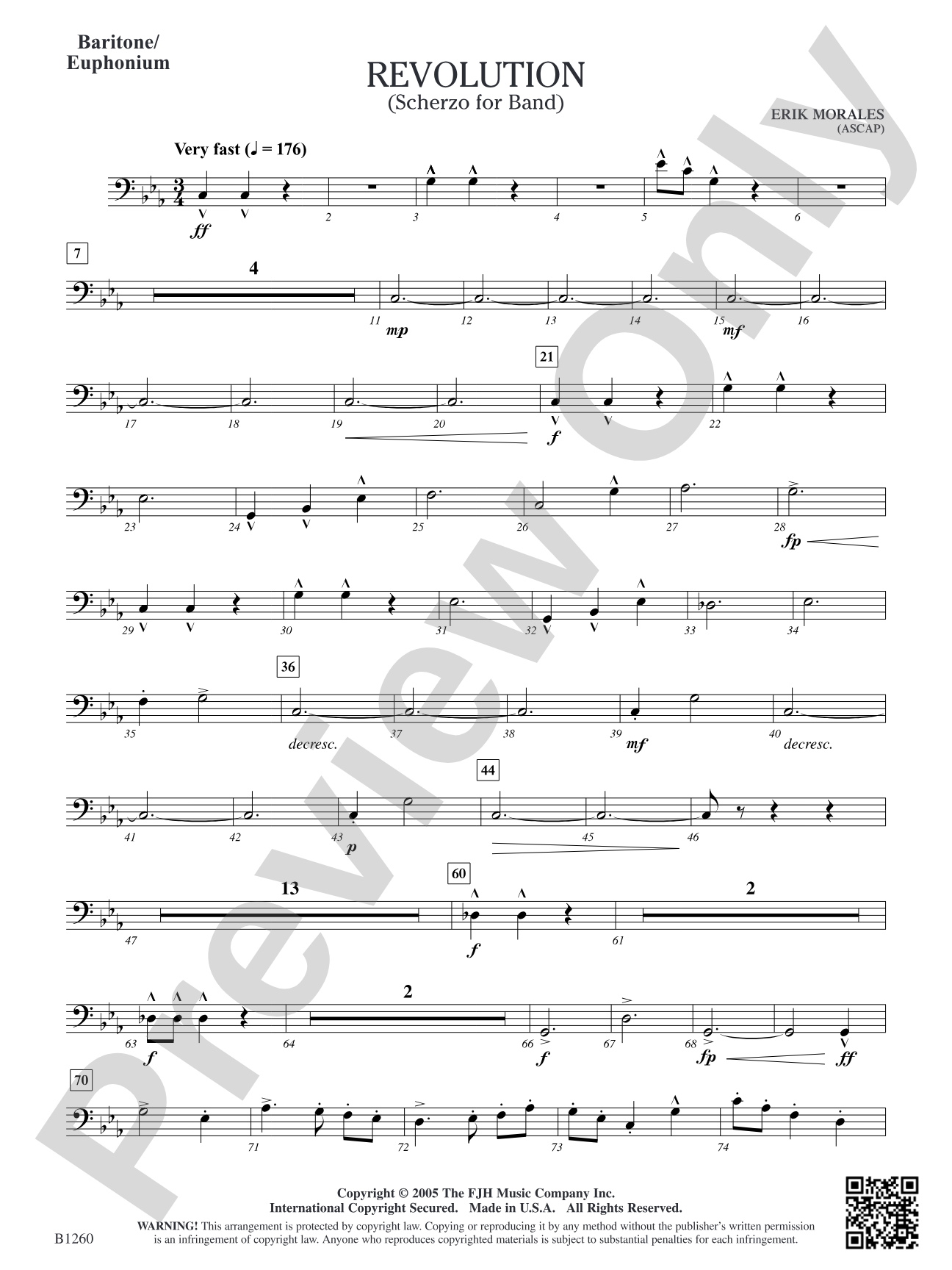

Revolution (Scherzo for Band): Baritone/Euphonium
Scherzo for Band
By Erik Morales
Grade: 5
Item: 98-PC-DB1260_BBC1
$7.00
Pickup currently not available
Description
Be immersed in a sea of swirling colors with this bold and exciting new scherzo for band. The furious 3-beat pulse evokes images of spiraling colors and dark, passionate and intense moods. Animated rhythms give way to a poignant hymn introduced and concluded by a piccolo solo in a contrasting lyrical section. Spiraling once again into a juxtaposition of themes, the work combines excellent percussion writing, soaring melodies, and great counterpoint to drive the piece to a furious and spectacular finish!


Revolution (Scherzo for Band): Baritone/Euphonium isn't in MakeMusic Cloud just yet...but it could be. Let us know you'd like to see it, and you'll help shape what comes next. In the meantime, start a free trial and dive into thousands of interactive titles your students can play along with today.
Request This Title
Tell us you want it.
Start Your Free Trial
Explore everything that's ready to play right now.
Sample Audio
1
Audio File
--:--
0:00
0:00
Sample Video
No sample videos found.
Additional Details
Series:
FJH Symphonic Band
Publisher:
The FJH Music Company, Inc.
SKU:
98-PC-DB1260_BBC1
More about this title
About the Composer: Erik Morales

Erik Morales was born in New York City in 1966 and began composing during his high school years in South Florida. His early work as an arranger for a local marching band launched a prolific career in educational music publishing. He studied composition at Florida International University and earned his bachelor's degree from the University of Louisiana, Lafayette in 1989.
With over 150 published works spanning wind, orchestral, jazz, and chamber ensembles, Morales has established himself as a composer who balances artistic integrity with pedagogical value. His contributions to the trumpet repertoire are particularly notable; his trumpet ensemble works have earned first place finishes at the National Trumpet Competitions, and his Concerto for Trumpet in C and Piano premiered at the 2009 International Trumpet Guild conference. In 2016, he was inducted into the Louisiana Association for Jazz Education's Hall of Fame. His music continues to be performed globally and regularly commissioned by schools and organizations nationwide.
Why we love this
Morales writes with a conductor's understanding of what makes a scherzo resonate with both performers and audiences. The contrast between the relentless 3-beat drive and the introspective piccolo solo creates genuine dramatic weight without sacrificing the kinetic energy Grade 5 bands need to stay engaged. The orchestration and counterpoint throughout give your ensemble real musical meat to sink their teeth into, elevating this beyond a typical fast piece.
What to expect
Revolution plunges you into a whirlwind of spiraling motion and dark, passionate intensity. The relentless 3-beat meter churns beneath animated rhythmic patterns that create a sense of turbulent forward momentum, then suddenly softens into a tender, contemplative moment as the piccolo sings its poignant hymn. The work pulls you back into the fray with renewed urgency, layering competing themes until the final eruption leaves you breathless.
Who it's for
This scherzo suits advanced Grade 5 concert bands with the rhythmic precision and sectional independence to handle its animated figures and layered textures. Directors preparing groups for festival or contest performance will find the work demands real musicianship while remaining achievable for strong high school and college programs. The piece rewards ensembles capable of executing clean articulation and sustaining lyrical focus through contrast.
How to get the most out of it
- Shape the underlying pulse with care during the rhythmically animated sections; the energy should feel propulsive rather than rushed, allowing the harmonic colors to register with the audience.
- Isolate the piccolo solo in sectional rehearsals early. This lyrical moment is the emotional anchor of the piece, and giving the piccolo player confidence and musical ownership pays dividends in the full score.
- Balance the interplay between soaring melodies and countermelodies by having different sections rehearse separately first, then layer them gradually to hear how the voices interact.
- Ensure the full ensemble understands the architecture of the final build. The "juxtaposition of themes" leading into the spectacular finish requires everyone to track which material is primary and which supports it.
How to use it
Program Revolution as a centerpiece for a concert built around contemporary concert band literature or as the high-energy anchor in a festival performance. The dramatic arc and visceral impact make it an excellent complement to a more introspective opening work, or you might pair it with lighter fare to showcase your band's range and precision. Its Grade 5 difficulty positions it well for late-season performances when your ensemble has developed the technical and musical maturity to execute its demands.
Skills your students will build
- Maintaining clarity in animated rhythmic figures while preserving the underlying pulse
- Executing clean articulation across multiple independent melodic lines
- Balancing soaring primary melodies against active countermelodic material
- Controlling dynamic intensity and shaping sustained lyrical passages
- Reading and executing complex layered textures typical of modern concert band scoring
- Responding to conductor cues that manage thematic juxtaposition and dramatic contrast