
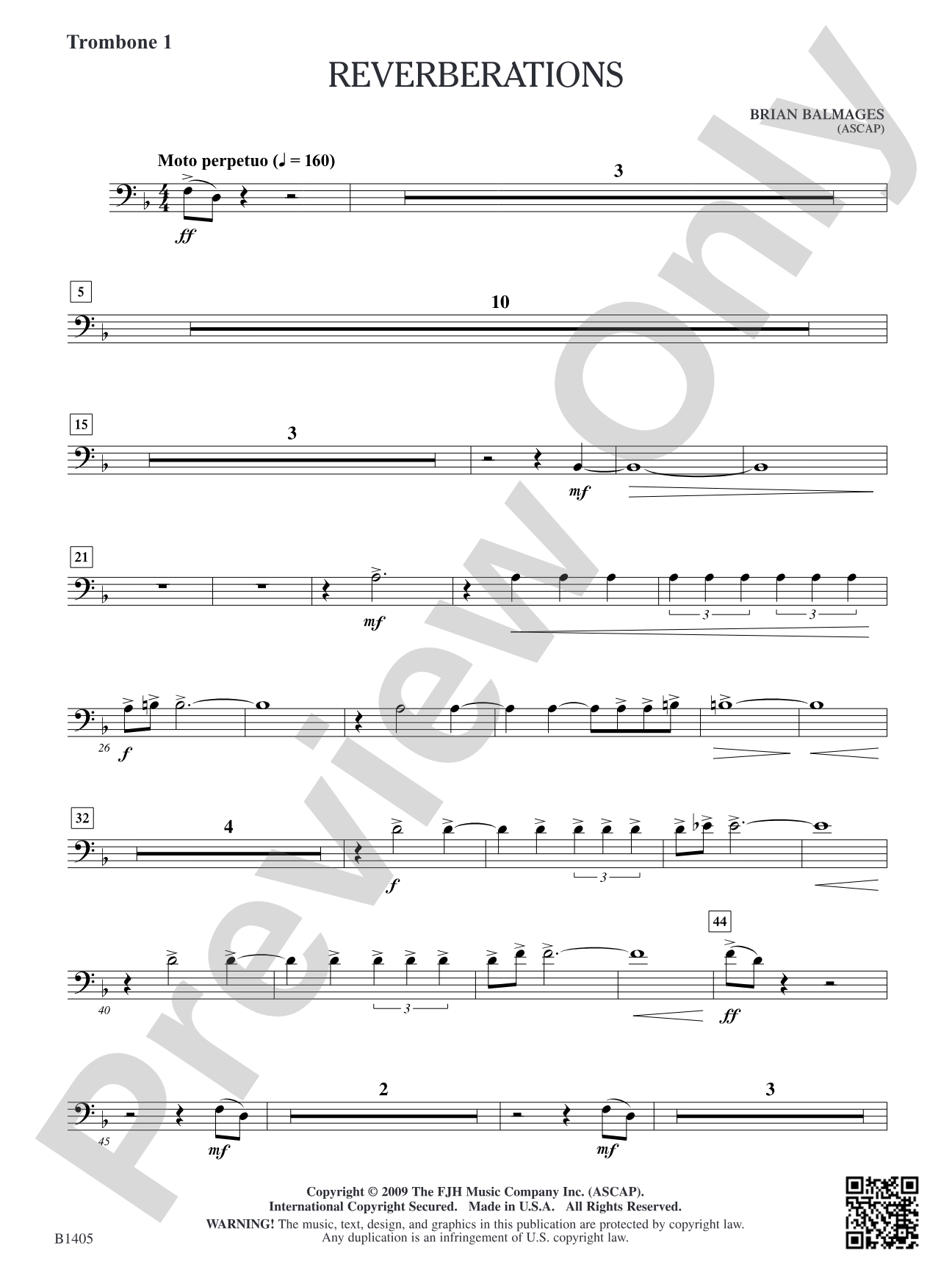

Reverberations: Trombone 1
By Brian Balmages
Grade: 3
Item: 98-PC-DB1405_TN1
$7.00
Pickup currently not available
Description
This explosive short concert fanfare explores various sounds as they echo throughout the ensemble. Based entirely on a two-note motif, the music makes use of minimalist techniques while adding fanfare themes and an extensive percussion backdrop. The end of the work reverses the direction of the motif as the woodwinds echo each other while the brass present the final powerful statements. An incredible contemporary opener!


Don't just read it, hear it, play along with it, and watch your students grow with it. In MakeMusic Cloud, Reverberations: Trombone 1 comes alive with professional accompaniment, adjustable tempo, and built-in practice tools that turn solo practice into real progress.
Open in the Player
Jump straight in and assign it today.
Start Your Free Trial
Open this title and explore the full library in minutes.
Sample Audio
1
Audio File
--:--
0:00
0:00
Sample Video
No sample videos found.
Additional Details
Series:
FJH Concert Band
Publisher:
The FJH Music Company, Inc.
SKU:
98-PC-DB1405_TN1
More about this title
About the Composer: Brian Balmages

Brian Balmages brings equal facility to orchestral, band, and chamber contexts, earning recognition from some of the nation's most prestigious musical institutions. His works have premiered at Carnegie Hall, the Kennedy Center, and the Sydney Opera House, performed by ensembles ranging from professional orchestras to elementary school bands. He received the A. Austin Harding Award from the American School Band Directors Association and won the 2020 NBA William D. Revelli Composition Contest. Balmages was honored with the inaugural James Madison University Distinguished Alumni Award and later commissioned by the University of Miami to compose for the presidential inauguration of Dr. Julio Frenk. His music appeared in the 2013 Presidential Inaugural Prayer Service attended by President Obama and Vice President Biden.
As a conductor, Balmages maintains a global presence, guest conducting at the Midwest Clinic, Western International Band Clinic, and festivals across Australia, Italy, and throughout North America. He serves as Director of MakeMusic Publications and Digital Education for Alfred and MakeMusic, positioning him at the center of contemporary music publishing and education technology.
Why we love this
Balmages crafts this fanfare with a clear structural logic that makes it teachable at Grade 3 while sounding genuinely sophisticated. The two-note motif approach gives your students something concrete to lock onto, yet the minimalist framework and reversal technique at the end create genuine musical development that feels contemporary without overwhelming the ensemble.
What to expect
Explosive energy tempered by architectural clarity. The two-note motif creates hypnotic forward momentum as it ricochets through the ensemble, while the extensive percussion work adds shimmer and resonance that makes the whole band sound larger and more textured than it is. The reversal at the end feels like a sudden shift in perspective, turning the familiar motif inside out as the brass deliver powerful punctuation.
Who it's for
Grade 3 concert bands seeking a contemporary opener with real substance and contest appeal. Directors who want their ensemble to engage with minimalist compositional techniques while maintaining accessible instrumentation and readable parts.
How to get the most out of it
- Establish the two-note motif with absolute clarity in early rehearsals. Once your students hear it as the DNA of the entire work, the architecture becomes transparent and intonation improves across the board.
- Balance the percussion backdrop carefully so it supports rather than overwhelms the melodic exchanges. The extensive percussion writing is the harmonic and textural engine; clarity matters more than volume.
- Approach the motif reversal section as a true structural moment. The woodwind echoes and brass statements at the end require precision and mutual listening to land the dramatic impact Balmages intends.
How to use it
Program this as a concert opener that establishes your band's sophistication and contemporary fluency. At Grade 3, it serves double duty as both a crowd-pleasing fanfare and a pedagogical showcase of how minimalist economy can drive musical interest and ensemble cohesion.
Skills your students will build
- Identifying and tracking a unifying motif across a full ensemble texture
- Balancing percussion within an ensemble mix
- Precision in rhythmic synchronization when material echoes between sections
- Understanding contemporary compositional techniques (minimalism, inversion, textural layering)