
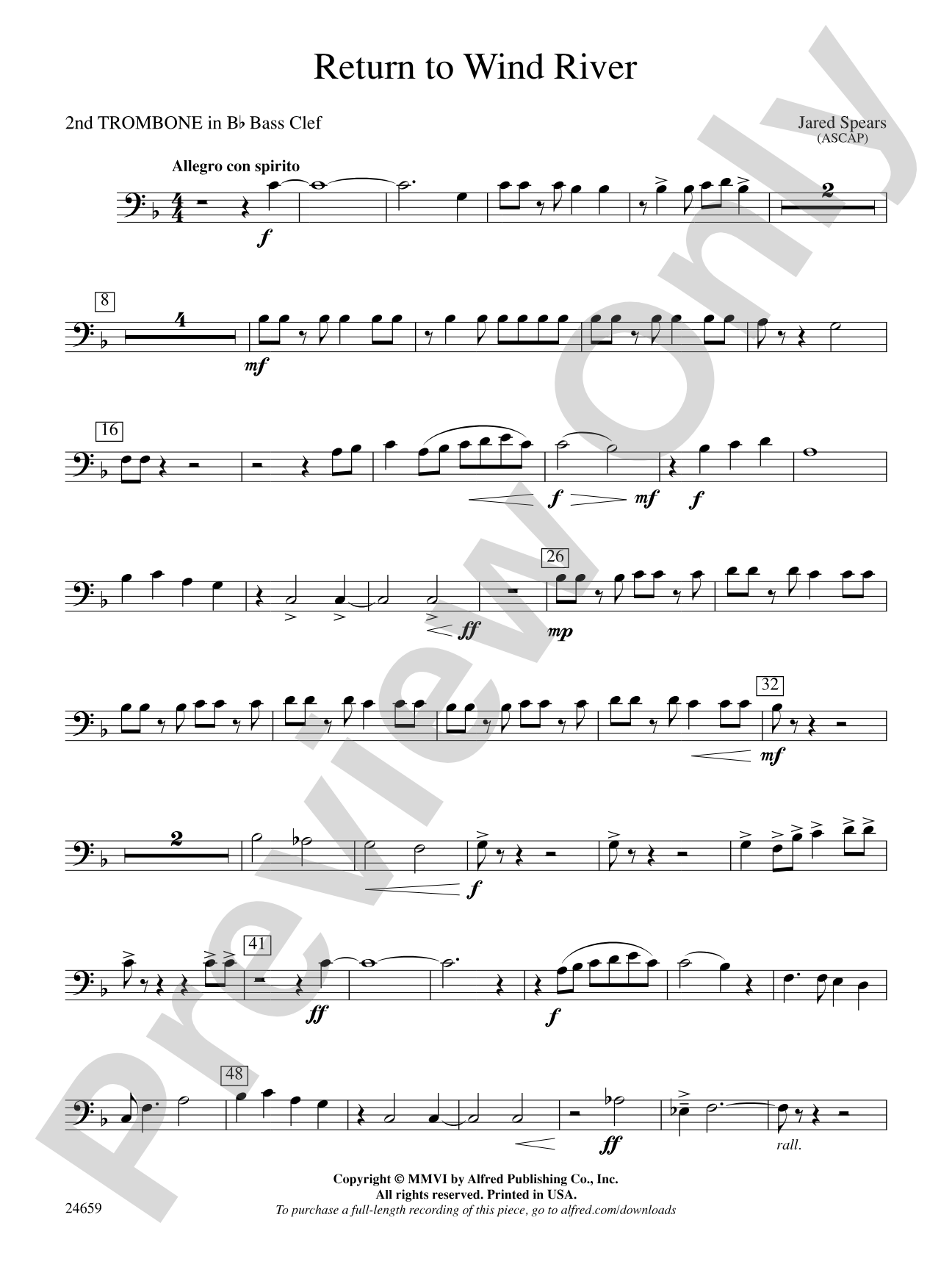
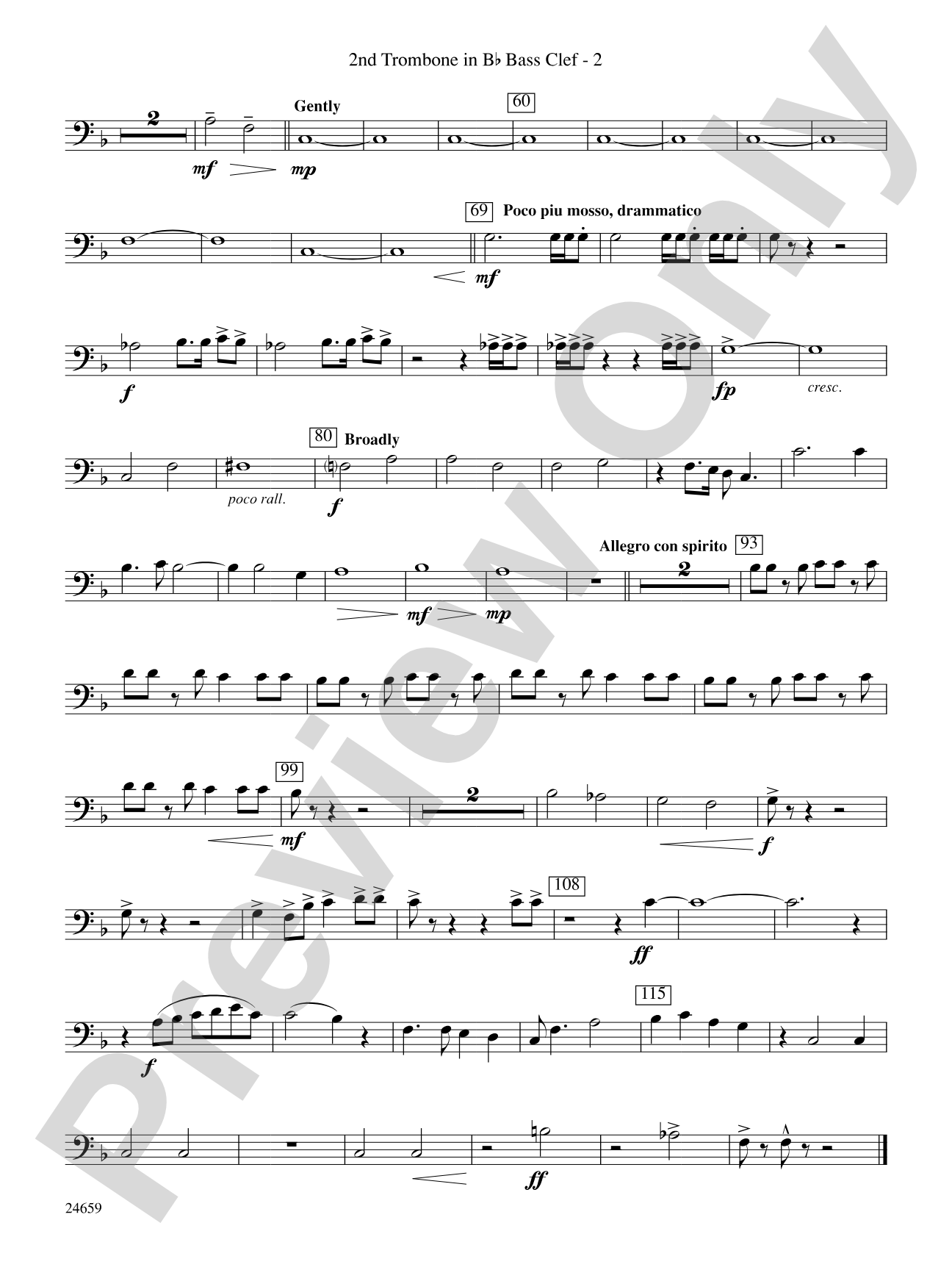

Return to Wind River: (wp) 2nd B-flat Trombone B.C.
By Jared Spears
Grade: 2.5 (Medium Easy)
Item: 00-PC-0000827_wpTN2BC
$3.00
Pickup currently not available
Description
The Wind River Mountain Range and many wilderness areas lie southeast of Yellowstone's National Park in Wyoming. This descriptive overture was inspired by the composer's visits to this beautiful, pristine and mysterious country during his college days. The outer allegro sections recall the excitement of travel, exploration and discovery. The slower, contrasting section portrays the stillness and beauty of a serene mountain lake or peaceful riverbank where, a long time ago, Native Americans may have fished, hunted, and played.


Don't just read it, hear it, play along with it, and watch your students grow with it. In MakeMusic Cloud, Return to Wind River: (wp) 2nd B-flat Trombone B.C. comes alive with professional accompaniment, adjustable tempo, and built-in practice tools that turn solo practice into real progress.
Open in the Player
Jump straight in and assign it today.
Start Your Free Trial
Open this title and explore the full library in minutes.
Sample Audio
1
Audio File
--:--
0:00
0:00
Sample Video
No sample videos found.
Additional Details
Series:
Young Symphonic
Publisher:
Alfred Music
Page Count:
278
SKU:
00-PC-0000827_wpTN2BC
More about this title
About the Composer: Jared Spears

Jared Spears holds the rank of Professor of Music Emeritus at Arkansas State University, where he taught for 32 years across theory, history, composition, percussion, and band at every educational level from elementary through college. A native of Chicago, he earned degrees from Northern Illinois University, the Cosmopolitan School of Music, and Northwestern University, studying with notable composers including Alan Stout and Anthony Donato.
Since retiring in 1999, Spears has maintained an active schedule as both composer and conductor, creating over 250 original works published by American and European publishers. His accolades include the Faricy Award for Creative Music from Northwestern, the University President's Award at Arkansas State, multiple ASCAP awards, and recognition in Who's Who in the World of Percussion and the International Who's Who in Music. His compositions have been performed and recorded worldwide, and he has led festivals, clinics, and guest lectures across North America and Europe.
Why we love this
Spears captures genuine landscape narrative here without resorting to predictable tone painting. The structure lets young musicians experience how contrasting tempos and textures build architectural coherence, and the Grade 2.5 scoring demands real musicianship (balance, phrasing, sectional independence) rather than technical flash. Programming this piece signals to your community that concert band repertoire can be both accessible and substantive.
What to expect
The outer sections pulse with the restless energy of exploration and travel; you hear the landscape unfold as the band moves forward together. The central movement settles into reflective stillness, invoking quiet waters and open sky, before the journey resumes with renewed wonder.
Who it's for
Intermediate concert bands ready to step beyond rhythmic and melodic basics into genuine musical storytelling. This works well for ensembles with solid fundamentals who can handle sectional independence and maintain ensemble blend without constant cuing.
How to get the most out of it
- Shape the outer allegro sections with clear forward motion and energy; the piece draws power from sustained excitement rather than speed, so lock the tempo and let articulation drive the character.
- Bring the middle section into sharp focus by isolating its melodic voices during sectional rehearsals; younger players often bury the lyrical material under thick accompaniment.
- Balance the transition back to the final allegro carefully; it should feel like a natural return to discovery, not a jolt. Use the last few measures of the slow section to gradually brighten the harmonic color.
- Record a full run-through early in rehearsal to establish your interpretation; this helps students internalize the arc and prevents the piece from fragmenting into disconnected sections.
How to use it
Use this as a concert opener or the centerpiece of a program exploring American landscape and culture. It pairs effectively with other multicultural or nature-inspired pieces, and its accessible Grade 2.5 level makes it ideal for early-season performances while you build toward more technically demanding literature.
Skills your students will build
- Maintaining independent melodic and harmonic lines within ensemble texture
- Controlling dynamic contrast between allegro and andante sections
- Sustaining tone quality and intonation across longer phrases
- Shaping musical architecture across an entire piece rather than measure-to-measure
- Responding to conductor cueing for smooth sectional transitions