
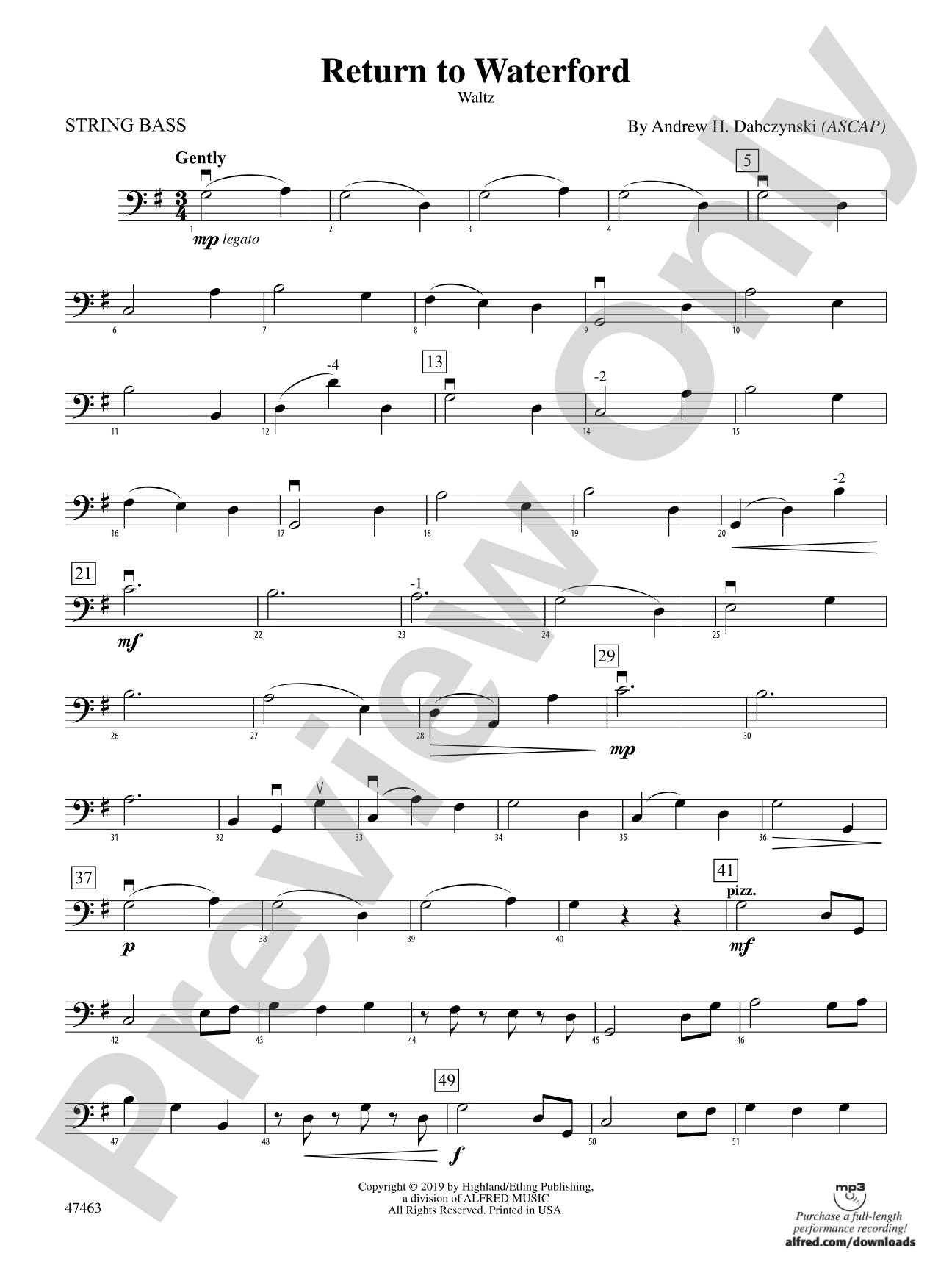

Return to Waterford: String Bass
Waltz
By Andrew H. Dabczynski
Grade: 2.5
Item: 00-PC-0017992_SB
$5.99
Pickup currently not available
Description
This tender, flowing waltz conveys a sense of peaceful nostalgia, reflecting his family's long association with the pastoral village of Waterford, Maine. This enchanting piece provides an opportunity for young string players to master graceful phrasing and smooth legato bowing. Totally approachable for intermediate players, yet appropriately challenging for more advanced musicians, it includes a delightful optional harp/piano part. An original fiddle waltz, written to celebrate the wedding of the composer's daughter, this piece will transport audiences and complement any string orchestra program.


Don't just read it, hear it, play along with it, and watch your students grow with it. In MakeMusic Cloud, Return to Waterford: String Bass comes alive with professional accompaniment, adjustable tempo, and built-in practice tools that turn solo practice into real progress.
Open in the Player
Jump straight in and assign it today.
Start Your Free Trial
Open this title and explore the full library in minutes.
Sample Audio
1
Audio File
--:--
0:00
0:00
Sample Video
Additional Details
Series:
Highland/Etling String Explorer
Publisher:
Alfred Music
Page Count:
140
SKU:
00-PC-0017992_SB
More about this title
About the Composer: Andrew H. Dabczynski

Andrew H. Dabczynski served as Emeritus Professor of Music Education at Brigham Young University, where he founded the BYU "New Horizons Orchestra" as both a performance ensemble for adult beginning string players and a training ground for string pedagogy. His contributions to music education earned him BYU's Joseph E. White Fellowship for Teaching and Learning, and Utah ASTA recognized him as "Higher Education Teacher of the Year" in 2005 and later honored his "Outstanding Contributions to Music Education."
Dabczynski's career spans performance, teaching, and research. He performed as violist with the Rochester Philharmonic, Hartford Symphony, Portland Symphony, and other regional orchestras, and served as a member of the Colden String Quartet at Western Michigan University. His deep expertise in string pedagogy informed the widely respected String Explorer method series, co-authored with others and published by Alfred. A lifelong engagement with folk music and fiddling traditions has shaped both his research and his compositional voice, particularly evident in works like this waltz.
Why we love this
Dabczynski wrote this waltz as a personal tribute to his daughter's wedding, but it transcends that occasion to become a piece that teaches something essential: how to shape a melody with warmth and restraint. The balance between approachable intermediate technique and genuine musical depth means your section will grow musically without struggling technically, and your stronger players will find room to develop interpretive nuance. The optional harp or piano part adds textural richness that opens programming possibilities beyond the standard string orchestra sound.
What to expect
The waltz unfolds with unhurried warmth, evoking a pastoral New England village and inviting reflection without melancholy. The flowing melodic lines and smooth accompaniment create an intimate musical landscape that feels like memory itself: clear, tender, and peaceful.
Who it's for
Intermediate and advanced string orchestras working at the Grade 2.5 level will find this piece rewarding. It serves ensembles ready to explore graceful phrasing and legato bowing without requiring virtuosic technique, making it ideal for groups progressing beyond early-intermediate repertoire but not yet into advanced territory.
How to get the most out of it
- Shape the phrasing in two-bar or four-bar units rather than note-by-note. Let the waltz rhythm breathe naturally, and the legato will emerge from intentional phrase arcs rather than from forcing every bow change.
- Keep the tempo steady but unhurried. The "peaceful nostalgia" in the piece depends on allowing listeners (and players) space to settle into the waltz character without rushing.
- If using the optional harp or piano part, balance it so it supports harmonic foundation without overwhelming the string melody. The strings should remain the primary voice.
- Encourage consistent vibrato that complements the lyrical quality. Young players sometimes hold back vibrato on "simple" melodies; remind them that expressive vibrato deepens the nostalgia the piece conveys.
How to use it
This piece fits naturally into a concert celebrating composition, folk traditions, or American music. Its accessible charm makes it an excellent bridge between lighter ensemble selections and more substantial works on the same program. The wedding origin story adds a lovely program note that audiences appreciate, whether you perform it on a spring concert, festival, or celebration of ensemble accomplishments.
Skills your students will build
- Shaping long, flowing phrases across multiple measures
- Executing smooth legato bowing with consistent tone quality
- Balancing melody and accompaniment in a traditional waltz texture
- Playing with vibrato that enhances lyricism without obscuring tuning
- Understanding folk-based compositional language and American fiddle traditions