
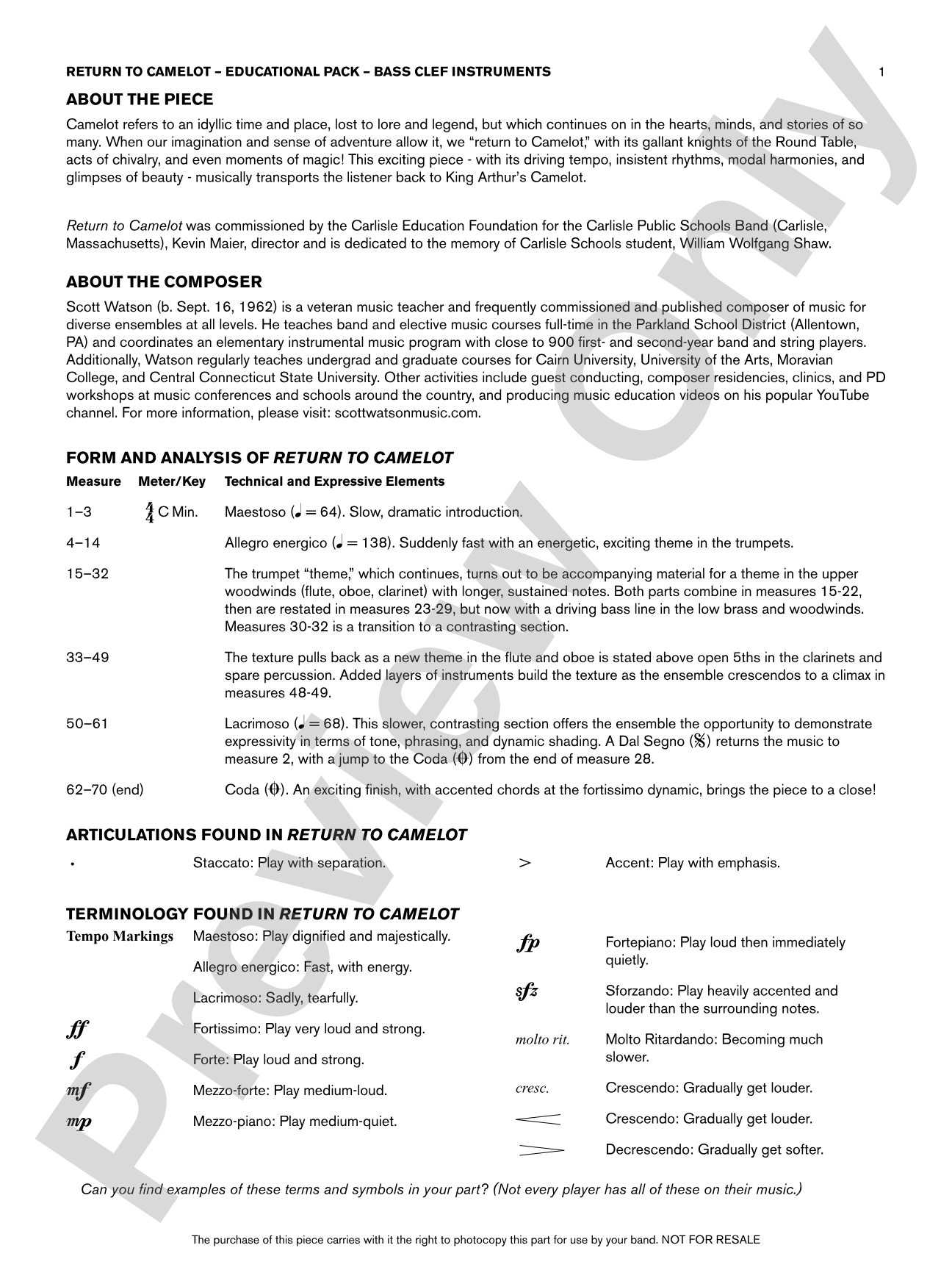

Return to Camelot: Bass Clef Educational Pack
By Scott Watson
Grade: 2 (Medium Easy)
Item: 00-PC-0018669_BC_EDPAK
$3.00
Pickup currently not available
Description
Camelot refers to an idyllic time and place, lost to lore and legend, but which continues on in the hearts, minds, and stories of so many. When our imagination and sense of adventure allow it, we return to Camelot, with its gallant knights of the Round Table, acts of chivalry, and even moments of magic! This exciting piece by Scott Watson---with its driving tempo, insistent rhythms, modal harmonies, and glimpses of beauty---musically transports the listener back to King Arthur's Camelot. (3:25) This title is available in MakeMusic Cloud.


Don't just read it, hear it, play along with it, and watch your students grow with it. In MakeMusic Cloud, Return to Camelot: Bass Clef Educational Pack comes alive with professional accompaniment, adjustable tempo, and built-in practice tools that turn solo practice into real progress.
Open in the Player
Jump straight in and assign it today.
Start Your Free Trial
Open this title and explore the full library in minutes.
Sample Audio
1
Audio File
--:--
0:00
0:00
Sample Video
Additional Details
Series:
Sound Innovations for Concert Band
Publisher:
Alfred Music
Page Count:
136
SKU:
00-PC-0018669_BC_EDPAK
More about this title
About the Composer: Scott Watson

Scott Watson holds the position of Associate Professor of Music at Cairn University in Langhorne, Pennsylvania. Before joining the faculty, he spent 35 years in the Parkland School District near Allentown, where he directed high school bands and later coordinated the elementary band and strings program across the district.
Watson has composed more than 120 works for concert band, string orchestra, and chamber ensembles, ranging from elementary through advanced levels. His compositions have been performed internationally and at prominent American venues including the Academy of Music in Philadelphia, the Midwest Clinic in Chicago, and the White House. Beyond composing and conducting, he has authored the music education text Using Technology to Unlock Musical Creativity (Oxford University Press, 2011) and regularly leads workshops for music educators. He serves as an exclusive composer and clinician for Alfred Publications.
Why we love this
Return to Camelot succeeds because it balances accessibility with genuine musical substance. A Grade 2 piece that actually sounds like concert music rather than a study, it offers the driving rhythmic energy and modal color that engage audiences while remaining within the technical reach of developing ensembles. Directors appreciate how Watson builds interest through orchestration and harmonic movement rather than relying on complexity.
What to expect
The piece conjures gallant adventure and medieval pageantry through modal harmonies and rhythmic drive, then shifts to reveal intimate moments of magic and beauty. Throughout, the orchestration transports listeners to a legendary time and place, building from mystery to triumph without sacrificing accessibility.
Who it's for
This work suits developing concert bands preparing for festival or contest performance. It demands solid fundamentals from section leaders and the rhythm section but does not require advanced technical facility, making it ideal for Grade 2 level ensembles seeking programmatic material with musical weight.
How to get the most out of it
- Shape the driving rhythmic figures with slight rubato in the lyrical passages to prevent the piece from feeling mechanical; let the beauty glimpses breathe without losing momentum.
- Balance the modal harmonies by ensuring inner voices maintain independence; these colors dissolve if all sections lock into unison or simple block voicing.
- Emphasize the programmatic journey from the opening fanfare through moments of magic to the triumphant return. Mark these transitions in rehearsal so the band understands the narrative arc, not just the notes.
- Guard against rushing during the faster sections. Lock the rhythm section first, then layer in the melodic voices so the insistent rhythms feel relentless rather than frantic.
How to use it
Program Return to Camelot as a centerpiece for a festival or contest round where the band's playing maturity matters more than technical flash. It pairs well alongside classical or contemporary classics, offering a narrative middle ground that appeals to both judges and audience members. The 3:25 duration fits comfortably into most concert formats.
Skills your students will build
- Sustaining modal harmonic color across sections
- Maintaining rhythmic precision in driving figures without rushing
- Balancing melodic independence within an ensemble texture
- Interpreting programmatic intent through phrasing and dynamic shape
- Reading intermediate concert band orchestration across all instrument families