
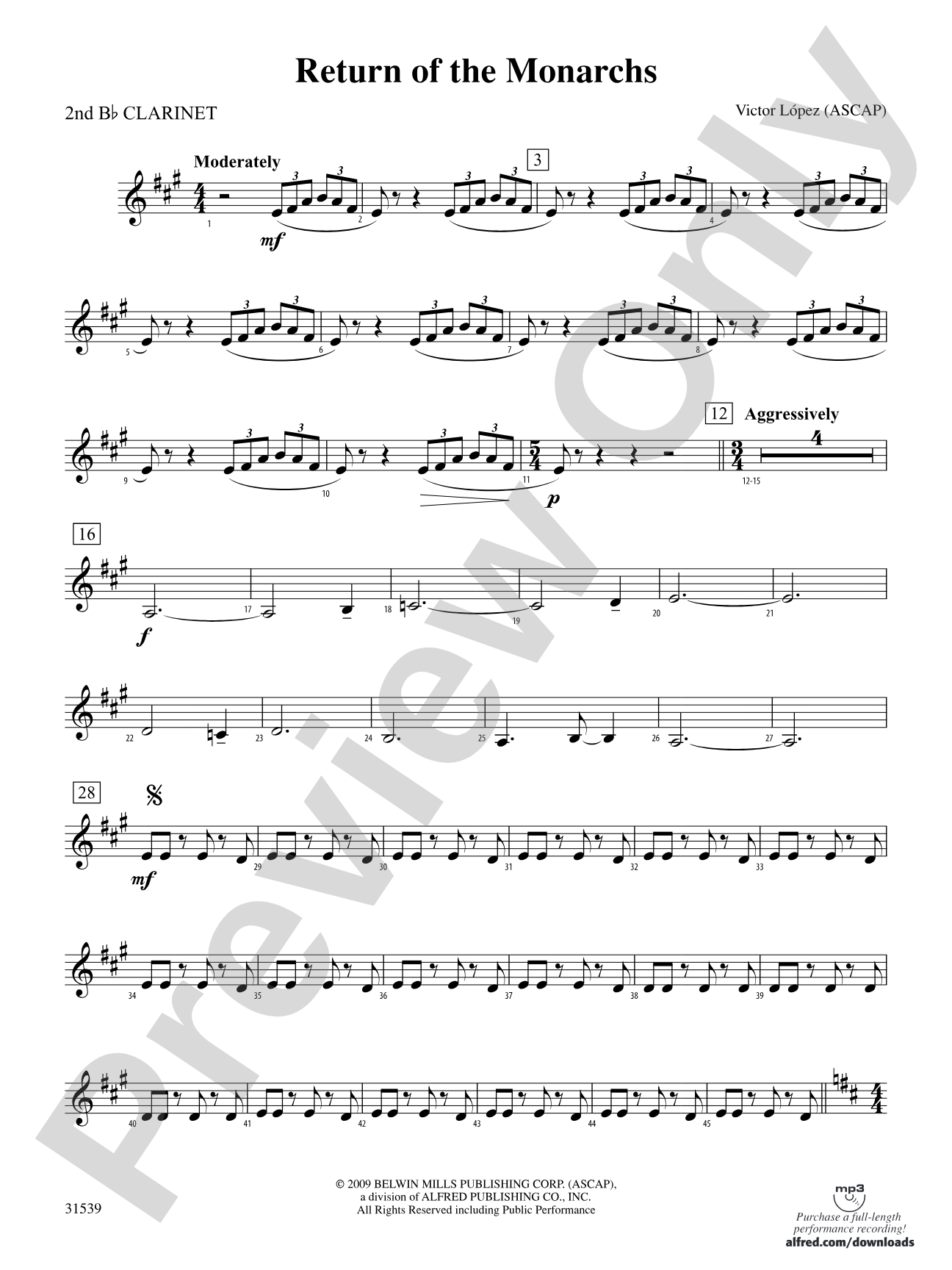

Return of the Monarchs: 2nd B-flat Clarinet
By Victor López
Grade: 3
Item: 00-PC-0001727_C2
$3.00
Pickup currently not available
Description
This original composition is somewhat flamboyant and impulsive in nature, yet includes luscious full sections, as it interprets the migration of the monarch butterfly. Extensive scientific information is included, setting the stage for a great interdisciplinary thematic educational experience for your students.


Don't just read it, hear it, play along with it, and watch your students grow with it. In MakeMusic Cloud, Return of the Monarchs: 2nd B-flat Clarinet comes alive with professional accompaniment, adjustable tempo, and built-in practice tools that turn solo practice into real progress.
Open in the Player
Jump straight in and assign it today.
Start Your Free Trial
Open this title and explore the full library in minutes.
Sample Audio
1
Audio File
--:--
0:00
0:00
Sample Video
No sample videos found.
Additional Details
Series:
Belwin Intermediate Full Orchestra
Publisher:
Alfred Music
Page Count:
254
SKU:
00-PC-0001727_C2
More about this title
About the Composer: Victor López
Victor López is a prolific composer and arranger whose catalog spans educational wind band, orchestra, and jazz ensemble literature. His compositions for young musicians balance technical accessibility with genuine musical substance, often drawing inspiration from nature, cultural narratives, and historical events. López's work appears regularly on festival programs and contest stages across North America, earning recognition for orchestrations that engage students while remaining performable by developing ensembles.
Why we love this
The flamboyant character paired with substantive musical content makes this piece a standout choice for programs seeking something beyond standard Grade 3 fare. The built-in scientific narrative transforms what could be a simple concert piece into a genuine educational experience that connects orchestral music to observable natural phenomena. Students engage with sophisticated ensemble writing without sacrificing the approachability that makes them actually want to perform it.
What to expect
The piece captures the monarch butterfly's journey with a character that shifts between delicate, precise passages and moments of sweeping grandeur. There's an inherent sense of motion and purpose throughout; the flamboyant personality keeps things from ever feeling static or predictable.
Who it's for
This score and parts work for conductors leading full orchestras at the Grade 3 level who want repertoire that satisfies both concert and festival contexts. Ensembles with developing players across all sections will find López's orchestration both challenging and rewarding, with parts written to allow meaningful contribution from every chair.
How to get the most out of it
- Establish the impulsive character early in rehearsal through clear articulation and rhythmic precision; the piece's energy relies on players committing fully to the flamboyant gestures López writes.
- Balance the luscious full sections by ensuring upper winds have projection without overwhelming the harmonic foundation in the lower voices; this piece works best when all orchestral colors shine through.
- Use the scientific context as a rehearsal aid. Have students research or read excerpts about monarch migration patterns before rehearsals begin; connecting the music's narrative arc to actual biological facts deepens their interpretive choices.
- Pay attention to dynamics markings as character indicators rather than mere volume instructions. The shifts between flamboyant passages and fuller, rounder sections define the piece's storytelling shape.
How to use it
Program this as a concert opener or second piece to showcase your orchestra's range and ensemble cohesion to an audience. The combination of spectacle and substance also makes it an excellent festival selection, allowing your ensemble to demonstrate growth in both technical execution and musical interpretation within a single work.
Skills your students will build
- Balancing individual voice projection within full orchestral textures
- Interpreting character-driven conducting gestures across contrasting musical sections
- Sustaining rhythmic precision during rhythmically complex passages
- Responding to dynamic and articulation changes as expressive and structural tools
- Reading and performing from individual parts that serve the larger orchestral narrative