
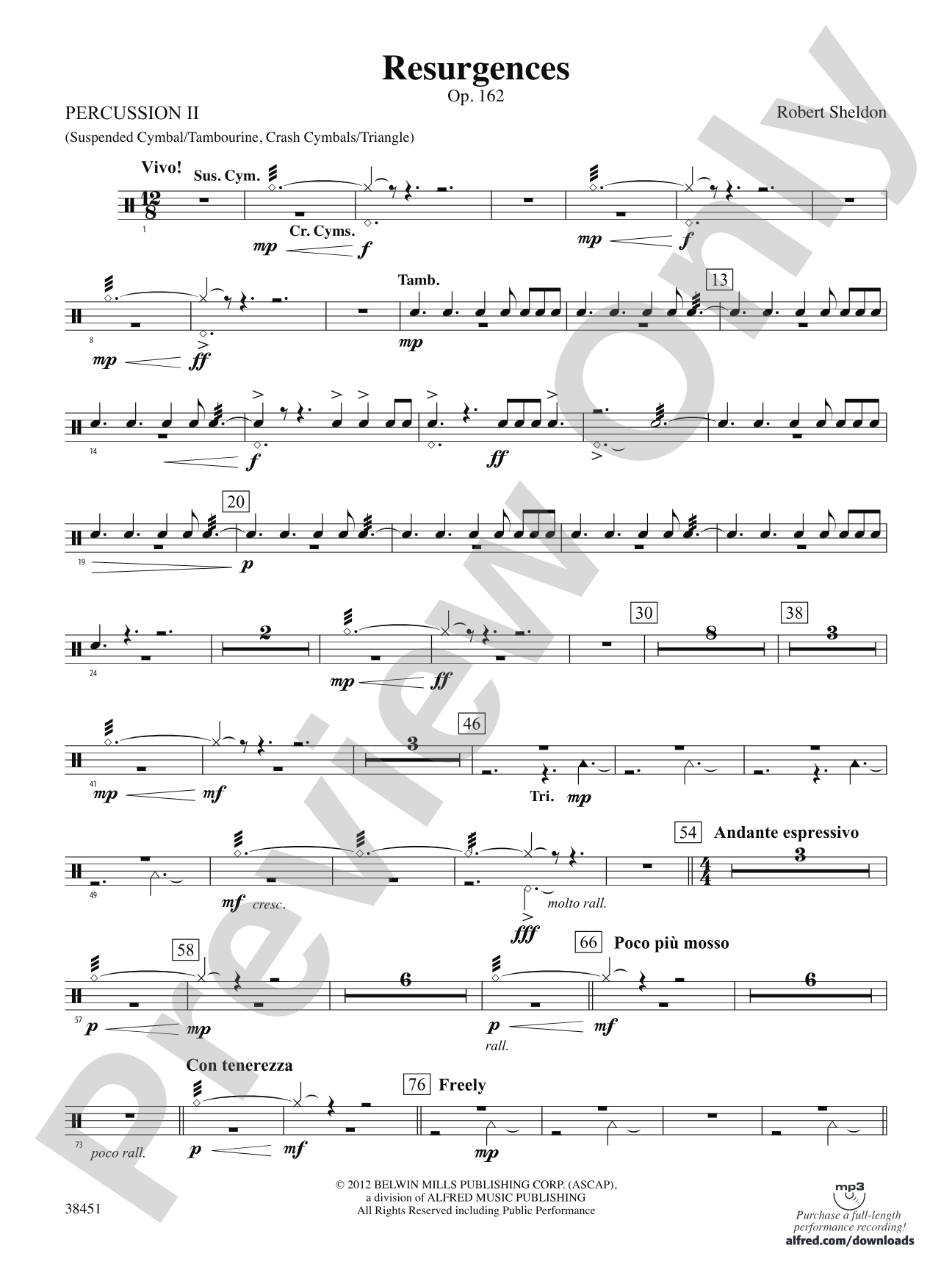

Resurgences: 2nd Percussion
Op. 162
By Robert Sheldon
Grade: 4
Item: 00-PC-0015507_PC2
$3.00
Pickup currently not available
Description
A fantastic original piece for full orchestra, players and audiences will delight in this new work. Perfect for any occasion, this is a celebratory piece expressing the joy and exhilaration of a new beginning.


Don't just read it, hear it, play along with it, and watch your students grow with it. In MakeMusic Cloud, Resurgences: 2nd Percussion comes alive with professional accompaniment, adjustable tempo, and built-in practice tools that turn solo practice into real progress.
Open in the Player
Jump straight in and assign it today.
Start Your Free Trial
Open this title and explore the full library in minutes.
Sample Audio
1
Audio File
--:--
0:00
0:00
Sample Video
No sample videos found.
Additional Details
Series:
Belwin Concert Full Orchestra
Publisher:
Alfred Music
Page Count:
228
SKU:
00-PC-0015507_PC2
More about this title
About the Composer: Robert Sheldon

Robert Sheldon's compositions appear on concert stages and festival programs across the globe with remarkable frequency. His works have earned recognition from the American School Band Director's Association, Phi Beta Mu, and ASCAP, and he has conducted his own music in venues ranging from Carnegie Hall to the Sydney Opera House. Beyond composing, Sheldon co-authored Sound Innovations for Concert Band and maintains an active schedule as a guest conductor for honor bands and a clinician at universities and state music education conferences.
Sheldon's international conducting experience spans the United States, Japan, Canada, Italy, Germany, Australia, and China. His output consistently meets the needs of school and community orchestras, and he regularly accepts commissions for new works. VanderCook College of Music awarded him an honorary doctorate in 2020.
Why we love this
Sheldon writes orchestral music that balances accessibility with genuine substance, and Resurgences exemplifies this approach. The Grade 4 score gives every section meaningful material without requiring advanced technical demands, making it suitable for most school orchestras while remaining engaging for accomplished ensembles. Its celebratory character and clear sense of forward motion make it an ideal vehicle for building ensemble confidence and showcasing the full palette of orchestral colors.
What to expect
Resurgences radiates optimism and forward momentum, with bright orchestral textures and a sense of arrival that feels earned rather than forced. The piece embodies genuine celebration without sentimentality, capturing the energy and possibility of beginning anew.
Who it's for
This work suits high school and college orchestras with mixed ability levels, as well as community and youth orchestras looking for repertoire that builds musicianship without excessive technical burden. Conductors will appreciate both the educational value and the polished, professional quality that resonates with diverse audiences.
How to get the most out of it
- Balance the dynamic shifts that define the architecture of this piece; mark cue points in the parts so sections can hear each other's entrances clearly and maintain ensemble cohesion through the transitional passages.
- Establish a steady, confident tempo early in rehearsals and lock it in before adding expressive details; this piece depends on rhythmic security to project its celebratory energy.
- Work the string sections separately on their sustaining passages to ensure they provide a stable harmonic foundation while winds and brass carry melodic material overhead.
- Bring out the distinctive instrumental colors that emerge in different sections without overblowing dynamics; Sheldon's orchestration reveals character detail when each family is heard clearly.
How to use it
Program this as an opening piece on a concert to set an uplifting tone for the audience, or use it to anchor a concert theme around renewal and positive change. Its length and grade level also make it effective for festival or contest settings where a confident, well-executed performance can showcase your orchestra's musicality.
Skills your students will build
- Sustaining tone quality across dynamic shifts in longer string passages
- Ensemble balancing between melodic and harmonic instrumental roles
- Reading and executing clear sectional entrances and cues
- Responding to and executing celebratory character with controlled intensity
- Maintaining rhythmic precision across multiple metric and textural changes