
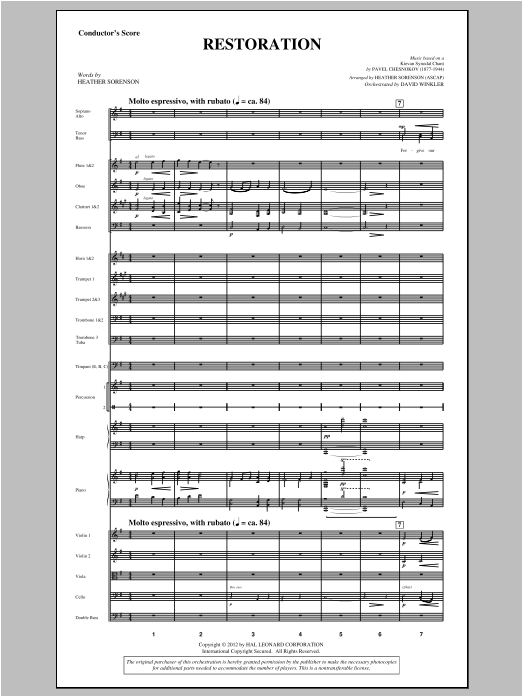

Restoration: Choral Instrumental Pak
By Pavel Chesnokov
Item: 35-PK00251768
$74.95
Pickup currently not available
Buy Extra Parts (Digital PDF Download)
Parts Added to Cart!
Description
From the pages of concert music repertoire comes an adaptation that incorporates the power of the original masterwork with the impact of a new sacred text.
Contemplative in nature, the cry for forgiveness and mercy rises like a prayer from the luxurious textures of the choral sonority. Linear voice leading gives this through-composed anthem an organic quality flowing with emotion and religious devotion. A noble orchestration crowns the whole with dignity and nobility. Duration: ca. 4:47


Restoration: Choral Instrumental Pak isn't in MakeMusic Cloud just yet...but it could be. Let us know you'd like to see it, and you'll help shape what comes next. In the meantime, start a free trial and dive into thousands of interactive titles your students can play along with today.
Request This Title
Tell us you want it.
Start Your Free Trial
Explore everything that's ready to play right now.
Sample Audio
No sample audio found.
Sample Video
No sample videos found.
Additional Details
Publisher:
Hal Leonard
SKU:
35-PK00251768
More about this title
About the Composer: Pavel Chesnokov
Pavel Chesnokov (1877–1944) was a Russian choral composer and conductor whose sacred works became foundational to the Orthodox choral tradition. His mastery of vocal writing and harmonic language made him one of the most performed Orthodox composers in concert settings, and his influence on choral arrangers extends far beyond his lifetime.
Chesnokov's compositional approach centered on the expressive potential of the human voice layered in rich sonorities. His understanding of how text and music could deepen spiritual meaning shaped an entire school of sacred choral writing that remains essential repertoire for directors seeking authenticity in religious concert music.
Why we love this
Chesnokov's compositional voice carries genuine spiritual weight without sentimentality, and this adaptation honors that integrity while opening the work to orchestral forces. The through-composed structure means there's no formulaic repetition to lean on; every moment demands that singers stay engaged with the text and its emotional arc. It's the kind of piece that reshapes how your choir thinks about phrasing and collective sound.
What to expect
A meditation that unfolds with quiet intensity. The harmonic language is rich enough to sustain attention across nearly five minutes, yet never feels heavy; instead, the luxurious textures create a sense of being held within something sacred. The cry for forgiveness emerges not as desperate but as honest and clear, like light through a colored window.
Who it's for
This works best with an experienced choir comfortable with sustained harmonic complexity and sensitive phrasing, paired with an orchestra capable of lyrical accompaniment. The piece demands singers and instrumentalists who can find beauty in restraint and understand that power doesn't require volume.
How to get the most out of it
- Honor the linear voice leading by releasing each phrase cleanly at its natural conclusion rather than sustaining into the next entrance; the overlapping lines create texture, not muddle.
- Balance the choir against the orchestra with care during the climactic passages; the orchestration should amplify, not bury, the choral sonority.
- Shape the dynamics organically from the text rather than following a predetermined arch; mercy and forgiveness don't build the same way from phrase to phrase.
- Work with your orchestra on the expressive weight beneath the choral line; the accompaniment carries as much devotional intent as the voices do.
How to use it
Position this as an anchor for a sacred music concert, where it can breathe without competing with lighter fare. It pairs naturally with other Orthodox or contemplative works, or it can stand alone as a powerful opening statement. Consider programming it when your orchestra is present for a joint concert rather than forcing it into an all-choir concert.
Skills your students will build
- Singing through-composed forms without melodic landmarks or repetition
- Balancing independent voice lines in dense harmonic writing
- Sustaining emotional authenticity across a long, slow piece
- Coordinating phrasing and breathing with orchestral accompaniment
- Interpreting sacred text with precision and reverence