Restoration Sheet Music Preview

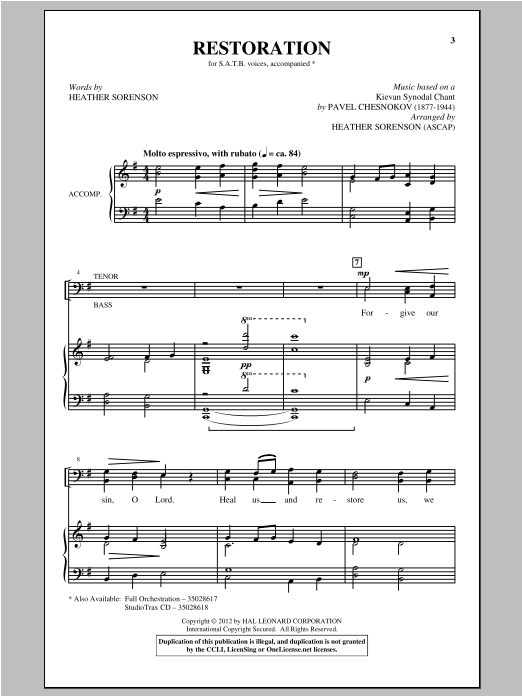
Restoration: SATB Choral Octavo

By Pavel Chesnokov / Arranged by Heather Sorenson

Item: 35-DS00249698

Digital Download
$2.99
Description

Restoration: SATB Choral Octavo isn't in MakeMusic Cloud just yet...but it could be. Let us know you'd like to see it, and you'll help shape what comes next. In the meantime, start a free trial and dive into thousands of interactive titles your students can play along with today.

Sample Audio
No sample audio found.
Sample Video
Additional Details
Publisher: Hal Leonard
Page Count: 10
SKU: 35-DS00249698

More about this title

About the Composer: Pavel Chesnokov

Pavel Chesnokov (1877-1944) was a Russian choral composer and conductor whose sacred music defined the Russian Orthodox liturgical tradition during the late 19th and early 20th centuries. His compositional voice merged strict counterpoint with distinctly Russian harmonic language, creating works that balance technical rigor with profound spiritual expression. Chesnokov's choral writing demands precision and sensitivity from singers while rewarding them with music of lasting beauty and theological weight.

His catalog of over 500 works encompasses full liturgies, motets, and shorter sacred pieces, many of which remain central to Orthodox and ecumenical choral repertoires worldwide. Chesnokov's influence on music education extends through his ability to craft pieces that challenge developing musicians while remaining entirely singable, a quality that has kept his music vital in school, collegiate, and professional choirs for more than a century.

Why we love this

Heather Sorenson's arrangement unlocks Chesnokov's Russian Orthodox sensibility for SATB choirs without compromising the composer's harmonic sophistication. The sacred text paired with rich, accessible voicing makes this piece resonate immediately with singers and audiences alike, while the musical integrity keeps it in your concert rotation year after year. At ten pages, it carries genuine substance and theological weight suitable for programs that honor both musical and spiritual depth.

What to expect

The piece unfolds with quiet reverence and architectural clarity. Sorenson's arrangement maintains Chesnokov's intricate harmonic voice leading while allowing each section of your choir to experience moments of lyrical beauty and shared harmonic complexity. The ten pages create a journey that feels both intimate and grand, drawing the listener into a space of profound stillness and contemplation.

Who it's for

This octavo suits advanced high school choirs and collegiate ensembles ready to engage with sacred repertoire that asks something of their musicianship. It also works well for concert choirs, church choirs, and festival programs seeking music that carries liturgical authenticity without requiring a specialized knowledge of Orthodox practices.

How to get the most out of it

  • Balance the harmonic palette by rehearsing inner voices separately; Sorenson's voice leading rewards careful attention to alto and tenor independence, particularly in passages where these parts carry the harmonic momentum.
  • Shape phrases with long, sustained breath support rather than pushing tempo. Russian sacred music thrives on spaciousness, and allowing singers to sit into their resonance transforms the piece from correct to transcendent.
  • Mark vowel consistency across all four parts during diction work. The unified Russian Orthodox text demands precision in pronunciation and vowel uniformity that creates the tonal blend this arrangement requires.
  • Consider the registered recording as a rehearsal tool for learning bass and tenor lines, but prioritize your own interpretation once the notes are secure. The musical character shifts when your choir claims ownership of the phrasing and balance.

How to use it

Pair this with other sacred music by Russian or Eastern European composers to create a concert segment that explores Orthodox and ecumenical choral traditions. Its length and spiritual substance make it an effective anchor piece for programs centered on faith, hope, or restoration themes. Consider programming it in the second half of a concert after lighter fare, allowing the audience to settle into its meditative intensity.

Skills your students will build

  • Russian Orthodox harmonic language and voice leading
  • Sustained legit tone production in sacred context
  • Precise vowel unification across SATB texture
  • Phrasing with long breath spans and sustained musical ideas
  • Performing liturgical text with authentic accent and pronunciation

You May Also Like