
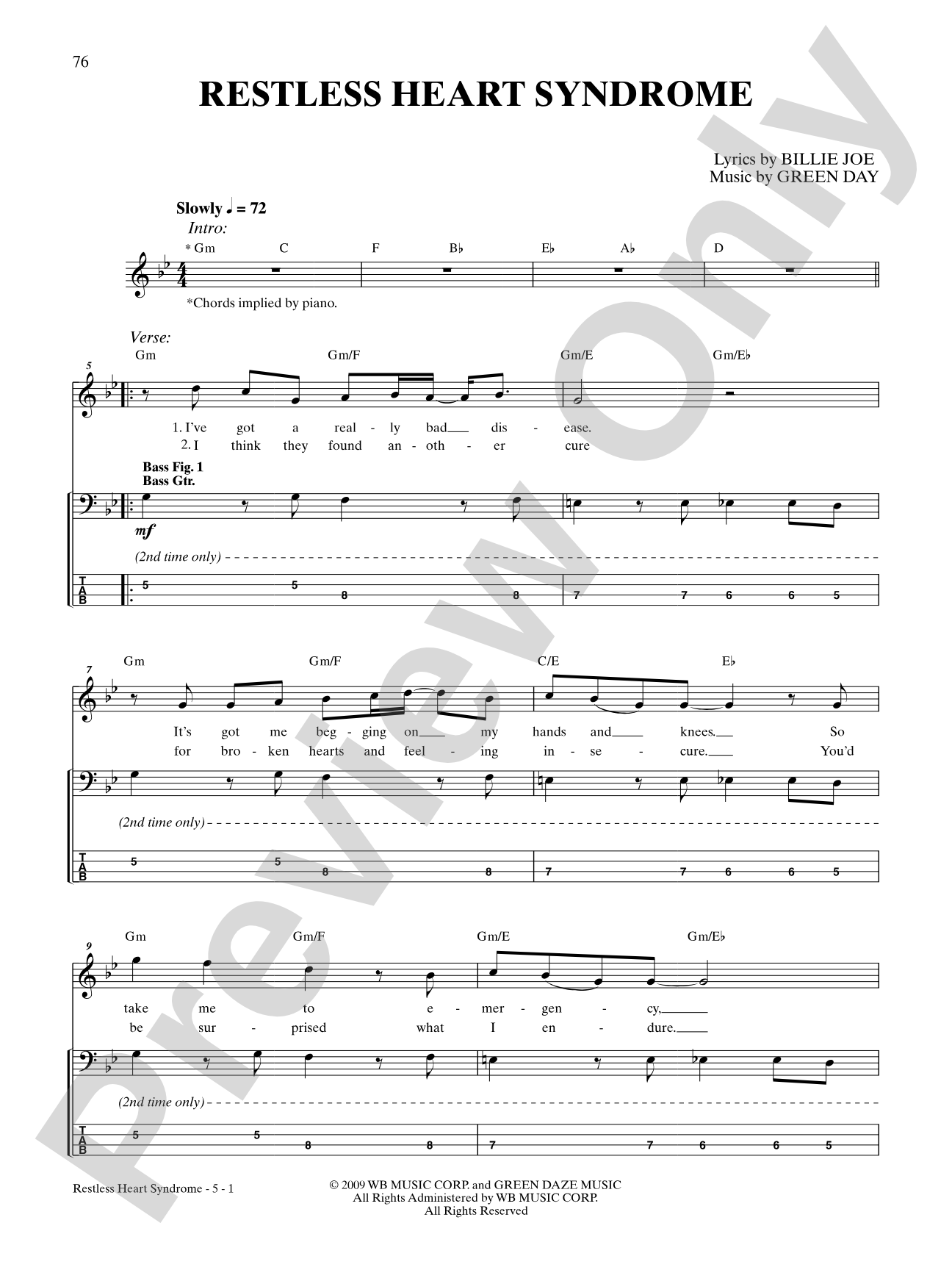

Restless Heart Syndrome: Bass TAB
Green Day
Item: 00-PS-0011063
$4.99
One moment…
Related Items
Know Your Enemy: Piano/Vocal/Chords |
$5.99
|
View | |
Know Your Enemy: Authentic Guitar TAB |
$5.99
|
View | |
See the Light: Authentic Guitar TAB |
$5.99
|
View | |
See the Light: Piano/Vocal/Chords |
$5.99
|
View | |
Restless Heart Syndrome: Piano/Vocal/Chords |
$5.99
|
View | |
Restless Heart Syndrome: Authentic Guitar TAB |
$5.99
|
View | |
21st Century Breakdown: Authentic Guitar TAB |
$9.99
|
View | |
21st Century Breakdown: Piano/Vocal/Chords |
$9.99
|
View | |
Last Night on Earth: Piano/Vocal/Chords |
$4.99
|
View | |
Last Night on Earth: Authentic Guitar TAB |
$4.99
|
View | |
Song of the Centrury: Piano/Vocal/Chords |
$4.99
|
View | |
¡Viva La Gloria!: Piano/Vocal/Chords |
$5.99
|
View | |
¡Viva La Gloria!: Authentic Guitar TAB |
$5.99
|
View | |
Before the Lobotomy: Authentic Guitar TAB |
$5.99
|
View | |
Before the Lobotomy: Piano/Vocal/Chords |
$5.99
|
View | |
Christian's Inferno: Piano/Vocal/Chords |
$4.99
|
View | |
Christian's Inferno: Authentic Guitar TAB |
$4.99
|
View | |
East Jesus Nowhere: Authentic Guitar TAB |
$5.99
|
View | |
East Jesus Nowhere: Piano/Vocal/Chords |
$5.99
|
View | |
Peacemaker: Piano/Vocal/Chords |
$5.99
|
View | |
Peacemaker: Authentic Guitar TAB |
$5.99
|
View | |
Last of the American Girls: Authentic Guitar TAB |
$5.99
|
View | |
Last of the American Girls: Piano/Vocal/Chords |
$5.99
|
View | |
Murder City: Piano/Vocal/Chords |
$5.99
|
View | |
Murder City: Authentic Guitar TAB |
$4.99
|
View | |
¿Viva La Gloria? (Little Girl): Authentic Guitar TAB |
$5.99
|
View | |
¿Viva La Gloria? (Little Girl): Piano/Vocal/Chords |
$5.99
|
View | |
The Static Age: Piano/Vocal/Chords |
$5.99
|
View | |
The Static Age: Authentic Guitar TAB |
$5.99
|
View | |
American Eulogy (A: Mass Hysteria B: Modern World): Authentic Guitar TAB |
$9.99
|
View | |
American Eulogy (A: Mass Hysteria B: Modern World): Piano/Vocal/Chords |
$9.99
|
View | |
Horseshoes and Handgrenades: Authentic Guitar TAB |
$5.99
|
View | |
Horseshoes and Handgrenades: Piano/Vocal/Chords |
$5.99
|
View | |
21 Guns: Piano/Vocal/Chords |
$5.99
|
View | |
21 Guns: Authentic Guitar TAB |
$5.99
|
View | |
Know Your Enemy: Bass TAB |
$5.99
|
View | |
See the Light: Bass TAB |
$4.99
|
View | |
21st Century Breakdown: Bass TAB |
$5.99
|
View | |
Last Night on Earth: Bass TAB |
$4.99
|
View | |
Song of the Centrury: Bass TAB |
$4.99
|
View | |
¡Viva La Gloria!: Bass TAB |
$5.99
|
View | |
Before the Lobotomy: Bass TAB |
$5.99
|
View | |
Christian's Inferno: Bass TAB |
$4.99
|
View | |
East Jesus Nowhere: Bass TAB |
$5.99
|
View | |
Peacemaker: Bass TAB |
$4.99
|
View | |
Last of the American Girls: Bass TAB |
$5.99
|
View | |
Murder City: Bass TAB |
$4.99
|
View | |
¿Viva La Gloria? (Little Girl): Bass TAB |
$5.99
|
View | |
The Static Age: Bass TAB |
$5.99
|
View | |
American Eulogy (A: Mass Hysteria B: Modern World): Bass TAB |
$9.99
|
View |
Description
The album-matching authentic bass TAB songbook to 21st Century Breakdown, Green Day's brilliant concept album. Titles: Song of the Century * 21st Century Breakdown * Know Your Enemy * ¡Viva La Gloria! * Before the Lobotomy * Christian's Inferno * Last Night on Earth * East Jesus Nowhere * Peacemaker * Last of the American Girls * Murder City * ¿Viva La Gloria? (Little Girl) * Restless Heart Syndrome * Horseshoes and Handgrenades * The Static Age * 21 Guns * American Eulogy (Mass Hysteria / Modern World) * See the Light.


Restless Heart Syndrome: Bass TAB isn't in MakeMusic Cloud just yet...but it could be. Let us know you'd like to see it, and you'll help shape what comes next. In the meantime, start a free trial and dive into thousands of interactive titles your students can play along with today.
Request This Title
Tell us you want it.
Start Your Free Trial
Explore everything that's ready to play right now.
Sample Audio
No sample audio found.
Sample Video
No sample videos found.
Additional Details
Publisher:
Alfred Music
Page Count:
112
SKU:
00-PS-0011063
More about this title
About the Composer: Green Day
Green Day formed in 1987 in the East Bay area of California and became one of the most influential rock bands of the 21st century. Their 2004 album 21st Century Breakdown marked a creative peak, showcasing sophisticated songwriting, layered arrangements, and thematic coherence that elevated punk-influenced rock to art-rock ambitions. The band's commitment to intricate instrumentation and conceptual storytelling makes their catalogue essential study material for musicians learning how rock composition and bass playing can carry narrative weight.
Why we love this
This TAB collection captures Mike Dirnt's bass work on one of Green Day's most musically ambitious albums, giving electric bass students direct access to how a working professional uses the instrument to anchor complex song structures, build momentum, and create harmonic interest within a rock context. Rather than simplified versions, these are the actual album arrangements, making them authentically challenging and rewarding to master.
What to expect
The bass lines pulse with both urgency and restraint. Dirnt moves between driving eighth-note grooves and sparse, single-note statements, creating dynamics that pull you forward through the concept album's narrative arc. Moments of melodic ornamentation sit alongside straightforward anchor lines, and the tuning and tone choices emphasize the album's mix of raw energy and introspective passages.
Who it's for
Electric bass students and hobbyists who want to learn from a major-label rock album with professional-quality arrangements. Players with some fretboard familiarity will find these songs challenging enough to develop technique while remaining within reach; advanced students will appreciate the harmonic and rhythmic sophistication throughout the album.
How to get the most out of it
- Study the bass lines in relation to the kick drum pattern; Dirnt frequently locks with the drums to create pocket while leaving space for the guitars to layer over top.
- Pay attention to dynamic control across the album. Some passages sit deep in the mix while others push forward; adjusting your touch and pick attack between songs prevents the performance from sounding monotonous.
- Use the album recording as your reference for tone and articulation; the subtle muting techniques and sustain choices are part of the composition itself, not optional decoration.
How to use it
Assign individual songs as supplementary material for bass students working on style and dynamics within a rock idiom, or tackle the full album as a semester-long project for advancing players. The album's dramatic arc also makes it suitable for interdisciplinary presentations about rock storytelling and how bass contributes to composition beyond rhythm section duty.
Skills your students will build
- Reading and executing accurate TAB notation
- Playing pocket-oriented bass lines in rock contexts
- Developing muting and articulation control for tonal variation
- Locking rhythm patterns with drums in 4/4 and varied song structures
- Understanding bass function in supporting melodic and harmonic movement