
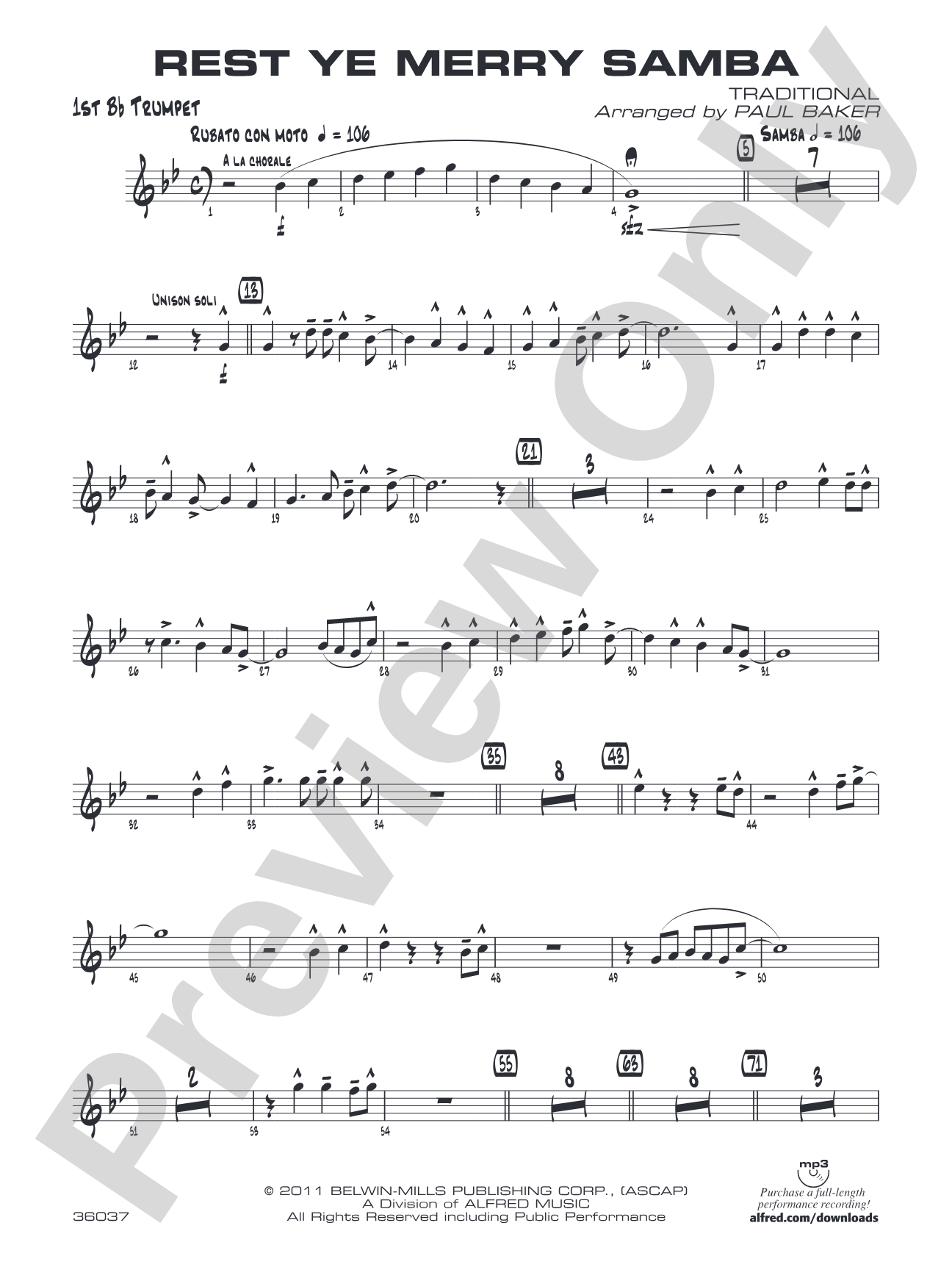

Rest Ye Merry Samba: 1st B-flat Trumpet
Traditional / arr. Paul Baker
Grade: 2 (Medium Easy)
Item: 00-PC-0016694_T1
$3.00
Pickup currently not available
Description
Based on the traditional "God Rest Ye Merry, Gentlemen," this samba treatment cooks. After a short chorale intro, the samba rhythm kicks in either cut time or bright-four groove. Written-out solos are provided for alto 1 and trombone 2 but cued for trombone 1 plus a drum and/or percussion solo. A nice shout chorus and optional auxiliary percussion part complete this excellent arrangement. (3:08)
"A memorable addition to any holiday program, the piece is sure to be a favorite of audiences and performers alike."
Mark Hosler, The Instrumentalist


"A memorable addition to any holiday program, the piece is sure to be a favorite of audiences and performers alike."
Mark Hosler, The Instrumentalist
Don't just read it, hear it, play along with it, and watch your students grow with it. In MakeMusic Cloud, Rest Ye Merry Samba: 1st B-flat Trumpet comes alive with professional accompaniment, adjustable tempo, and built-in practice tools that turn solo practice into real progress.
Open in the Player
Jump straight in and assign it today.
Start Your Free Trial
Open this title and explore the full library in minutes.
Sample Audio
1
Audio File
--:--
0:00
0:00
Sample Video
Additional Details
Series:
Young Jazz Ensemble
Publisher:
Alfred Music
Page Count:
94
SKU:
00-PC-0016694_T1
More about this title
About the Arranger: Paul Baker

Paul Baker brings a career spanning jazz, film, television, and Broadway composition into every arrangement he writes. Based in Austin, Texas, he has performed as a saxophonist from the Village Vanguard to European jazz festivals and composed for projects ranging from theatrical productions to video game soundtracks. His formal training includes a B.M. in jazz studies from North Texas State University and advanced film composition study at USC, giving him both the improvisational foundation and orchestral sophistication that define his work.
Baker's experience scoring for multiple media and leading jazz ensembles of all sizes informs his approach to writing for student groups. He understands how to craft arrangements that challenge without overwhelming, and how to keep young musicians engaged through rhythmically sophisticated but accessible parts.
Why we love this
Paul Baker nails what makes a holiday novelty arrangement actually work: real musicianship wrapped in infectious energy. The samba groove and written solos give your ensemble something to dig into beyond seasonal window dressing, while the optional auxiliary percussion and shout chorus mean everyone gets a moment to shine. It's the kind of piece that gets audiences smiling and students asking when they can play it again.
What to expect
A festive Latin groove with jazz articulation and swing sensibility. After a short moment of reverent chorale harmony, the samba rhythm launches with a brightness and infectious bounce that never lets the piece feel heavy. The energy stays playful and propulsive throughout, building momentum through the solos and shout chorus until the final ensemble push.
Who it's for
Jazz ensembles at the Grade 2 level with enough rhythmic confidence to handle the samba feel and enough sectional balance to support written solos. Directors looking for a holiday number that respects the musicianship of young jazz players will find this especially valuable. The piece works for groups that have some jazz vocabulary but don't need extensive improvisation prep.
How to get the most out of it
- Nail the transition from the chorale intro into the samba rhythm. The contrast makes the samba hit harder. Bring the ensemble in together and lock the groove immediately after the chorale ends.
- Let the alto 1 and trombone 2 solos breathe. These are written out, not improvised, so encourage the soloists to voice them expressively without rushing the time.
- Balance the shout chorus so the ensemble's rhythmic parts support the solo voices rather than overshadow them. This is about call and response, not volume competition.
- If using the optional auxiliary percussion part, position that player where they can see your conducting clearly. The cued drum and percussion solos need precise ensemble coordination.
How to use it
Program this as a closing number on a winter concert when you want to send audiences out smiling. The familiar melody gives audiences an instant entry point, while the samba treatment signals that this isn't a traditional Christmas performance. It pairs well after more serious holiday repertoire or contemporary choral pieces, providing both musical and emotional contrast.
Skills your students will build
- Playing in samba/Latin feel with swing inflection
- Supporting written solo lines with ensemble accompaniment
- Executing the transition between chorale and groove sections
- Responding to cued solo breaks from drums and percussion
- Balancing ensemble parts in a shout chorus structure
- Reading and executing cut time and bright-four feels accurately