
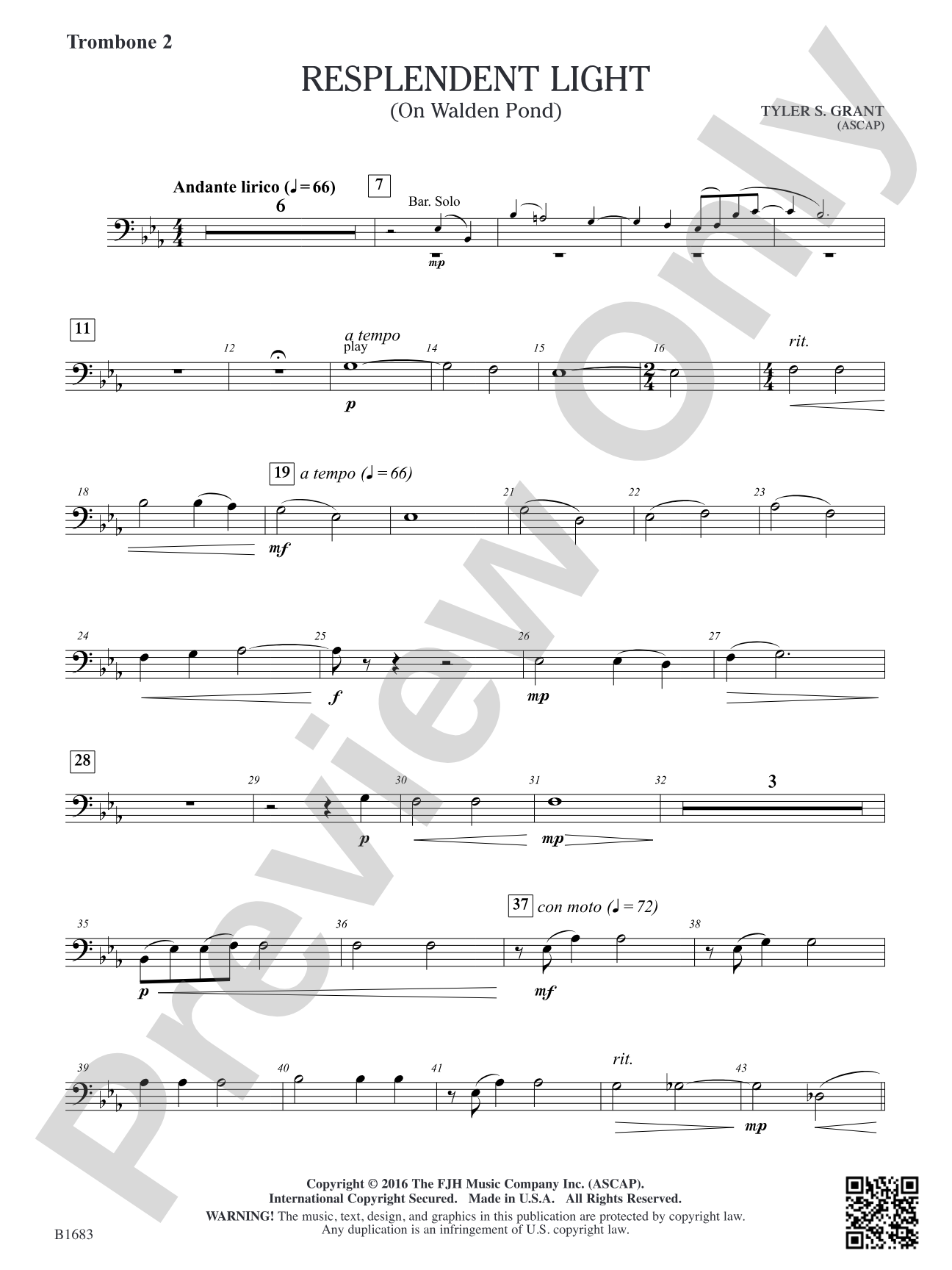

Resplendent Light: Trombone 2
By Tyler S. Grant
Grade: 2.5
Item: 98-PC-DB1683_TN2
$7.00
Pickup currently not available
Description
This serene and introspective work is based on self-reflection and the need to block out the noise of the world. It is a magical and harmonically sophisticated work that is quite playable, yet offers a wealth of musical opportunities. Derived from the tenth chapter of Thoreau's Walden, the music will certainly depict a “resplendent light” at sunset and bring peace to your audience.


Resplendent Light: Trombone 2 isn't in MakeMusic Cloud just yet...but it could be. Let us know you'd like to see it, and you'll help shape what comes next. In the meantime, start a free trial and dive into thousands of interactive titles your students can play along with today.
Request This Title
Tell us you want it.
Start Your Free Trial
Explore everything that's ready to play right now.
Sample Audio
1
Audio File
--:--
0:00
0:00
Sample Video
No sample videos found.
Additional Details
Series:
FJH Young Band
Publisher:
The FJH Music Company, Inc.
SKU:
98-PC-DB1683_TN2
More about this title
About the Composer: Tyler S. Grant

Tyler S. Grant has established himself as a prolific composer and arranger whose works circulate regularly through state and regional honor bands. His compositions have earned recognition through major competitions, including a 2014 win in the Dallas Wind Symphony's "Call for Fanfares" Competition with Panoramic Fanfare, a piece that has since reached collegiate and professional ensembles across North America. Since 2010, he has maintained a consistent output of commissions and publications while simultaneously building a conducting and clinician practice across more than 15 states.
Beyond composing, Grant contributes to music education through clinic engagements, guest conducting appearances at all-state festivals, and collaborative work on educational publications. He holds a degree in instrumental music education from the University of Alabama, where he studied conducting under Randall Coleman. His works have been performed at venues including The Midwest Clinic, Carnegie Hall, and the Meyerson Symphony Center, establishing him as a composer whose music appeals to both developing and advanced ensembles.
Why we love this
Grant crafts a work that reads as introspective and harmonically layered without overwhelming younger musicians. The Grade 2.5 difficulty allows intermediate bands to engage with genuine musical substance, creating an experience that feels substantial rather than simplified. Programming a piece rooted in Thoreau and sunset imagery opens conversations with your audience about how music translates reflection and natural beauty.
What to expect
Resplendent Light unfolds with a contemplative quality, inviting listeners into a moment of stillness and introspection. The harmonic language is rich and modern without becoming dissonant, creating a sense of warmth and peaceful resolution. As the piece develops, it builds toward that Thoreauvian image of light at dusk, achieving a luminous quality that feels earned rather than forced.
Who it's for
Concert bands at the upper intermediate level (Grade 2.5) who are ready to tackle harmonic sophistication and sustained lyrical playing. Directors seeking repertoire that combines accessibility with genuine musical content will find this especially valuable. This works well for groups interested in programming meaningful content for festivals or community performances.
How to get the most out of it
- Shape the phrasing around the harmonic progression rather than bar lines; let chord changes and voice leading guide the breath marks and intensity peaks.
- Balance the inner voices carefully so the sophisticated harmonies read clearly without the lower voices overwhelming the texture.
- Take time in rehearsal to discuss the Thoreau connection and the sunset imagery; students who understand the emotional landscape will play with more intention.
- Resist rushing the quiet passages; the serenity of the piece depends on your willingness to give it space and let sonorities bloom.
How to use it
Open a concert with this piece to establish an introspective mood that carries through the rest of your program, or place it as the final selection to leave your audience in a contemplative state. It pairs naturally with other lyrical or nature-inspired works and provides a refreshing contrast if programmed alongside more energetic selections. For festival consideration, this demonstrates musicianship and maturity without requiring virtuosic technical demands.
Skills your students will build
- Sustaining long phrases with consistent tone and line shape
- Reading and balancing complex harmonic progressions across all sections
- Adjusting dynamics and intonation to support harmonic color and blend
- Maintaining focus and ensemble unity during extended quiet passages
- Connecting musical expression to programmatic intent and imagery